


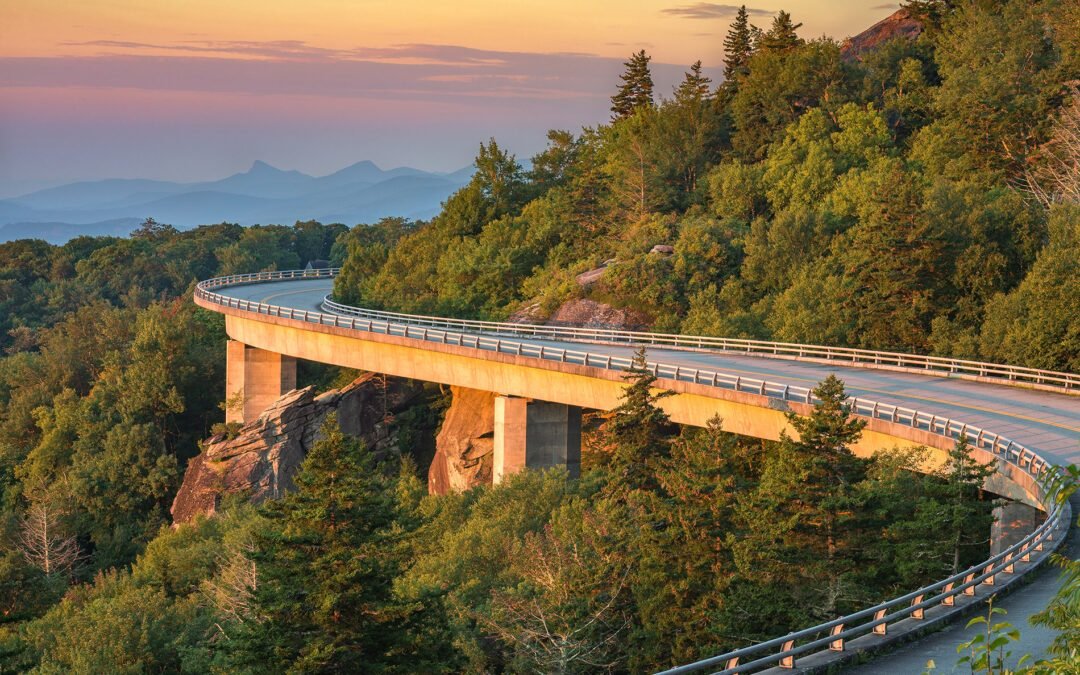
Discover One of America’s Most Spectacular Scenic Roads in Appalachia
In the depths of the Appalachian Mountains, located in the southeastern part of the United States, lies the Blue Ridge Parkway, which extends over 750 kilometers against the breathtaking backdrop of hills and woods. Join me as we embark on an exploratory adventure!
The Blue Ridge Parkway, a legendary path amidst the heavens, woods, and mountain ranges.
The Blue Ridge Parkway derives its name from the Blue Ridge Mountains that run through it, earning their appellation due to both their blue-hued appearance and the distant greenish tinge of the surrounding forests. Spanning more than 750 kilometers, this scenic drive was crafted with the purpose of providing an immersive experience into nature’s splendor. It connects various attractions including the Great Smoky Mountains National Park situated nearby.
North Carolina
and Tennessee, to Shenandoah National Park in Virginia.
Constructing the roadway spanned nearly fifty years, culminating in an extraordinary feat of environmental engineering. The path winds intricately along cliffsides or soars across streams via majestic bridges, offering breathtaking vistas of rolling hills, dense woodlands, and towering summits at every bend. Its uniqueness lies in how it transforms with each passing season. During winter, frosty blankets and early fog lend a magical allure. Spring breathes life into the slopes through vibrant blooms of wildflowers, azaleas, and rhododendrons. Summer turns the woods into refreshing retreats perfect for leisurely hikes. However, autumn stands out as arguably the parkway’s peak moment; the leaves ignite into vivid hues—reds, oranges, and yellows—that draw countless tourists eager to witness nature’s grand display.
A captivating encounter with the surrounding natural environment, traditions, and past.
The Blue Ridge Parkway offers an idyllic setting for hikers with over 185 miles of trails that vary from easy walks to strenuous hikes. Nestled among mountains and woodlands, this area allows visitors to discover famous landmarks like Mount Mitchell, which stands as the tallest mountain east of the Mississippi River, or Linville Gorge, often referred to as the “Grand Canyon of the East.” Additionally, numerous rivers and lakes provide opportunities for activities such as fishing, canoeing, and kayaking.
However, the Blue Ridge Parkway offers a chance to delve into the area’s deep cultural heritage and historical background. Situated close to the Blue Ridge Parkway,
Asheville, North Carolina
, is an absolute must-visit. Known for its bohemian vibe, this town overflowswith art galleries, artisanal shops, and well-known eateries. Asheville also gained prominence for the
Biltmore Estate
, the largest private home in the United States, which offers fascinating insights into the wealth of the Vanderbilt family in the late 19
th
century.
Another must-see attraction is the Moses H. Cone Memorial Park, which exemplifies Colonial Revival style. This magnificent estate was constructed early in the 20th century.
th
In this century, the property features meticulously maintained gardens and offers, from the mansion’s terrace, stunning vistas of the Blue Ridge Mountains. Additionally, in Virginia stands the Mabry Mill, an impeccably preserved watermill that has become iconic within the area. This location allows visitors to observe demonstrations of corn grinding as well as the creation of traditional implements, providing insight into historical craftsmanship methods.