oleh admin | Mar 24, 2025 | affordable housing, cost of living, economics, real estate, rent
In Australia, an individual currently requires an annual income of at least AUD130,000 (US$81,700) to rent a standard dwelling without experiencing financial stress.
According to a recent report by the advocacy group Everybody’s Home, even individuals with incomes over $100,000 are experiencing housing expenses surpassing 30% of their earnings in major urban centers and several rural regions. As reported by the source, this trend highlights the widespread nature of the issue across different parts of the country.
ABC
.
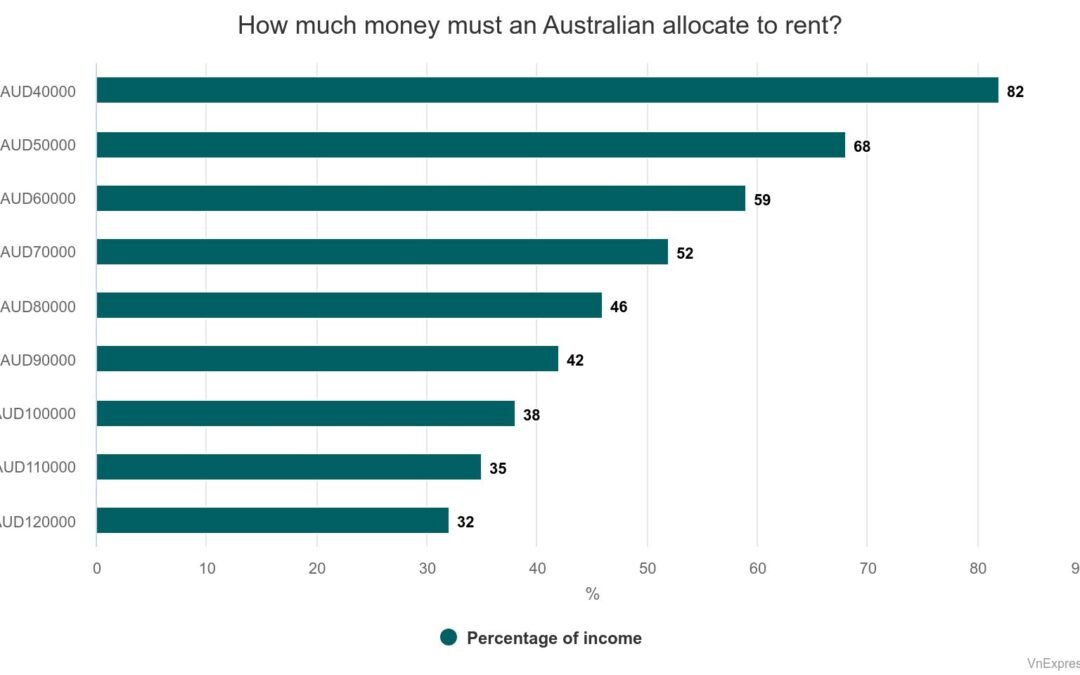
The analysis examined rental affordability for people with annual incomes ranging from AUD40,000 to AUD130,000.
Specialists frequently refer to the 30% benchmark as a crucial measure of housing affordability, especially when considering low-income families.
People earning below AUD130,000 could struggle financially when paying rent.
For an individual with an annual salary of AUD70,000, rental costs would absorb over half of their earnings according to typical property prices.
Individuals earning as low as AUD40,000 might have to dedicate more than 70% of their income towards rental payments.
Maiy Azize, a representative for Everybody’s Home, stated that the study underscores how people with high incomes are also finding themselves burdened by “astonishingly high” rental costs.
She further noted that the circumstances are even grimmer for individuals with lower earnings, as those making AUD 40,000 annually experience significant rent-related financial strain across the country.
The report highlighted capital cities along with their adjacent regions as the costliest places. Notably, Sydney and the Gold Coast presented particularly difficult situations.
In
Sydney
For someone earning AUD40,000, the rent would constitute 102% of their income.
“This figure indicates that rent alone exceeds their entire income, making it completely unaffordable without additional sources of financial support,” the report noted.
Karen Walsh, the CEO of National Shelter—an organization dedicated to enhancing housing conditions for those with lower incomes—spoke to the audience about this issue.
ABC
Many Australians find themselves in a desperate predicament.
“Households with low incomes are increasingly being pushed out of the private rental sector, and due to insufficient supply of social and affordable housing options, they face a higher likelihood of becoming homeless,” she stated.
Everyone’s Place is calling for immediate steps as the national elections draw near, emphasizing that housing should be considered a crucial issue.
The report highlighted that investments in social housing have decreased over the last forty years, not matching the rate of population increase, whereas affordability has worsened considerably.
The Housing and Homelessness Minister, Clare O’Neil, recognized housing as a crucial governmental concern.
“I want everyone to be aware that I genuinely comprehend the strain this housing crisis is placing on individuals, regardless of whether they require social housing, are tenants, or aspire to purchase a home—and I am committed to working tirelessly each day to reverse this situation,” she stated.
oleh admin | Mar 24, 2025 | affordable housing, economics, government regulations, public policy, social issues
A report from BuyLetLive indicates that the lack of regulatory encouragement for producing construction materials locally is worsening the housing crisis.
The statement also noted that Nigeria still depends significantly on imported building supplies, making the sector susceptible to fluctuations in currency values and worldwide increases in prices. It suggested that producing items like tiles, roof sheeting, and concrete locally might aid in steadying expenses and enhancing cost-effectiveness gradually.
The report indicates that the Nigerian government has introduced multiple policies designed to improve housing affordability.
It read, “Initiatives like the Family Homes Fund and the National Housing Fund were designed to provide financing options for low- and middle-income earners. However, these programmes face significant challenges, including limited funding, bureaucratic delays, and a lack of transparency.”
The report further highlighted that inflation has exacerbated the difficulties faced by households in affording homes within the housing market.
The statement went on to say, “Increasing mortgage rates and rising property values have surpassed wage increases, leading numerous households to either downscale their living spaces, postpone buying homes, or grapple with higher rent expenses. Inflation has prompted a significant change in housing choices. Individuals with middle and lower incomes are now leaning towards acquiring smaller, cost-effective residences like studios or opting for communal living situations.”
Demand for housing in suburban and peri-urban areas is also growing, as these locations typically offer lower rents and purchase prices compared to city centres.
Once a pillar of Nigeria’s high-end real estate sector, upscale residential properties are now facing sluggish sales due to a reduction in the number of wealthy purchasers. Real estate developers who were primarily concentrated on luxury homes are starting to expand their portfolios to incorporate middle-income and affordable housing alternatives to align with shifting consumer preferences.
The report highlighted that inflation became a crucial element influencing economic and social conditions in Nigeria.
The passage continued, “During 2024, the ongoing rise in inflation underscored the intricate interplay among several economic elements such as fiscal measures, monetary strategies, exchange rates, and global trade patterns. Currency volatility represented one of the key economic hurdles encountered by the nation in 2024. The naira experienced a substantial depreciation of 24.3 percent relative to the U.S. dollar, dropping from an initial exchange rate of N1,413 for $1 at the beginning of the year to N1,757 for $1 by late November—a peak point not seen in more than twenty years, reported the National Bureau of Statistics.”
The continuous increase has exerted substantial pressure on households, businesses, and various sectors, particularly the real estate industry. With rising costs of products and services, the demand for housing has been significantly disrupted. Factors such as higher construction expenses, reduced affordability, and changing consumer preferences have all contributed to inflation’s deep and varied effects on Nigeria’s housing sector. This escalation in inflation exacerbated financial difficulties for households within the housing market. Increasing mortgage rates coupled with soaring property values surpassed income gains, leading numerous families to either downscale their living arrangements, postpone buying homes, or grapple with heightened rental fees.
Although inflation was a substantial hurdle, it simultaneously created chances for advancement within Nigeria’s real estate sector. Builders are progressively embracing money-saving innovations like modular building techniques and pre-fabricated components. Such approaches help cut down both construction periods and expenses without compromising quality benchmarks. Additionally, eco-friendly power options including solar panels are becoming more popular as means to lower tenant and homeowner utility expenditures. Trends towards buildings with high-energy efficiency ratings along with intelligent residential tech features are also surfacing, aiding in luring purchasers and renters interested in reducing their long-run energy outlays.
Provided by Syndigate Media Inc. (
Syndigate.info
).


