oleh admin | Mar 25, 2025 | asia, college and university ranking, education, higher education, world
In the QS World University Rankings by Subject for 2025, universities across Asia, notably those located in Singapore, mainland China, and Hong Kong, have shown significant progress with an impressive rise in their number of subjects placed within the top 50 categories.
The rankings evaluate more than 18,300 programs at 1,700 universities spanning 100 nations, underscoring the escalating worldwide rivalry in tertiary education.
American educational institutions remain at the forefront, topping the rankings in 32 fields, with Harvard claiming the number one spot in 15 areas and MIT leading in 11 disciplines.
British universities stand out in 18 disciplines, with Cambridge topping the charts in four areas. According to QS, a UK-based higher education data company, the University of Leeds has the most subject listings at 53 across all U.K. educational bodies.
The United Kingdom experienced a general improvement in its subject rankings, with 1,831 submissions from 104 institutions this year, compared to 1,797 last year.
Asia’s rapid rise
Asian universities have surpassed those in the U.K. in terms of enhancements in subject rankings.
Specifically, Mainland China has significantly increased its representation among the top 50 institutions, rising from 100 subjects in 2020 to 231 this year—a growth of 131%. Additionally, the count of Chinese universities within the top 10 positions has skyrocketed from five to twenty-one, marking an impressive rise of 320%.
Hong Kong showed significant progress as well, with its number of subjects in the top 10 list growing from two to six, and its count within the top 50 jumping from 76 to 108 positions, marking a rise of 42%.
Singapore has witnessed the most remarkable improvements, with its top 10 subject rankings jumping from eight to 34 — an increase of 325%.
The University of Hong Kong tops Asian institutions, placing within the top 200 across an impressive 55 disciplines—the largest number among regional universities. This year, it also showed the greatest progress with 47 subject rankings improving, closely trailed by The Chinese University of Hong Kong which had 43 advancements.
Our most extensive subject rankings yet continue to shed light on elements affecting the quality of global higher education institutions. Although the countries that typically lead international university rankings still maintain their dominant positions at the top, they are starting to face competition from emerging higher education sectors,” said Ben Sowter, QS Vice President.
The PIE News
.
This can be seen in the impressive showings from nations across Asia and the Middle East this year—a pattern that is expected to persist as institutions of higher learning in the U.S., U.K., Australia, and Canada grapple with significant financial challenges,” he noted.
The 2025 QS World University Rankings by Subject encompass 55 disciplines distributed among five major academic areas: Arts & Humanities, Engineering & Technology, Life Sciences & Medicine, Natural Sciences, and Social Sciences & Management.
This year’s iteration stands out as the most comprehensive yet, featuring 171 additional educational institutions over the 2024 rankings. Fields including medicine, computer science & information systems, and materials science now boast a higher number of ranked universities than has previously been seen.
oleh admin | Mar 24, 2025 | asia, education, educational systems, public education, thailand
The Office of the Education Council (OEC) has dismissed a report that ranked Thailand’s educational system lower than those of most other ASEAN nations, stating that the rankings lacked concrete evidence and did not accurately depict the present circumstances.
According to the 2025 education rankings from World Population Review, a site focused on demographic information, Thailand ranks 107th out of 203 nations surveyed and falls behind most Southeast Asian neighbors. The top-ranking ASEAN country is Singapore at position 11, followed by Brunei at 47, Indonesia at 67, Vietnam at 53, the Philippines at 71, Malaysia at 89, and Laos at 102. Among all ASEAN members, only Myanmar and Cambodia have worse placements than Thailand.
The top ranking went to South Korea, with Denmark and the Netherlands following closely behind.
Associate Professor Prawit Erawan, who serves as the secretary-general of the OEC, stated that the rankings were at odds with the information cited from the yearly Best Countries Report compiled by US News and World Report, BAV Group, and the Wharton School of the University of Pennsylvania.
The report encompassed 73 nations and placed Thailand at 48th position, ranking third within ASEAN after Singapore at 22nd and Malaysia at 37th. Laos and Brunei did not appear in the listings.
Mr. Prawit stated that The World Population Review didn’t provide additional details about the rankings. Therefore, claiming that Thailand was at the lower end might be premature and should be examined and understood with caution.
He mentioned that additional data displayed on the site included the literacy rates per country as of 2021, failing to capture the present circumstances.
The OEC has been carrying out its independent evaluation of literacy rates among Thai individuals who are 15 years old and above. According to him, the preliminary literacy rate stood at 99%, which is the highest within ASEAN. The definitive outcomes will be released towards the end of this month.
Mr. Prawit stated that every organization has its distinct objectives and roles. Individuals ought to concentrate on the literacy rates since they provide a clearer indication of the comparative strengths and weaknesses of different countries.
Mr. Prawit mentioned that the World Population Review rankings highlighted the necessity for Thailand to remain vigilant and take decisive action regarding issues within its educational framework and strive for further development of the sector.
Provided by Syndigate Media Inc. (
Syndigate.info
).
oleh admin | Mar 24, 2025 | asia, exhibitions, faith and religion, politics, religion
The organizers of the World Expo in Osaka have denied a petition asking for additional prayer areas for Muslims and adherents of other faiths because of limited space, according to an insider who spoke about the issue on Monday.
Given that just one prayer room is provided without catering to any particular faith, there are worries about whether the requirements of the Expo attendees will be adequately addressed. It’s anticipated that approximately 3.5 million individuals will arrive from abroad for this event.
Although the precise capacity hasn’t been revealed, an official from the organization mentioned that the space can probably fit about a dozen individuals at most.
As stated by the Japan Association for the 2025 World Exposition, a prayer room will be established in a resting area within the exposition grounds, featuring segregated areas for men and women. Additionally, mats will be supplied for Muslim attendees to use during their prayers.
The Japanese Ministry of Economy, Trade and Industry predicts that approximately 85 percent of expected international tourists will originate from Asia, which includes numerous Muslim travelers who adhere to the practice of praying five times daily.
In January, an Indonesian journalist, whose country holds the title of having the biggest Muslim populace globally, approached the exposition organizers regarding incorporating portable mosques. However, a high-ranking member of the organization stated that there wasn’t enough room and suggested setting up these facilities within each separate exhibit area instead.
In 2018, a company based in Tokyo created a portable mosque utilizing a 25-ton truck equipped with an extended rear area designed to form a praying zone covering approximately 48 square meters. This setup allows for roughly 50 individuals to pray simultaneously.
The vehicle comes with air conditioning units and a generator, along with water faucets designed for ritual purification before prayers.
The Indonesian reporter has raised concerns about the absence of a prayer area at the exhibition site, considering several nations have withdrawn from building their respective pavilions. They suggested that having a portable mosque might prove “helpful.”
The reporter stated, “Prayer is essential for Muslims, and it’s disheartening that providing sufficient praying areas was overlooked.”
oleh admin | Mar 24, 2025 | asia, climate, flowers, meteorology, news
The cherry blossoms emerged on Monday in downtown Tokyo, coinciding with their usual appearance for this time of year according to the meteorological bureau.
At Yasukuni Shrine, the “Somei Yoshino” cherry blossom tree, used as a benchmark for flowering by the Japan Meteorological Agency in Tokyo, began blooming five days sooner this year compared to last, following unusually chilly temperatures. This variety typically reaches full bloom within roughly a week from now.
The private meteorological firm Weathernews Inc. forecasts that cherry blossoms will start blooming across western and eastern parts of Japan this month. The blooms are predicted to occur in the nation’s northeastern region between early and mid-April, with Hokkaido seeing them appear towards the end of April.
A meteorological authority representative verified that by approximately 2 p.m., at least six blossoms were visible at Yasukuni Shrine, satisfying the requirements to declare the start of the cherry blossom season. This declaration elicited cheers from those present at the site.

oleh admin | Mar 24, 2025 | asia, business, energy sector, politics, u.s. china relations
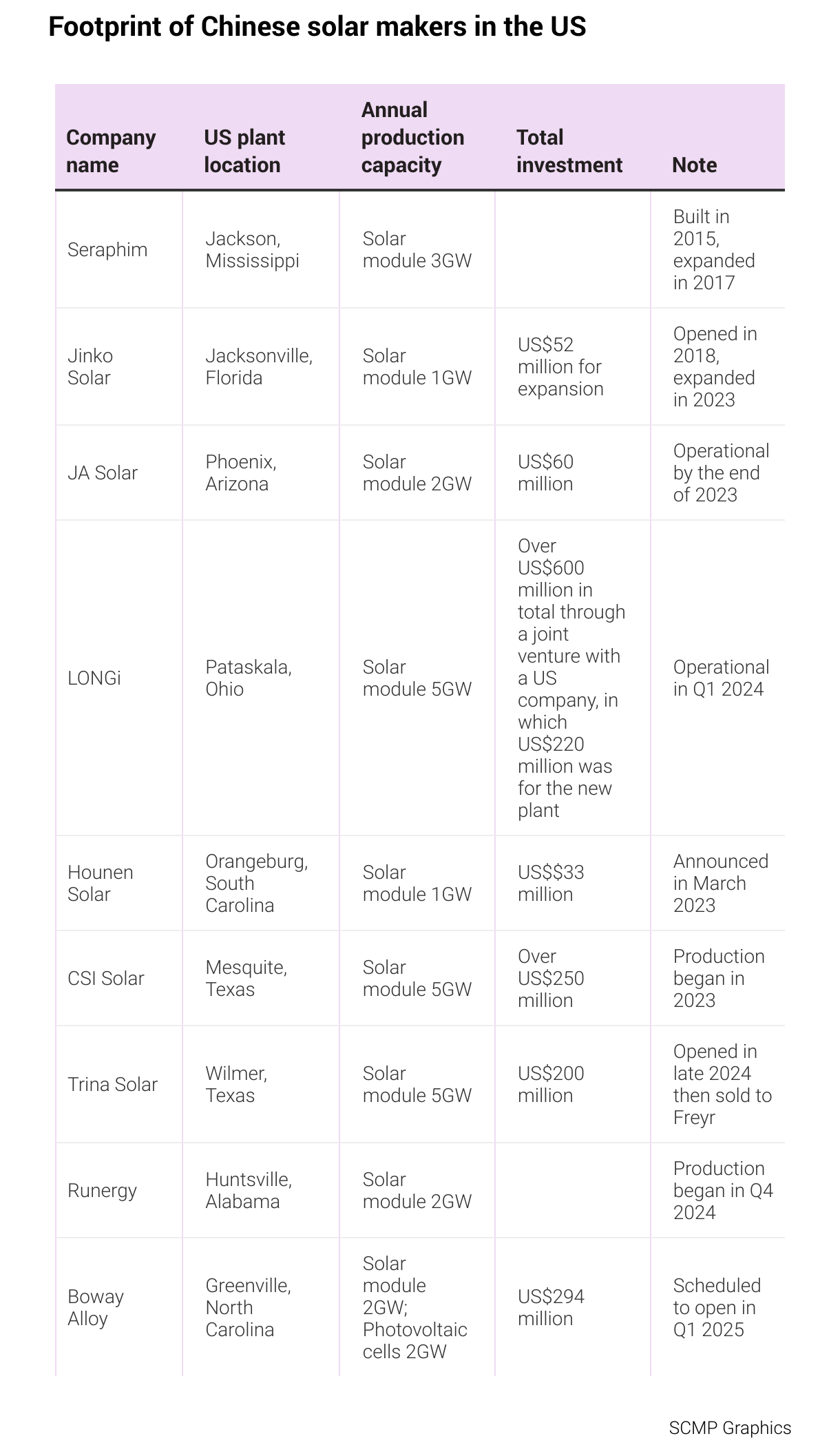
The “regressive policy shifts” implemented by US President Donald Trump concerning China’s solar industry may inadvertently damage America’s clean energy sector by prompting Chinese companies to divert their investments elsewhere, as stated in a recent report.
Chinese solar firms had committed to constructing multiple facilities for producing photovoltaic solar components in the U.S., with plans totaling more than 20 GW expected to become operational by late 2025. However, future initiatives could face challenges because of policy changes under the Trump administration, according to an analysis of worldwide solar manufacturing developments published on Monday by the Sydney-based research group Climate Energy Finance.
Since resuming his role in the administration, Trump has
raised tariffs
For all Chinese products, the tax breaks established under the Inflation Reduction Act to motivate companies to move their manufacturing to the United States were put on hold, along with Department of Energy loans being suspended. This has made Chinese solar businesses hesitant when considering investments in the U.S. market.
Are you looking for insights into the most significant issues and global trends? Find your answers here.
SCMP Knowledge
Our updated platform features handpicked content including explainer articles, FAQ sections, detailed analysis, and informative infographics, all provided by our acclaimed team.
“Import taxes can shield local producers, yet this comes with the drawback of higher expenses for domestic buyers,” stated Harry Martin, an analyst from the research institute.
Instead, Chinese companies will
accelerate their expansion
Into Southeast Asia and the Middle East, where authorities must rapidly increase solar power capabilities to address escalating energy needs.
“Other policymakers should pay attention: erecting trade barriers against China will merely divert investments to other areas ready to capitalize on its tech supremacy,” Martin stated.
China is the energy boon of this century – why lock the stable door? Numerous countries are already securing their positions with attractive incentives.
Last year, China’s outward investment in clean technology “turned into a major rush,” with Chinese firms pouring approximately US$140 billion into overseas projects since 2023, according to the report.
Before Trump’s presidency, Chinese firms had been actively seeking investment opportunities in the U.S. As highlighted in the report, in 2024, China-based LONGi teamed up with American clean energy firm Invenergy to launch a 5 GW photovoltaic (PV) solar panel plant in Ohio. Additionally, Jiangsu Runergy inaugurated a 2 GW PV module facility in Alabama as per the same document.
However, China’s solar sector is now redirecting its focus to other markets. The report forecasts that by 2030, Chinese firms will dominate the module manufacturing capacity in the Middle East and North Africa — just as they currently do in Southeast Asia.
In 2024, China favored forming strategic partnerships and undertaking extensive multi-phase initiatives in Southeast Asia, the Middle East, North Africa, and the broader Global South, according to Climate Energy Finance.
The report stated that government-set renewable energy goals, utility-led auctions, incentive programs, and extended power purchasing contracts were the factors attracting Chinese firms to invest in these areas.
Through expansion into Southeast Asia, Chinese firms have the potential to serve Western energy markets by bypassing trade barriers via solar photovoltaic production primarily situated in countries like Vietnam, Thailand, Cambodia, and Malaysia, as mentioned in the report.
The report mentioned that in late 2024, the United States introduced anti-dumping and countervailing duties as high as 271 percent on panels coming from specific Southeast Asian countries. This action impacted Chinese initiatives within the area.
These additional responsibilities have imposed significant financial strain on Chinese producers and led to reduced output and idle facilities in nations such as Vietnam.
However, Chinese manufacturers have countered by relocating their production to countries like Indonesia and Laos that are exempt from these tariffs, according to Martin.
According to the report, Chinese firms are making significant advances in the Middle East and North Africa, drawn by factors such as free trade zones, reasonably priced land, exemption from tariffs, substantial governmental backing, increasing domestic consumption, and their pivotal role for accessing both burgeoning and European-American markets.
“Saudi Arabia
is leading the region
In terms of luring investments from Chinese solar photovoltaic firms, the area is witnessing multibillion-dollar commitments from these enterprises,” stated Martin.
More Articles from SCMP
What is 6G and why is China racing ahead of US and Europe with the technology?
8 participants from the Hong Kong study group traveling to mainland China contracted norovirus.
AI specialist Guo-Jun Qi moves from the US to China
Rolling out the red carpet for ASEAN guests is indeed the appropriate move.
Chinese Premier Li Qiang meets US Senator Daines: calls for frankness, deeper trust
The article initially appeared on the South ChinaMorning Post (www.scmp.com), which is the premier source for news coverage of China andAsia.
Copyright © 2025. South ChinaMorning Post Publishers Ltd. All rights reserved.

oleh admin | Mar 24, 2025 | asia, thailand, Travel, travel destinations, travel planning and tips
Following its feature in HBO’s series “White Lotus,” the nation experienced an increase in online search interest.
Thailand
has emerged as one of the top 15 global travel destinations for 2025, ranking amongst
insurance premiums being 45%
under the global average of $219, as per travel insurance comparison statistics provided by Squaremouth.
Thailand experienced a 12% rise in attractiveness as a travel spot, akin to how Sicily witnessed a surge in tourist interest following its appearance in the second season of “The White Lotus,” where search inquiries grew by 32%.
According to Squaremouth, vacations in Thailand are not only less expensive compared to other nations but also typically last longer.
Ned Tadic, who manages public relations at Squaremouth, pointed out that this increase in popularity indicates a shift towards preferring extended and more thrilling trips. This has led travelers to look for broader insurance coverage.
A usual journey to Thailand extends for about 25 days, making it 66% more extensive compared to an ordinary international trip lasting 15 days.
Moreover, the typical expense for a journey to Thailand amounts to $3,275, which is 41% less than the worldwide average of $5,617.
The longer trip durations have driven increased demand for travel insurance plans covering medical emergencies, trip cancellations, and high-risk activities.
Travel insurance designed for adventure and sports enthusiasts may include coverage for activities such as scuba diving, surfing, motorcycling, and zip-lining, offering reassurance to individuals looking for thrilling adventures.
Halaman 4 dari 7« Awal«...23456...»Akhir »