oleh admin | Agu 29, 2025 | disaster management, disasters, emergencies, flooding, news
Released on, Aug. 19 — August 19, 2025 at 11:02 AM
Intense monsoon downpours have caused rivers in Punjab to rise to alarming levels, submerging communities, damaging agricultural land, and isolating areas due to blocked roadways, with the NDMA issuing a critical warning about impending rainfall.
A warning was issued as Khyber-Pakhtunkhwa experienced severe floods that resulted in more than 320 fatalities. Prime Minister Shehbaz Sharif instructed his ministers to take direct responsibility for overseeing aid efforts in the most severely impacted areas.
Beginning in late June, continuous heavy rains, sudden floodwaters, and mudslides have resulted in the deaths of at least 657 individuals and injuries to almost 1,000 others throughout Pakistan. Authorities worry about deteriorating situations with additional rainfall expected.
The National Disaster Management Authority stated that intense to extremely high amounts of rain are anticipated throughout Punjab, Khyber Pakhtunkhwa, Sindh, Balochistan, Azad Jammu and Kashmir, and Gilgit-Baltistan. Authorities cautioned that precipitation could surpass 50 to 60 percent over typical rates.
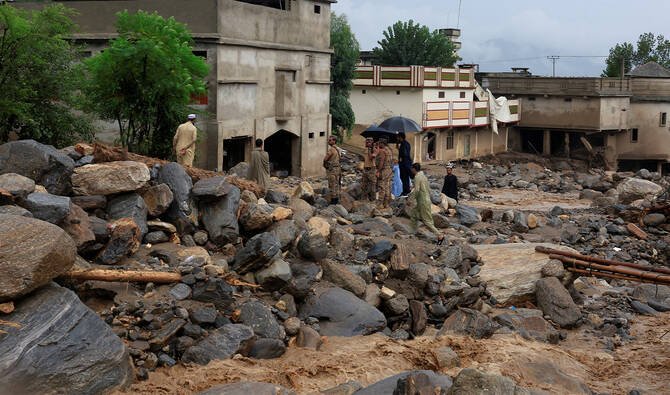
K-P continues to be the most severely affected area, with regions such as Buner, Swat, Shangla, and Bajaur experiencing extensive damage. Many houses have suffered destruction or harm, and roadways and bridges are still obstructed due to landslides.
At the same time, rescue efforts are being carried out. The NDMA along with regional authorities are providing tents, quilts, provisions, and monetary assistance. The Prime Minister pledged to the individuals affected by floods that their damaged houses will be reconstructed and security protocols enhanced.

oleh admin | Agu 28, 2025 | disaster management, disaster preparedness, disasters, emergency management, news
Released on, Aug. 19 — August 19, 2025 at 3:07 PM
The central administration, military forces, and National Disaster Management Authority conducted a combined media update in Islamabad regarding the current monsoon emergency. Representatives stated that torrential rainfall has resulted in 670 fatalities throughout Pakistan. Numerous additional individuals remain wounded or unaccounted for. Teams from the NDMA are continuing efforts to locate those carried off by floodwaters. Immediate relief activities are ongoing in every impacted area.
Lieutenant General Ahmed Sharif from DG ISPR stated that the flooding has caused damage to roads and bridges, particularly in Khyber Pakhtunkhwa. In order to act swiftly, the military sent two engineering battalions to KP and another two to Gilgit-Baltistan. These teams are working on unblocking roadways and repairing damaged structures. Military engineers are additionally assisting with restoring communication networks. The availability of relief supplies is gradually increasing in isolated regions.
At the same time, military medical personnel are providing assistance to those wounded in flooded areas. To date, more than 6,000 individuals have been provided with healthcare services. Nine mobile field hospitals are functioning within impacted regions. Two established medical facilities have been stationed in Khyber Pakhtunkhwa and Gilgit. Additionally, two battalions are offering medical aid in Buner and Shangla. Numerous survivors are being treated for severe wounds.
The military is operating based on specific directives issued by the Chief of Army Staff, Field Marshal Asim Munir. Extra battalions have been deployed for recovery and assistance efforts. In order to assist those impacted, the army has contributed a day’s worth of provisions from its stockpiles. Aid materials are handed out every day. Supplies such as food, drinking water, and medical items are transported to isolated regions using aircraft and vehicles.
To sum up, Pakistan’s civilian and military organizations are collaborating effectively to handle the crisis. The administration called on citizens to remain vigilant and adhere to safety instructions. Aid operations will persist until everyone impacted is secure. The NDMA mentioned that restoration and rebuilding could require an extended period. Nevertheless, complete nationwide backing has been pledged for each affected area.

oleh admin | Agu 26, 2025 | climate change, disaster management, disasters, environmental disasters, environmentalism
Released on, Aug. 19 – August 19, 2025 at 7:02 AM
Throughout history, natural disasters have consistently been a part of human life. However, advanced and accountable democratic nations draw lessons from such tragedies. They examine their shortcomings, develop strong infrastructures, and ensure the safety of citizens against upcoming dangers. Their choices are guided by long-term planning, established laws, and evidence-based studies rather than temporary political strategies or catchy phrases. Regrettably, Pakistan’s experience with the environment presents another narrative—one marked by remorse, slow reactions, unfulfilled commitments, and relief requests lost among bureaucratic procedures.
Take the example of the Netherlands, a nation mostly situated beneath sea level, which emerged from the catastrophic floods of 1953. The country redesigned its rivers, launched the “Room for the River” initiative, and built the “Delta Works,” considered among the most sophisticated flood defense networks globally. This network consists of tidal gates, dams, and locks that safeguard countless lives and crucial economic assets. Consequently, even with increasing ocean levels, the Netherlands has maintained nearly no fatalities due to flooding over many years.
By passing the Clean Air Act in 1970, the United States introduced strict environmental rules. These actions significantly cut down air pollution, enhanced public well-being, and provided a global model for combining economic development with nature protection. South Korea launched extensive tree-planting initiatives, sowing more than 9 billion trees from 1970 to 2000, turning lifeless areas into vibrant mountainous regions. This effort contributed to lessening soil erosion, enhancing air purity, and increasing wildlife diversity.
Despite being classified as a lower-middle-income nation with scarce resources, Bangladesh implemented community-driven cyclone readiness initiatives. These early alert mechanisms, along with cyclone safe havens and awareness campaigns, have cut down cyclone-related fatalities by almost 90% since the 1970s, demonstrating how collective action and preparation can preserve human lives. On the contrary, Pakistan faces significant challenges. Following the disastrous floods of 2010, each subsequent natural calamity followed a similar cycle: alerts were overlooked, destruction occurred, politicians issued declarations, assistance was pledged, yet nothing came after. The 2010 flooding affected more than 20 million individuals, damaged two million houses, and led to financial damages approximated at $10 billion. The UN requested over $2 billion in relief funds, but Pakistan managed to secure approximately $600 million.
The 2022 flooding caused greater destruction—resulting in the loss of 1,739 lives, impacting over 33 million individuals, and causing economic losses estimated at around $40 billion, which accounts for almost 9% of the nation’s GDP. Although commitments made during the 2023 Geneva summit included providing $9 billion in assistance, only slightly over $1 billion has been actually distributed so far. A significant portion of the promised support is stuck within administrative procedures or hindered by IMF requirements and political protocols. The World Bank cautions that should Pakistan not tackle climate issues effectively, it could face a reduction of up to 20% in its economic production by 2050. The Asian Development Bank ranks Pakistan among the top five nations highly susceptible to climate-induced catastrophes. Reports from Amnesty International identify Pakistan as one of the five most sensitive countries worldwide regarding climatic changes.
However, governmental policies and focus reflect indifference instead of concern. The National Disaster Management Authority (NDMA) and Provincial Disaster Management Authorities (PDMAs) typically respond only following disasters. Pakistan dedicates just 0.2% of its GDP to environmental studies, far below the world average of 2.3%. Moreover, most available resources end up being spent on consulting services and ineffective initiatives rather than supporting practical, scientifically grounded solutions. Nature keeps reminding us constantly. The 2023 storm in Bonair, Khyber Pakhtunkhwa, devastated many—over 200 individuals lost their lives, crops were ruined, and houses collapsed. The wails of a nursing baby buried under debris and the quiet sorrow of grieving mothers deeply affected the country’s sense of morality. Still, in Islamabad and Peshawar, political maneuvering took precedence over compassion, with official systems remaining slow to act.
Residents keep asking: Where are the one billion trees that were promised? Where are the billions committed for assistance? What happened to the climate strategy that was introduced with great excitement? Where is the government that swore to clear drainage systems, study cloudbursts, and implement advanced technologies? Scholars such as Professor Shafiq Ahmed Kamboh from Punjab University had previously cautioned about rising instances of cloudbursts and unpredictable rainfall. However, their warnings went unheard, buried under bureaucratic delays and political apathy. Pakistan does not possess a Nationwide Flood Strategy, an all-encompassing Drainage Development Plan, nor a contemporary early warning mechanism linked with weather forecasts. Meanwhile, nations like China have started “Soaking Urban Areas” initiatives designed to capture storm water and minimize floods, whereas Pakistan continues using obsolete structures and temporary solutions. Bribery and poor administration continue to undermine citizen confidence. Audit Office findings indicate that as much as 40 percent of the reported outcomes from the million-tree planting initiative cannot be confirmed. The expansive Living Indus Initiative faces irregular financial support and insufficient monitoring.
Pakistan should focus on improving environmental governance by setting up an elite Climate Change Commission that includes input from scientists, government officials, and members of the general public to support comprehensive and data-driven decisions. Adopting nationwide flood and drainage strategies inspired by the Netherlands could enable rivers to spread out naturally when flooding occurs, thereby easing stress on levees and city areas. Enhancing grassroots disaster readiness initiatives and funding early alert mechanisms, storm shelters, and awareness campaigns—similar to what has worked well in Bangladesh—can protect many lives. Boosting financial support for scientific exploration and technological advancements is essential, targeting a minimum allocation of 2 percent of GDP towards ecological and climatic research. Encouraging tree planting efforts through open oversight frameworks and involving nearby populations in eco-friendly land use practices can assist in restoring nature’s balance. It is vital to implement environmental regulations rigorously, reinforcing both the National Climate Strategy and methods aimed at controlling contamination. Lessening dependence on outside assistance by developing domestic capabilities to handle crises linked to weather changes will enhance Pakistan’s strength and independence.
At this moment, grief is all that remains—grief for the children lost due to flooding, the mothers who had to bury those they cherished, the farmers whose means of survival were destroyed, and a government that prioritized political maneuvering over genuine protection. Will Pakistan provide coming generations with a safe, independent, and environmentally sound home? Or will it keep sinking beneath floodwaters, unfulfilled pledges, and governmental indifference? The choice does not rest solely with leaders; it lies with the people as well. It is up to the country’s population to insist upon transparency, support efforts toward resilience, and create a Pakistan that genuinely protects both nature and its inhabitants. Now is the hour to take action—the future will not tolerate more waiting.

oleh admin | Agu 22, 2025 | disaster management, disasters, emergency management, news, search and rescue
Released on, Aug. 19 — August 19, 2025 at 3:49 PM
The Federal Information Minister, Atta Tarar, stated that Pakistan has initiated a synchronized nationwide approach involving all provinces, pertinent organizations, and the military to address the extreme floods resulting from monsoon rainfall. The administration has implemented an integrated plan to handle the crisis effectively and safeguard people.
At a media conference held in Islamabad, NDMA Chief Lieutenant General Inam Haider Malik and DG ISPR Lieutenant General Ahmed Sharif Chaudhry stated that search and rescue crews have successfully rescued approximately 25,000 individuals up to now. Updates are being continuously provided to all relevant parties to ensure efficient coordination of aid efforts.
The head of the NDMA mentioned that their official website regularly updates information regarding rainfalls, flood damages, and losses. To date, monsoon-related storms, sudden downpours, landfills, and flooding in northern regions have resulted in almost 670 deaths, with approximately 1,000 people wounded nationwide.
General Inam Haider mentioned that some of the people who were once unaccounted for have now been located, although regrettably, many did not make it. Ongoing rescue efforts involve the military and emergency personnel collaborating to conduct thorough searches and recoveries in the impacted regions.
Assistance initiatives involve supplying food, medical aid, and necessary items to those who have been forced to leave their homes. More than half of the destroyed infrastructure has been fixed, with key roads and expressways currently under repair and scheduled to be completely open again next week.
Lieutenant General Ahmed Sharif Chaudhry stated that the military has sent eight groups to Khyber Pakhtunkhwa and Gilgit-Baltistan as part of relief efforts. To date, more than 6,300 individuals have been treated at nine health centers, while food supplies and assistance are being provided in isolated areas with help from the PTA and army construction teams.
Authorities stated that assessments to determine the total extent of damage will start shortly, with findings made available to the public. They advised residents to adhere to safety protocols as search and recovery efforts proceed in regions affected by flooding.
oleh admin | Apr 13, 2025 | disaster management, disasters, water crises, water management, water supply
The coastal regions of District Sujawal and Thatta have faced severe water shortages over the last several months, with little indication of improvement on the horizon. “Water is essential for life, yet we’ve been denied this basic human right,” remarks Sattar Machi, a local from Union Council Karmalak within Taluka Jati, underscoring the crisis impacting these shores.
As per data shared by officials from the district irrigation department in Sujawal, the primary water sources feeding the coast—including Jati, Ladiyo, Chuhar Jamali, and Shahbunder—are experiencing severe shortages because of depleted water levels further down at Kotri. Given that Sindh faces a total shortfall of 47%, these coastal regions of the province may soon be grappling with drought conditions.
Allah Bux Temro, a local farmer, stated that standing crops like cotton and tomatoes were wilting. The circumstances in these regions have become critical, with both men and women having to cover extensive distances to collect water for drinking and everyday needs.
A local inhabitant named Ali Akbar Thaheem revealed that the groundwater along the coast had become saline, forcing residents to use water likely to cause various health problems.
In these regions, women obtain water from nearby vendors who transport it using donkeys and mules to the town centers within the district. Rasool Bux Bario, one such vendor, mentioned that he charges 150 rupees for a can of water; however, individuals in distant locations often struggle to make payments promptly because of their financial hardships and limited job prospects.
The ongoing scarcity of water has not only deteriorated the quality of life for locals but also endangered the ecological characteristics of the area. Once teeming with life, the riverbed of the Indus is now buried under layers of sand. Consequently, the Indus delta faces severe degradation due to insufficient water flow below the Kotri Barrage.
According to water specialist Naseer Memon, extracting additional water from the Indus River could exacerbate the challenges faced by the coastal area of Sindh. He also stated that the current water shortage has reached levels unseen over the past 25 years in the downstream regions of Sindh, specifically affecting Thatta, Sujawal, Badin, and Tando Muhammad Khan.
Supporting his argument, agricultural scientist and ex-Chief Engineer of the Irrigation Department in Sindh, Obhayo Khan Khushik, called upon the national administration to assess conditions in the downstream regions of Sindh prior to building new channels along the Indus River. He cautioned that insufficient water supply could exacerbate seawater intrusion into these lands, potentially leading to the demise of the Indus Delta.
Provided by SyndiGate Media Inc.
Syndigate.info
).
oleh admin | Apr 8, 2025 | disaster management, disaster preparedness, disasters, natural disasters, news
Thailand’s natural disaster early warning and alert system encounters significant hurdles following experts attributing a delayed reaction to the earthquake in Myanmar on March 28, which caused powerful shaking throughout Thailand, to inadequate coordination.
Seree Supratid, director of the Climate Change and Disaster Centre at Rangsit University, says he was appointed by the Interior Minister as an expert adviser at the National Disaster Warning Centre (NDWC) after the earthquake.
During an interview with the Bangkok Post, Mr. Seree mentioned that he had also been involved with the center back in 2005 when it was first established.
Bureaucratic loopholes
After coming back, I’ve already identified numerous gaps, especially within our operations involving collaborating organizations.
“Collectively, we function akin to a series circuit [where all elements are linked sequentially to create a solitary pathway for electrical current]… Data is transferred from one organization to the next as time progresses,” he stated.
He proposed that it might be more efficient if the agencies could function akin to contemporary computer circuits, operating concurrently without needing to await one another.
Specifically, the NDWC ought not to await information from other agencies. If flooding occurs, it shouldn’t rely on data from the Meteorological Department; similarly, during other natural events causing disorder, it shouldn’t depend on the DDPM.
Mr. Seree mentioned that the NDWS needs to seek out information independently and cross-reference it with other agencies prior to releasing warnings.
He stated that during the earthquake on March 28, the text messages alerting people about the quake were significantly delayed in being dispatched.
Passakorn Boonyalak, who serves as the director-general of the DDPM, mentioned earlier that the department had submitted the initial set of alerts to the National Broadcasting and Telecommunications Commission (NBTC) for distribution at 2:42 pm. This was shortly after an earthquake occurred at 1:20 pm on March 28.
The notification assured recipients that they were free to go back into structures to retrieve their possessions.
Trairat Wiriyasirikul, who serves as the interim secretary-general of the NBTC, mentioned that the notification was sent out at 2:44 pm to approximately 10 million mobile phone numbers. The distribution occurred gradually, with each batch containing 200,000 contacts, covering areas within Bangkok and its adjacent three provinces.
He further stated that the identical message was subsequently resent to recipients across all 76 provinces.
However, Prime Minister Paetongtarn Shinawatra stated during a gathering on March 29 that it was excessively time-consuming to disseminate the information. She instructed both the DDPM and NBTC to devise a method for surpassing the 200,000-per-send restriction as efforts commence to enhance the system.
She encouraged them to increase this capability to one million recipients per broadcast as they awaited the complete rollout of the NBTC’s cell broadcast technology.
Mr. Seree stated that the NDWC now has the legal duty to be the first entity to release official natural disaster alerts.
In case of another seismic event, the Meteorological Department will inform the NDWC, which will then utilize this data to release warnings and communicate the necessary steps individuals should follow along with safe locations to head towards.
He stated that during this timeframe, the Meteorological Department requires additional time to analyze more detailed aspects of the earthquake’s intensity and determine which areas might be impacted before they can forward this supplementary data to the NDWC.
Cell broadcast service system
“When the cell broadcast service [CBS] system is rolled out, it will enable the NDWC to issue warnings directly to individuals in impacted regions through cellular networks,” he explained, noting that full implementation of the CBS system is anticipated by August 1st.
The CBS system enables the distribution of urgent weather and natural disaster alerts through mobile phone notifications.
He mentioned that initially, the media might get details regarding the location and intensity of an earthquake from the Meteorological Department.
Nevertheless, it requires some time to compute and analyze the impact levels, after which the NDWC will release warnings through the CBS system and keep providing periodic updates until the situation improves, he stated.
He likewise highlighted the importance of enhancing the current disaster alert mechanism to guarantee a more rapid reaction during an emergency.
The NBTC plans to work together with television networks and radio stations to issue warnings through the TV Pool system, he stated, noting that no such alert was disseminated on March 28.
Free inspections
The president of the Thailand Structural Engineers Association, Amorn Pimanmas, stated that owners and inhabitants of tall buildings in Bangkok ought to request an inspection from structural engineers following the earthquake to alleviate their worries about safety.
As things stand, Bangkok boasts over 1,000 structures exceeding 23 meters or eight stories tall. Following the March 28 earthquake, numerous individuals have grown worried regarding the structural integrity of these buildings, he mentioned.
People can get assistance through Traffy Fondue, a complaint mechanism managed by the Bangkok Metropolitan Administration (BMA). Additionally, engineers who offer their services for free will inspect structures after an earthquake and provide guidance on making buildings more resistant to earthquakes at no cost.
Approximately 1,000 engineers are prepared to provide assistance at no cost; however, they do not have the authority to issue certifications for safety inspections.
“If property owners require certifications, they might need to engage private firms to examine their structures,” Mr Amorn stated.
He mentioned that a team of Thai investigators has created instruments for gauging structural movements. Currently, one such device is set up at the Thani Nopparat Building within City Hall’s Din Daeng district, while another is positioned at a facility in the Northern region.
Mr. Amorn stated that it is still not possible to accurately forecast precisely where and when an earthquake might strike beforehand. Additionally, issuing prompt alerts for shallow quakes similar to the one that hit Myanmar on March 28, which had a depth of merely 10 kilometers, continues to be challenging.
Scientists indicate that smaller earthquakes transmit rapidly and generally cause greater damage compared to those occurring at deeper depths. Waves generated by deep-seated seismic activities move slower through layers of rock, diminishing in intensity as they ascend towards the earth’s surface.
“Bangkok is approximately 1,000 kilometers distant from the epicenter located in Myanmar. However, vibrations were experienced in Thailand. Issuing prompt alerts was challenging because we required time to analyze the data,” Mr Amorn stated.
Itthaboon Onwongsa, the deputy secretary-general of the Thailand Consumers’ Council (TCC), stated that the organization has been advocating for the adoption of the CBS system ever since the tragic event at Siam Paragon in October 2023. This incident involved a troubled 14-year-old student who took the lives of three individuals and wounded multiple others.
He stated that delaying the installation of the system any longer would be unwise, and emphasized that it should also be tailored to meet the requirements of visually impaired and hearing-impaired individuals.
He stated that during natural disasters, the government must not abandon individuals to fend for themselves. Instead, it has an obligation to offer citizens essential information and prompt guidance.
Provided by Syndigate Media Inc. (
Syndigate.info
).


