oleh admin | Mar 24, 2025 | carbon emissions, climate change, energy consumption, energy sector, global warming
The rate of increase in global energy demand shot up last year, driving increased greenhouse gas emissions even with renewable energy and nuclear power supplying bulk of new electricity generation capacity.
On Monday, the International Energy Agency announced a 2.2% rise in worldwide energy consumption for the previous year, nearly doubling the annual average growth rate of 1.3% observed during the ten years leading up to 2023. However, electricity usage experienced an impressive spike of 4.3%, fueled primarily by heightened demands from data centers, electric vehicles, and particularly, air conditioning units.
The surge in extreme weather events, particularly heatwaves in China, India, and the U.S., accounted for one-fifth of the heightened demand for natural gas and electricity observed last year. Additionally, these conditions entirely drove a 123-million tonne (1.4%) rise in coal consumption, mostly at power plants, according to the report from an international organization based in Paris.
“The global heat waves, conversely, increased the demand for electricity, leading to a rise in coal consumption growth—particularly in certain nations such as China and India,” stated IEA President Fatih Birol during the unveiling of the 2025 edition of the Global Energy Review.
The evident trend led the IEA to discontinue at the end of last year their prediction that coal consumption was poised to reach its apex shortly, with worldwide demand expected to hit 8.7 billion tonnes in 2024.
This indicates that even though renewable sources such as solar and wind fulfilled 38% of the extra worldwide energy needs, with nuclear power adding another 8% and reaching an all-time high in electricity production, more than half of the rise in energy consumption was satisfied by coal, oil, and natural gas. This resulted in a 0.8% growth in energy-linked CO2 emissions.
Although this represents roughly two-thirds of the growth rate observed in the prior year, the overall tendency continues to be upward. This raises doubts yet again regarding the international community’s commitment to tackling climate change and achieving the net-zero emissions target, which scientists agree is essential at minimum to curb increasing temperatures.
If we look for the positive aspect, we can observe that there has been an ongoing separation between economic expansion and emission increases,” stated Laura Cozzi, who oversees the IEA’s efforts on energy sustainability and authored the report. Last year, the world economy expanded by 3.2%, significantly outpacing total energy consumption, thus reverting to a long-term trend following some disruptions caused by the pandemic.
Moreover, the global trajectory seems aligned with the commitment established during the COP28 climate conference in Dubai back in 2023 to triple the pace of renewable energy expansion by the end of this decade, as stated by Cozzi. “Regarding renewables, we’re nearly there—we stand at roughly a 2.7-fold growth by 2030,” he added.
However, according to the recent IEA report, this does not hold true for the commitment to double the yearly pace of energy efficiency enhancements—a measure indicative of reduced demand—which was also established during the worldwide climate conference that the UN celebrated as the “dawn” of the age without fossil fuels.
“If you examine the trends from last year, rather than a doubling, we’ve actually observed a halving,” Cozzi stated.
oleh admin | Mar 24, 2025 | electric power, energy sector, government, politics, politics and government
Prime Minister Shehbaz Sharif on Sunday ruled out any shift in the government’s policy and priorities regarding solar energy, directing authorities to dispel ambiguities surrounding the solarization policy with facts and figures.
Chairing a review meeting on power sector matters, the prime minister emphasized the need for a clear and transparent approach to inform the public about solar energy initiatives. He also instructed officials to swiftly complete legal and procedural formalities for the liquidation of generation companies and to accelerate the privatization process of power distribution firms, according to a statement from the PM Office.
To provide relief to consumers, PM Shehbaz announced that a package to reduce electricity tariffs was in the works and would be unveiled soon. Additionally, he stressed enhanced coordination between the Power Division, Water Resources Division, and Petroleum Division to develop a comprehensive energy sector strategy.
The meeting was attended by Federal Minister for Power Division Sardar Awais Leghari, Advisor to PM Dr. Taqeer Shah, and other senior officials. Federal Minister for Economic Affairs Ahad Khan Cheema and Advisor to PM Muhammad Ali participated via video link.
Provided by SyndiGate Media Inc. (
Syndigate.info
).

oleh admin | Mar 24, 2025 | asia, business, energy sector, politics, u.s. china relations
The “regressive policy shifts” implemented by US President Donald Trump concerning China’s solar industry may inadvertently damage America’s clean energy sector by prompting Chinese companies to divert their investments elsewhere, as stated in a recent report.
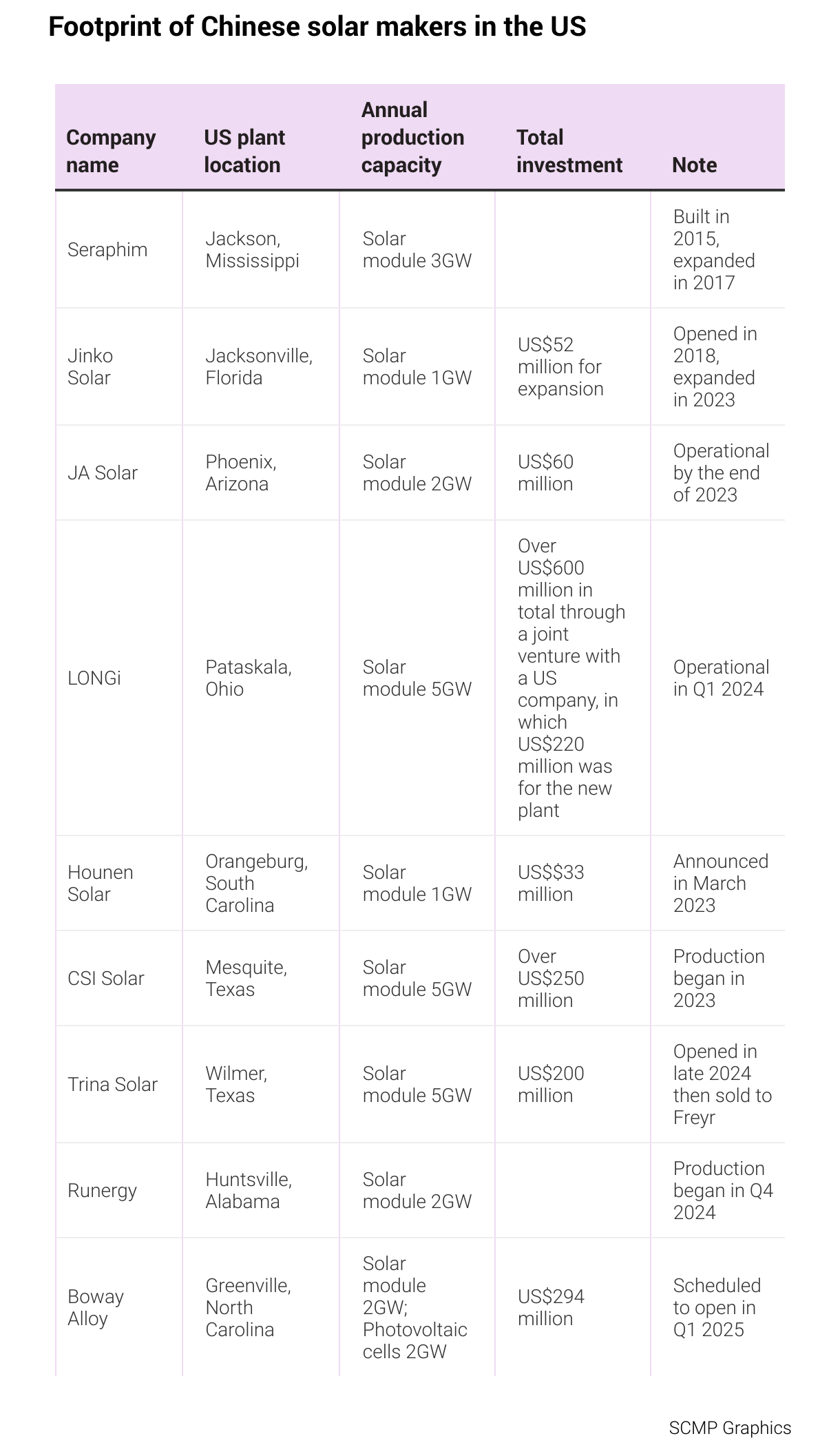
Chinese solar firms had committed to constructing multiple facilities for producing photovoltaic solar components in the U.S., with plans totaling more than 20 GW expected to become operational by late 2025. However, future initiatives could face challenges because of policy changes under the Trump administration, according to an analysis of worldwide solar manufacturing developments published on Monday by the Sydney-based research group Climate Energy Finance.
Since resuming his role in the administration, Trump has
raised tariffs
For all Chinese products, the tax breaks established under the Inflation Reduction Act to motivate companies to move their manufacturing to the United States were put on hold, along with Department of Energy loans being suspended. This has made Chinese solar businesses hesitant when considering investments in the U.S. market.
Are you looking for insights into the most significant issues and global trends? Find your answers here.
SCMP Knowledge
Our updated platform features handpicked content including explainer articles, FAQ sections, detailed analysis, and informative infographics, all provided by our acclaimed team.
“Import taxes can shield local producers, yet this comes with the drawback of higher expenses for domestic buyers,” stated Harry Martin, an analyst from the research institute.
Instead, Chinese companies will
accelerate their expansion
Into Southeast Asia and the Middle East, where authorities must rapidly increase solar power capabilities to address escalating energy needs.
“Other policymakers should pay attention: erecting trade barriers against China will merely divert investments to other areas ready to capitalize on its tech supremacy,” Martin stated.
China is the energy boon of this century – why lock the stable door? Numerous countries are already securing their positions with attractive incentives.
Last year, China’s outward investment in clean technology “turned into a major rush,” with Chinese firms pouring approximately US$140 billion into overseas projects since 2023, according to the report.
Before Trump’s presidency, Chinese firms had been actively seeking investment opportunities in the U.S. As highlighted in the report, in 2024, China-based LONGi teamed up with American clean energy firm Invenergy to launch a 5 GW photovoltaic (PV) solar panel plant in Ohio. Additionally, Jiangsu Runergy inaugurated a 2 GW PV module facility in Alabama as per the same document.
However, China’s solar sector is now redirecting its focus to other markets. The report forecasts that by 2030, Chinese firms will dominate the module manufacturing capacity in the Middle East and North Africa — just as they currently do in Southeast Asia.
In 2024, China favored forming strategic partnerships and undertaking extensive multi-phase initiatives in Southeast Asia, the Middle East, North Africa, and the broader Global South, according to Climate Energy Finance.
The report stated that government-set renewable energy goals, utility-led auctions, incentive programs, and extended power purchasing contracts were the factors attracting Chinese firms to invest in these areas.
Through expansion into Southeast Asia, Chinese firms have the potential to serve Western energy markets by bypassing trade barriers via solar photovoltaic production primarily situated in countries like Vietnam, Thailand, Cambodia, and Malaysia, as mentioned in the report.
The report mentioned that in late 2024, the United States introduced anti-dumping and countervailing duties as high as 271 percent on panels coming from specific Southeast Asian countries. This action impacted Chinese initiatives within the area.
These additional responsibilities have imposed significant financial strain on Chinese producers and led to reduced output and idle facilities in nations such as Vietnam.
However, Chinese manufacturers have countered by relocating their production to countries like Indonesia and Laos that are exempt from these tariffs, according to Martin.
According to the report, Chinese firms are making significant advances in the Middle East and North Africa, drawn by factors such as free trade zones, reasonably priced land, exemption from tariffs, substantial governmental backing, increasing domestic consumption, and their pivotal role for accessing both burgeoning and European-American markets.
“Saudi Arabia
is leading the region
In terms of luring investments from Chinese solar photovoltaic firms, the area is witnessing multibillion-dollar commitments from these enterprises,” stated Martin.
More Articles from SCMP
What is 6G and why is China racing ahead of US and Europe with the technology?
8 participants from the Hong Kong study group traveling to mainland China contracted norovirus.
AI specialist Guo-Jun Qi moves from the US to China
Rolling out the red carpet for ASEAN guests is indeed the appropriate move.
Chinese Premier Li Qiang meets US Senator Daines: calls for frankness, deeper trust
The article initially appeared on the South ChinaMorning Post (www.scmp.com), which is the premier source for news coverage of China andAsia.
Copyright © 2025. South ChinaMorning Post Publishers Ltd. All rights reserved.