oleh admin | Mar 24, 2025 | health, healthcare and medicine, illness, infectious diseases, news
…Commits an additional one billion naira
ABUJA
— The First Lady of Nigeria and Senator Oluremi Tinubu has raised an alert about the country’s tuberculosis (TB) emergency, stating that someone succumbs to TB every seven minutes, even though the illness can be both prevented and treated.
At the World TB Day 2025 Community Outreach event held in Sauka village on Monday in Abuja, Tinubu referred to the circumstances as a national crisis demanding immediate and firm measures to preserve life.
“In the brief period we’ve been here, numerous additional lives could be lost unless we take immediate and firm action,” she cautioned, referencing startling data provided by the World Health Organization (WHO).
Even though there have been global improvements in treating tuberculosis, Nigeria continues to be among the eight nations with the highest incidence of the disease globally. Tinubu expressed concern that numerous Nigerians still endure silently because of stigma, insufficient knowledge, and procrastination in getting medical help.
“It is intolerable that numerous men and women keep losing their lives to a condition that can be prevented and treated,” she said.
As part of the Renewed Hope Agenda, President Bola Ahmed Tinubu aims to increase tuberculosis testing and treatment facilities throughout Nigeria, ensuring that free and readily available care is provided to those who require it.
She praised Coordinating Minister of Health and Social Welfare, Prof. Muhammad Ali Pate, for his dedication to eliminating tuberculosis via enhanced diagnostic methods, treatment plans, and preventive measures.
The First Lady additionally highlighted that the government cannot conquer the battle against TB single-handedly, urging traditional chiefs, religious figures, young organizations, businesses, and global allies to aid in raising public consciousness and promoting prompt diagnosis.
Tinubu pledged ₦1 billion via her Renewed Hope Initiative aimed at bolstering tuberculosis control initiatives and enhancing medical infrastructure in underprivileged areas.
Moreover, she verified that the Minister of State for Health has sanctioned the creation of a primary healthcare facility within the community, thereby enhancing accessibility to TB diagnostics and treatments.
Promoting personal accountability for health among residents, Tinubu highlighted the significance of timely diagnosis and care.
“If your cough lasts for over two weeks, don’t dismiss it; get medical assistance right away,” she emphasized.
She made a commitment to push for more funds, gather necessary resources, and combat stigmas so that women, children, and underrepresented communities can receive equitable TB treatment.
As Nigeria aims for its 2030 target of eliminating TB, Tinubu’s stance stays firm: “Each life is significant. We have to take action immediately to halt this stealthy threat.”
The Minister of State for Health and Social Welfare, Dr. Iziaq Salako, indicated that the federal government has stepped up its initiatives to eradicate tuberculosis (TB) by 2030. This includes upgrading more than 10,000 primary healthcare centers (PHCs) and training 120,000 healthcare personnel.
Salako reiterated President Bola Ahmed Tinubu’s dedication to making sure Nigeria plays a significant role in the worldwide effort against tuberculosis. He highlighted that the administration is broadening TB screening, diagnostic capabilities, and treatment options within both public and private medical centers as part of the universal health coverage initiative. Furthermore, the government aims to boost community involvement and offer improved social support for individuals affected by TB and their households to lessen the impact of the illness.
Salako expressed his appreciation for the dedicated healthcare professionals who continue to serve diligently amidst Nigeria’s economic difficulties, encouraging citizens to acknowledge their significant contribution in fighting tuberculosis. He further lauded Senator Oluremi Tinubu, the First Lady, for her substantial financial backing and efforts in raising awareness, noting how these have been instrumental in motivating people across the nation to get diagnosed promptly and follow through with treatments. “Tuberculosis is neither an inevitable fate nor terminal—it can be prevented and cured,” he emphasized, offering reassurance to those impacted by the illness that the federal government stands steadfastly behind them, ensuring they receive all required medical care and assistance.
Previously, Hon. Amobi Godwin Ogah, the Chairperson of the House Committee on HIV/AIDS, Tuberculosis, and Malaria, advocated for enhanced local financial support to fight tuberculosis (TB) in Nigeria, highlighting that international funds are dwindling. Through Hon. Dominic Okafo, he stressed the importance of securing additional resources as vital for addressing TB effectively within the nation. He disclosed that the House of Representatives has encouraged the private sector to establish a dedicated TB fund akin to those created for HIV and malaria, aiming at long-term sustainability. Additionally, he praised President Bola Ahmed Tinubu for committing an extraordinary ₦700 billion towards improving Nigeria’s healthcare infrastructure, indicating that this step signifies the country’s capacity to address public health issues independently from substantial external assistance.
Ogah likewise denounced the stigmatization and discrimination faced by individuals with tuberculosis, stating that the House Committee would shortly enact legislation to ban such practices. He emphasized the importance of expandingTB screening programs, enhancing training for health care providers, and launching more effective public awareness campaigns to underscore that TB is both preventable and treatable. “To eradicate TB by 2030, we have to make commitments, allocate resources, and take action,” he asserted, calling upon all parties involved—including businesses and non-governmental organizations—to step up their contributions towards combating TB.
Dr. Austin Arinze Obiefuna, the Board Vice Chair of the Global Stop TB Partnership in Geneva, highlighted that Nigeria is taking the lead globally in combating tuberculosis (TB). This leadership stems from robust commitments, targeted financial investments, and successful implementation of TB intervention programs. He applauded Nigeria’s significant strides in enhancing its healthcare personnel and addressing TB issues, noting that these endeavors place the nation at the forefront within Africa and garner international acclaim.
“Whenever I find myself among the halls of WHO, the United Nations, or the African Union,” stated Dr. Arinze, “I feel pride in witnessing Nigeria’s achievements.” The doctor further lauded Senator Oluremi Tinubu, the First Lady, for her steadfast backing and promotion of anti-TB initiatives, encouraging continued governmental and stakeholder involvement to keep up the current positive trajectory. “In Nigeria, actions speak louder than words; they engage local communities effectively and produce tangible outcomes—a key strategy in battling TB,” he concluded.
In his goodwill address, Dr. Walter Kazadi Mulombo, WHO Representative to Nigeria, voiced worries about significant reductions in international health financing, cautioning that the advancements achieved in combating tuberculosis (TB) might be undone unless prompt financial commitments are secured.
He observed that global tuberculosis initiatives have rescued approximately 79 million lives since the year 2000, yet current funding gaps present a significant danger to maintaining this progress. He warned that interruptions in the fight against TB—such as advancements in sophisticated diagnostic tools, treatments, and vaccine development—are endangered because of economic limitations.
In spite of these difficulties, Dr. Mulombo praised Nigeria’s initiative in addressing tuberculosis, pointing out the contribution of TB testing equipment and ₦1 billion from Senator Oluremi Tinubu via her Renewed Hope Initiative. Additionally, he acknowledged the federal government’s extra funding of ₦700 billion aimed at battling HIV, TB, malaria, and vaccination programs. Furthermore, he welcomed the introduction of a $50 million plan by the private sector designed to hasten TB eradication. “Nigeria isn’t standing idle; Nigeria is acting,” he asserted, encouraging stakeholders such as donors, businesses, academic institutions, media outlets, and community groups to unite their efforts against TB. He restated his organization’s pledge to assist Nigeria in achieving its objective of eliminating TB by 2030 and emphasized the necessity of collaborative endeavors to maintain the advancements made thus far.
In a similar vein, HRH Usman Nga Kupi, the Sapeyi of Garki, advocated for the creation of a health center in Sauka, an overcrowded area within the Federal Capital Territory (FCT). This new facility should be designed specifically to diagnose and treat tuberculosis (TB). Emphasizing the importance of practical steps alongside educational efforts, he highlighted that investing in healthcare facilities is vital for effectively preventing, diagnosing, and treating TB. “As one of the significant yet underserved areas in the FCT lacking a proper medical facility, establishing a specialized TB center in Sauka could significantly aid in controlling this illness and enhancing general healthcare services,” he remarked. Additionally, he praised Senator Oluremi Tinubu and various donors for their dedication to combating TB, encouraging governmental bodies to turn these pledges into enduring improvements in public health care systems.
Mrs. Daju Kachollom, the Permanent Secretary at the Federal Ministry of Health and Social Welfare, was represented by Mr. Akpan who stressed the importance of early detection. He encouraged community members to utilize the provided screening services. “Should you or someone close to you have persistent symptoms like a prolonged cough, unexplained weight loss, fevers, or excessive sweating during nights, kindly seek out these screenings,” he stated.
Kachollom praised Senator Oluremi Tinubu, the First Lady, for her consistent efforts in combating tuberculosis (TB). Additionally, she recognized international organizations including the World Health Organization (WHO), The Global Fund, and the Stop TB Partnership for bolstering Nigeria’s approach towards addressing TB challenges. She also urged traditional authorities, local leaderships, and residents to progress from mere acknowledgment to proactive involvement in battling this disease. “Indeed, ending TB is within our reach,” she asserted confidently.
During her welcoming speech, Dr. Queen Ogbuji-Ladipo, the acting board chair of Stop TB Partnership Nigeria, stated that Nigeria continues to have the highest burden of tuberculosis (TB) in both Africa and ranks as the sixth-highest globally, with 499,000 new cases reported in 2023 and an individual succumbing to the disease every seven minutes. Emphasizing the critical necessity for greater financial commitment towards preventing, diagnosing, and treating TB—especially within isolated regions lacking adequate medical facilities—she praised Senator Oluremi Tinubu, the first lady, for rallying backing and donating equipment necessary for TB diagnostics which enhanced screening capabilities, particularly during their recent community engagement activity held in Sauka, Abuja. Additionally, she underscored the introduction of a $50 million private-sector project aimed at tackling this issue, encouraging all parties involved to persistently advocate and fundraise toward eradicating TB from Nigeria completely. “Collectively, we possess the power to defeat TB,” she affirmed confidently.
Provided by Syndigate Media Inc. (
Syndigate.info
).

oleh admin | Mar 24, 2025 | health, illness, journalism, news, news media
-
Over the past eight months, seasoned reporter Sophie Ikenye has faced challenges due to health issues.
-
In spite of the family’s constant attempts to meet her medical requirements, they have depleted all their financial resources.
-
They are looking for assistance from supporters to gather KSh 5 million for immediate surgery and continued care.
The family of seasoned journalist Sophie Ikenye has earnestly appealed to the community to assist in raising KSh 5 million for her immediate surgical needs and continued medical care.

As mentioned in an appeals post by Philip Etale, the family reported that over the last eight months, Sophie has received care across multiple healthcare centers.
The appeal, nevertheless, did not reveal specifics regarding the news anchor’s condition; nonetheless, it is expected that this information will be disclosed at an appropriate time.
Ways to Help Cover Sophie Ikenye’s Medical Expenses
Even though the family has worked tirelessly to address her medical requirements, they have depleted their financial resources and are now appealing for assistance from those who wish them well.
They mentioned that they had put every effort into supporting her medical needs, yet they had run out of all accessible resources.
“We are contacting her family, friends, fans, and supporters to assist us in raising KSh 5 million for immediate surgery and continued medical care,” the plea stated.
They additionally encouraged people to extend their prayers, generosity, and monetary assistance during these difficult times.
Submissions can be made using the information provided below:
Payment Bill No.: 8060995, Customer Name: Your Name, Payment Title: Sophie Ikenye Medical Fundraising.
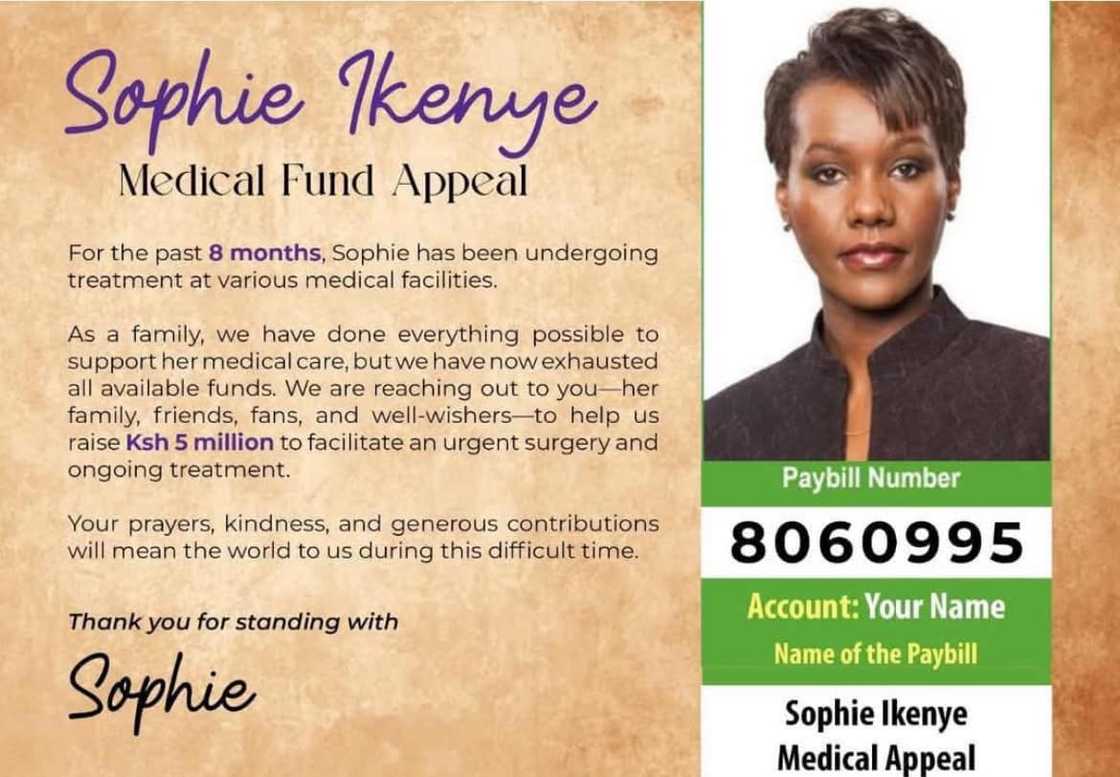
Fans send positive messages to Sophie Ikeneye
Colleagues, admirers, and people from various backgrounds across Kenya flocked to the comments section to post well-wishes for the ill journalist.
Florence Ngigi
O Mighty Healer, by every attribute through which you are recognized as Almighty, rise up and proclaim complete restoration into Sophie’s life in the name of Jesus. Let the healing strength found within Christ’s redeeming blood course from the top of her head down to the soles of her feet.
Joyce Mutai
Sophie, you truly inspired me and have kept my passion for journalism alive. Please get well soon.
Grace Sang:
The lovely woman who captivated the screen with genuine emotion since those initial times! May she find healing now!
Idris Kasavumbu:
She has put in considerable effort, yet now she requires support from friends to cover the medical expenses! Life can be quite uncertain.
While messages filled with optimism and support keep flooding in, the family stays hopeful that substantial donations will enable Sophie to receive the critical medical care she desperately requires.
KBC journalist dies under mysterious circumstances in Kinoo
Her request was made as the Kenyan media sector was grieving over yet another young reporter who passed away at his residence in Kinoo.
Fredrick Parsayo, a promising journalist at the Kenyan national broadcaster KBC, passed away on Friday, March 21.
The body was transported to the St. Theresa Hospital mortuary in Kikuyu, where investigators from the Kinoo Police Station took charge of examining the circumstances leading to his demise.

oleh admin | Des 4, 2024 | health, healthcare and medicine, illness, medical conditions and diseases, medicine and healthcare
Lifehack My ID
,
Jakarta
– Beberapa
penyakit
Kronis atau tak dapat disembuhkan sepenuhnya, kondisi tersebut membutuhkan perawatan berkelanjutan guna mengendalikan gejala dan mencegah komplikasi yang lebih parah. Di bawah ini merupakan sejumlah penyakit yang mensyaratkan pasiennya menjalani pengobatan secara kontinu:
minum obat
sepanjang hidup.
1. Hipertensi
Tekanan darah tinggi atau
hipertensi
Merupakan tenaga yang memacu aliran darah menuju dinding bagian dalam pembuluh nadi. Akibat dari tekanan darah tinggi ini bisa melipat gandakan kemungkinan terjadinya serangan jantung, menaikkan potensi komplikasi gagal jantung, serta masalah pada sistem sirkulasi termasuk penyakit arteri ekstremitas.
Dilansir dari
Vinmec
Pengidap hipertensi harus minum obat sepanjang hayat sesuai dengan anjuran dari dokter. Tujuan utama terapi ini adalah untuk mencegah serta menghilangkan dampak buruk akibat penyakit tersebut. Tambahan pula, guna menjaga efektivitas penanganan sangat diperlukan upaya dalam menangkal kambuhnya penyakit dan meredam pertumbuhan situasi medis yang semakin parah.
2. Diabetes
Diabetes adalah suatu kondisi jangka panjang yang sering dialami masyarakat di Indonesia. Sebagaimana dikutip dari
URMC Rochester
,
penyakit diabetes harus dikontrol dengan mengonsumsi obat, terutama penderita diabetes 1. Diabetes tipe 1 harus menggunakan suntikan insulin dikarenakan tubuh yang tidak lagi memproduksi insulin sama sekali.
Sementara itu diabetes tipe 2 harus mengonsumsi obat, namun tidak semuanya. Kemudian diabetes gestasional adalah diabetes yang terjadi selama kehamilan. Dengan kadar gula darah yang dapat dikontrol sejak awal kehamilan tanpa obat-obatan.
3. HIV
Virus Imunodifikasi Manusia (HIV) merupakan virus yang serangan terhadap sistem pertahanan badan. HIV ini akan memukul sel-sel darah putih dalam tubuh, akibatnya menyusutkan kemampuan benteng dari dalam dan menjadikan seseorang lebih gampang jadi mangsa berbagai macam penyakit layaknya kanker, tuberkulosa, serta infeksi lain-lain. Bagi mereka yang menderita sakit HIV diharapkan untuk minum obat setiap harinya sebagaimana petunjuk medis.
Dilansir dari
Hiv.gov
Dengan mengonsumsi obat-obatan secara rutin bisa membantu menstabilkan viral load agar tetap rendah. Di sisi lain, jika terlewat bahkan hanya sekali pun, hal itu setara dengan memberikan peluang bagi virus HIV untuk berkembang biak lebih cepat. Hal ini pada gilirannya dapat melemahkan sistem imun dalam tubuh dan berpotensi menyebabkan Anda menjadi mudah terserang penyakit.
4. Asma
Dikutip dari
Mayo Clinic
, asma merupakan suatu kondisi jangka panjang yang mempengaruhi sistem pernafasan, di mana ada inflamasi serta pembengkakan pada jalur nafas sehingga membuatnya menjadi sempit. Hal ini dapat menimbulkan gejala-gejala seperti kesulitan bernapas, batuk, dan bunyi whistling saat bernapas. Meskipun penanganan asma bervariasi bergantung pada derajat keparahannya, orang-orang dengan asma biasanya harus menggunakan obat-obatan seperti bronchodilator ataupun kortikosteroid dalam bentuk inhaler selama sisa hayat mereka demi meredakan inflamasi dan mencegah serangan asma.
5. depresi serta gangguan kecemasan
Penyakit mental seperti
depresi
Dan kondisi cemas ini bisa bertahan cukup lama serta membutuhkan penanganan medis secara berkala. Obat anti-depresi dan anti-cemas dipergunakan untuk menyetabilkan kembali keseimbangan kimia di otak, hal tersebut sangat membantu pasien dalam mengendalikan gejalanya. Meskipun pendekatan terapis mental seperti CBT (Terapia Perilaku Kognitif) pun sama-sama efektif, tetapi obat-obatan kerapkali merupakan elemen utama dari proses penyembuhan jangka panjang.
Sukma Kanthi Nurani
bersumbang dalam penyusunan artikel ini.
Bahaya Konsumsi Obat Sakit Kepala Selama 15 Hari Lebih Kata Ahli Saraf

oleh admin | Agu 4, 2024 | health, health and exercise, health benefits, illness, inflammation
Hikers have long been aware that breathing in fresh countryside air has a positive effect on well-being. Experts now suggest that physicians consider recommending a daily stroll in the park as a remedy for chronic inflammation.
Following an examination of 1,244 Americans ranging in age from 34 to 84 years old, researchers at New York’s Cornell University determined that “a greater occurrence of favorable natural encounters correlated with reduced levels of systemic inflammation.”
It is often said that the influence extends further than the advantages associated with physical activity.


precisely how exposure to nature exerts its effects remains uncertain.
A hypothesis suggests that microorganisms emitted by plants and soil interact with bacteria present in the human gut, potentially shielding against inflammation associated with numerous chronic conditions such as cancer and cardiovascular diseases.
Another point is that being close to nature decreases stress, which is a cause of inflammation.
In a commentary released with the study, psychologists from Ohio State University stated: “As research advances, it may turn out that granting access to public parks and natural spaces could be just as crucial as giving access to hospitals and medical facilities.”
At an individual level, maybe physicians ought to recommend taking a daily stroll in the park as an initial approach for treating inflammation instead of prescribing medication right away, since these can be costly and come with numerous side effects.
Read more


