oleh admin | Apr 2, 2025 | government, korea national news, local news, news, politics and law
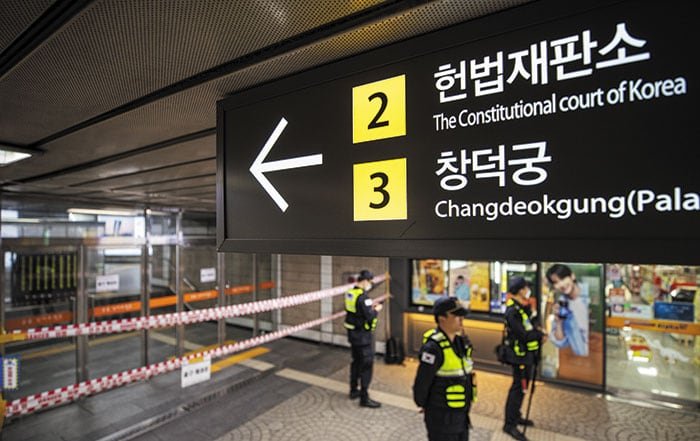
On April 4th, Seoul plans to enforce an unparalleled security measure near the Constitutional Court due to President Yoon Suk-yeol’s impeachment verdict scheduled for that day. The subway stations, fueling stations, and building sites within proximity will shut down temporarily, along with local educational institutions suspending their activities. Authorities stated that they would establish a barrier encompassing a hundred meters from the courthouse boundary, forming what has been termed as a “no-go zone,” excluding everyone without exception—even legislators won’t be allowed entry. Renowned cultural landmarks such as palaces, art museums, and exhibition halls will also cease operations. Businesses located in this region are advising staff members to opt for remote working arrangements instead.
On April 1, authorities stated that Anguk Station on Seoul Metro Line 3, situated close to the Constitutional Court, would remain shut throughout April 4, with trains bypassing this station without halting. Three days prior to the decision, four out of its six exits had been sealed off. Depending on circumstances, Seoul Metro might collaborate with law enforcement to make additional stations such as Gwanghwamun, Gyeongbokgung, Jongno 3-ga, Jonggak, City Hall, and Hangangjin pass-by stops as well.
The Seoul Metropolitan Police Department has implemented traffic limitations beginning at 1:00 PM on April 1st. They have completely blocked off Yulgak-ro near the Constitutional Court under a 24-hour urgent measure. Should gatherings increase, street closings might expand to include Sajik-ro and Sejong-daero.
On April 4, the National Palace Museum and surrounding cultural landmarks proximate to the Constitutional Court will be shut down, with 15 government employees designated for their security. In an effort to ensure student safety amid possible demonstrations, the Seoul Metropolitan Office of Education has mandated the closure of 11 educational institutions located in the vicinity; this includes kindergartens, elementary, middle, high, and specialized schools.
In order to minimize disruptions, the Seoul Metropolitan Government plans to station up to 1,350 crowd management personnel in crucial locations such as Gwanghwamun, Anguk Station, and Yeouido during the three-day period preceding and following the event. Additionally, the city has requested mobile service providers to install additional temporary cell towers to prevent network issues due to high pedestrian traffic.
A significant police deployment is scheduled for the day of the impeachment verdict, involving 20,000 riot police from 338 units across the country, with 14,000 officers stationed in Seoul. At midnight, the National Police Agency plans to declare a “Gapho” emergency, enabling complete activation of law enforcement resources. Additionally, on April 3rd, a “Eulho” emergency declaration will take effect specifically for Seoul and national-level policing efforts, deploying half of their personnel. Meanwhile, local police agencies throughout the regions will face a “Byeongho” emergency status requiring the involvement of 30 percent of their workforce.
The Korea Heritage Service’s Royal Palace and Tombs Center stated that visits to Gyeongbokgung, Changdeokgung, and Deoksugung palaces will be limited on April 4 due to safety concerns and efforts towards cultural conservation. Additional closures might occur based on circumstances preceding and following this decision. Notably, Changdeokgung, which holds the status of a UNESCO World Heritage site, lies merely 600 meters away from the Constitutional Court, whereas Gyeongbokgung has often served as a focal point for demonstrations.
A number of local museums and art galleries, such as the Seoul Museum of Craft Art, will remain closed on April 4. Additionally, the Unhyeongung Royal Residence, situated roughly 300 meters away from the Constitutional Court, will not accept visitors that same day.
A number of businesses close to the Constitutional Court are modifying their work schedules. The finance and public relations personnel at HD Hyundai, situated approximately 100 meters away from the court, have been instructed to either telecommute or go to the company’s Pangyo branch. Similarly, workers at Hyundai Oilbank within the same complex are making comparable adjustments. Additionally, both Hyundai Engineering & Construction and Hyundai Engineering are contemplating implementing remote working options for all team members; definitive choices will be finalized by early next month.
oleh admin | Mar 27, 2025 | electric power, energy sector, korea national news, korean, power plants
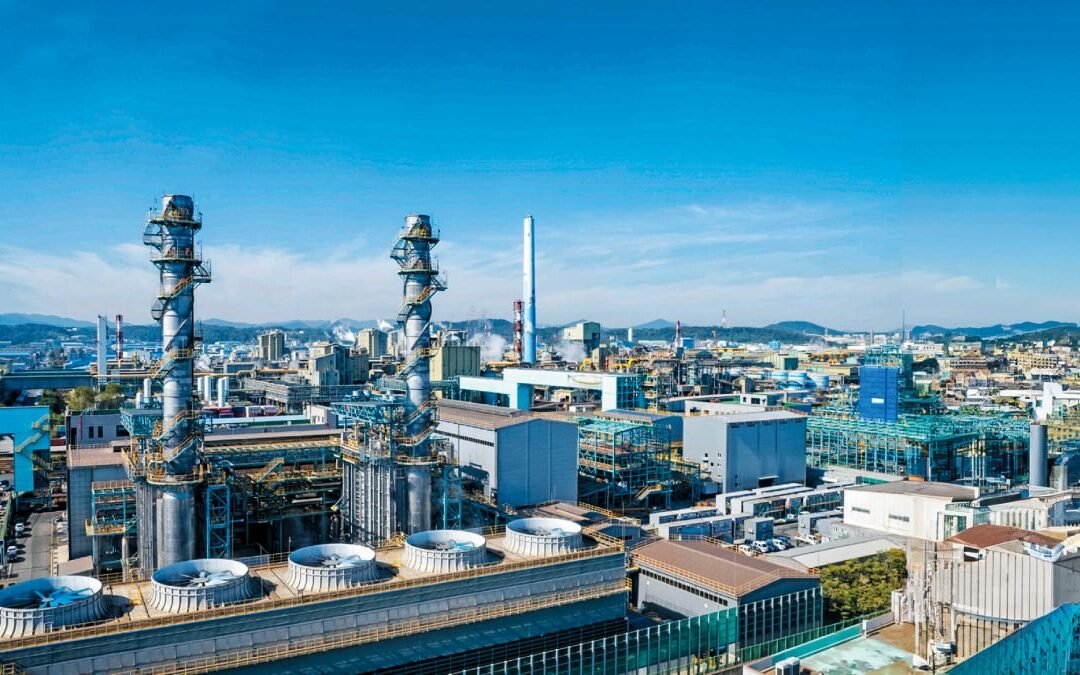
The Korea Railroad Corporation (KORAIL) intends to construct a Combined Heat and Power (CHP) facility, often referred to as a cogeneration power plant, at its Goyang train yard by 2027 with the aim of cutting down on electricity expenses.
The government-owned railroad authority, utilizing electric power for its operation of KTX high-speed services as well as various local routes such as Lines 1, 3, and 4 within the greater Seoul region, has experienced a significant surge in their utility expenditures recently. In the previous fiscal year, they allocated approximately 580 billion Korean won ($400 million)—which constitutes about 8.7% of their total operational spending amounting to 6.64 trillion Korean won—towards energy consumption alone. This expense is anticipated to increase further by around an additional 60 billion Korean won during the current year.
South Korea has consistently maintained some of the lowest industrial electricity rates globally. Despite the state-owned Korea Electric Power Corporation (KEPCO) experiencing significant financial losses and accumulating debts because of the former President Moon Jae-in’s initiative to reduce reliance on nuclear power along with rising crude oil costs, the authorities have increased electricity tariffs just once. To avoid provoking substantial public backlash, particularly regarding residential electricity charges, the government opted to raise industrial electricity rates two times starting from May 2023.
Soaring electricity expenses are driving numerous businesses to seek out alternate options, ranging from constructing their own power stations to buying less expensive energy directly from the wholesale market, thus avoiding KEPCO.
KORAIL, which operates 98% of its trains using electric power, is one of the businesses heavily impacted by the increases in industrial electricity rates. Despite a reduction of 1.2% in overall train kilometers traveled over the last three years, the company has seen rising expenses for electricity.
During a media briefing on March 25, KORAIL CEO Han Moon-hee stated that increasing electrical expenses are exerting significant strain on the corporation’s finances. Additionally, he mentioned that the firm intends to develop an extensive system of internal power stations across the country as a strategy to cut down operational expenditures.
The nation’s top manufacturing companies, which have significant energy requirements—such as those involved in oil refinement, semiconductor production, and steel industries—are increasingly working towards building their own power facilities.
HD Hyundai Oilbank is constructing a 277-megawatt (MW) liquefied natural gas (LNG) power station close to its Seosan complex in South Chungcheong Province, scheduled for completion in 2027. Meanwhile, Hyundai Steel intends to develop a 499 MW LNG facility at their Dangjin site within the same region by 2028.
In 2023 and 2024, SK Hynix started operations for two liquefied natural gas (LNG) facilities with a total capacity of 585 MW in Cheongju and Icheon as a reaction to increasing electricity costs. Meanwhile, since 2021, Korea Zinc has been producing its own power using a 272.5 MW combined-cycle LNG facility located at its Onsan smelting site.
Currently facing an unparalleled slump, the petrochemical industry is seeking alternate power sources beyond those provided by KEPCO. SK Advanced, which operates as part of SK Gas within this sector, has submitted an application to KPX with intentions to buy electricity directly from the wholesale market for approximately 30 won per kilowatt-hour (kWh). This represents a significant saving compared to KEPCO’s present industrial charge of 185.5 won per kWh.
The direct purchasing system, launched in 2003, enables customers to acquire electricity directly from the wholesale market without going through KEPCO. This option remained mostly unused due to consistently low prices set by KEPCO for an extended period. However, following KEPCO’s decision to raise industrial electricity charges to 185.5 won per kWh last October, businesses are considering this rarely used mechanism again after more than two decades of dormancy.
The Korea Enterprise Federation (KEF) observed that although household electricity prices have climbed by 40.4 won per kilowatt-hour over the last three years, industrial tariffs have gone up by 80 won. “Rising energy expenses pose a significant risk to manufacturing output and business investments,” stated the KEF in an announcement made on March 25th. According to a recent poll conducted by the Korea Chamber of Commerce and Industry, approximately 40 percent of South Korean producers are contemplating shifting towards different means for their power needs.
The Ministry of Trade, Industry, and Energy (MOTIE) plans to approve a new regulation on March 28 that will outline the process for direct electricity procurement. Upon completion, this framework is anticipated to gain wider acceptance amongst businesses.


