


Mexico’s Must-See UNESCO World Heritage Sites: A Global Guide
From the striking ruins of the Maya civilization to the untamed expanse of the Yucatán peninsula, here’s a look at the UNESCO World Heritage Sites you should visit when traveling through Mexico.
Heading to Mexico? Check out these articles for tips on planning your journey:
- 5 Unmissable Nature Reserves in Mexico’s Yucatán Region
- 5 environmentally friendly accommodations to check out in Mexico
- 5 Reasons to Explore Riviera Nayarit: Mexico’s Hidden Gem for Hip Set Enthusiasts
- Mexico: The most stunning cenotes for swimming in Yucatan
Which UNESCO World Heritage Sites and landmarks should you visit in Mexico?
The historical center of Oaxaca along with the Monte Albán archaeological site
Located at an elevation of 1,500 meters in the central valleys,
Oaxaca
It is one of the most thrilling Mexican cities. Designated as a UNESCO World Heritage Site in 1987, it sits amidst breathtaking mountains and boasts numerous colonial mansions alongside Baroque churches, all embellished with renowned decorations.
cantera verde
, a distinctive grey-green stone characteristic of the city’s renowned allure. Located about 10 kilometers from Oaxaca, the ruins of Monte Albán offer an impressive array of attractions. This former capital of the Zapotec people later served as a burial site for the Mixtec civilization. Its features include terraces, pyramids, canals, tombs, and temples, which together narrate over 1,400 years of historical significance.
The historical center of Mexico City and Xochimilco, treasures of the Mexican capital.
Built in the 16
th
a century amidst the remnants of Tenochtitlan, once the heart of the Aztec Empire
Mexico City
, has become one of the most densely populated urban areas globally. The historical center, designated as a UNESCO World Heritage site, provides unparalleled glimpses into Mexican heritage. Situated at a cultural nexus featuring Aztec, colonial, and contemporary influences, Mexico City’s principal plaza, the Zócalo, stands out as a key attraction within the metropolis. Noteworthy among these sights are the extensive murals crafted by artist Diego Rivera, showcased in the primary atrium of the Palacio Nacional, illustrating chapters of Mexican chronicles via vivid depictions. To the south lies the borough of Xochimilco, frequently referred to as “the Venetian quarter of Mexico,” renowned for an intricate web of waterways and floating gardens. While visiting this region, be sure not to miss embarking on a journey along these distinctive channels.
trajinera
, a conventional flat-bottomed vessel.
The El Pinacate Biosphere Reserve along with the vast Great Altar Desert, featuring lunar-like terrain
Located along the US-Mexico border and the Gulf of California, this biosphere reserve stands out as one of northern Mexico’s most significant natural marvels. On the western side, the expansive sand dunes of the Great Altar Desert, which form the southern portion of the Sonoran Desert, extend endlessly across the horizon with some reaching up to 200 meters high. If you head eastward into the dormant volcanic area known as Pinacate, you will find yourself trekking through a lunar-like terrain dotted with cinder cones, massive craters, and dark lava fields. This remarkable scenery has been recognized as a UNESCO World Heritage Site since 2013. Accessible via organized tours originating either at the coastal retreat of Puerto Peñasco or the quaint town of Magdalena, visiting here offers an unforgettable adventure.
The historical center of Puebla, a marvel of Renaissance architecture
Established in 1531 within an occupied valley approximately one hundred kilometers away from Mexico City, the city of Puebla stands as a stunning example of Renaissance architecture. It earned recognition as a UNESCO World Heritage Site in 1987. Nestled at the base of the formidable Popocatepetl volcano, this vibrant urban center offers visitors a captivating collection of Baroque structures such as the grandiose Puebla Cathedral and the remarkable Palafoxiana Library—the oldest library on the South American mainland. Additionally, ornate manors adorned with celebrated Talavera ceramics alongside quaint homes painted in myriad hues add charm to the landscape. The culinary scene here is equally impressive; known for its extensive range of traditional dishes, local food reflects great pride among residents.
The ancient city of Teotihuacan, known as the “Birthplace of the Gods,”
Locked in time approximately 50 kilometers away from Mexico City,
Teotihuacan
is the most visited pre-Columbian site in Mexico, and it’s easy to see why. Built on a semi-arid plateau between the 1
st
and 7
th
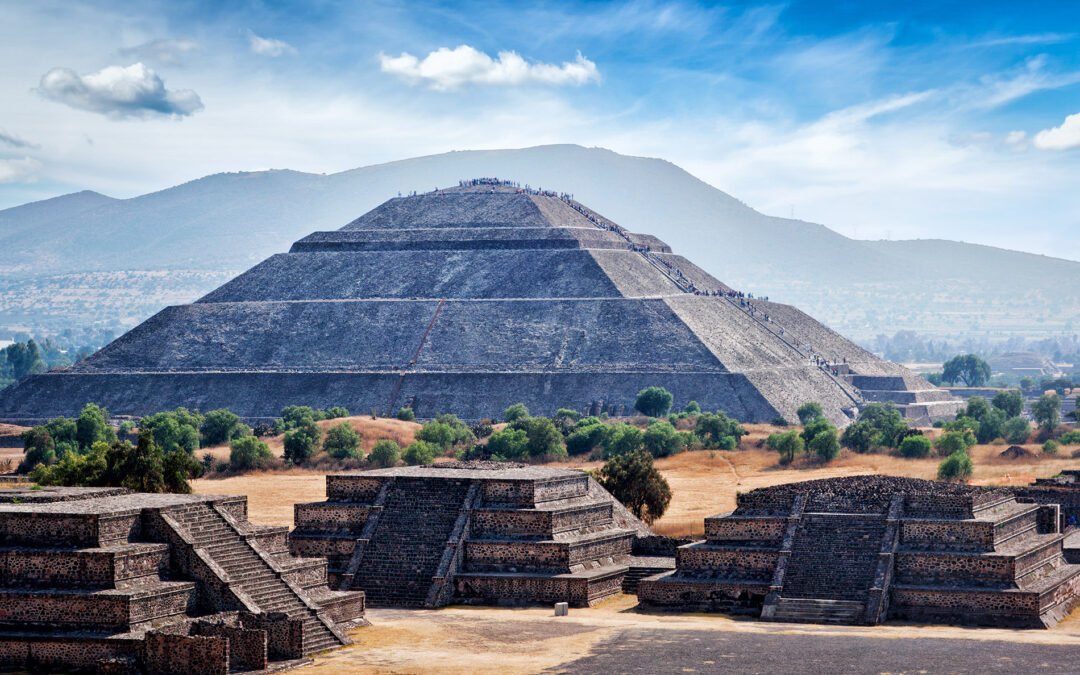
During the centuries AD, the remnants of this ancient Aztec city are breathtaking, showcasing magnificent craftsmanship and remarkable complexity. Among the most iconic structures are the Temple of Quetzalcoatl, the Pyramid of the Sun, and the Pyramid of the Moon. The Avenue of the Dead, a broad thoroughfare adorned with numerous monuments, cuts through the center of the city. Additionally, the well-preserved Palace of Quetzalpapálotl stands as evidence of the sophisticated artistic skills of its former residents. Visitors can explore several museums within the site that offer insights into Aztec heritage and traditions, all while enjoying stunning panoramic vistas of the surrounding area.
The ancient city of Chichén Itzá, which served as a spiritual hub in the Yucatán region before the arrival of Europeans,
Stunning, magnificent, immense… Even grand words fall short when describing Chichén Itzá, the most well-maintained archaeological site in the Yucatán, located just a three-hour drive away.
Cancún
. Spanning nearly 6 kilometers
2
In the area, the complex encompasses about two dozen structures, with each one being more captivating than the previous: the grand stepped Pyramid of Kukulkan (El Castillo), the High Priest’s Temple, the Group of a Thousand Columns, the Skull Platform (Tzompantli), and the Ball Court (Juego de Pelota). These sites narrate numerous tales of history, customs, and religious practices from when it stood as one of the most extensive Mayan urban centers. Recognized among the Seven Wonders of the Contemporary World, this location attracts countless visitors annually who come to explore its wonders. A visit here is essential for anyone traveling through Mexico; excursions depart regularly from all major towns and beachfront resorts across the Yucatan Peninsula.
The ancient town of Guanajuato, a vibrantly colored settlement atop a hillside, remains a sight to behold.
Nestled within a slender valley, the colonial city in central Mexico captures your heart at first sight with its vibrant charm. The array of vividly painted residences stands out dramatically along the hillsides, forming an impressive mosaic of winding lanes, cathedrals, Baroque palaces, and mixed-use buildings. Once you’ve marveled at these sights, prepare yourself for another astonishment—since 1998, Guanajuato has been designated a UNESCO World Heritage site and ranks among the most unusual urban settings globally. It’s constructed across two tiers: commercial areas and residential spaces occupy one plane, whereas bustling main roads run beneath ground level. This distinctive design originated in the eighteenth century.
th
During the century when the city was the global hub for silver mining, these activities left behind vast expanses of unused space that were perfect for new uses.
The Palenque National Park along with its ancient Maya city-state stands as both a cultural and natural wonder.
Established close to the mountains of the Sierra Madre de Chiapas region since the beginning.
st
In the century B.C., the Pre-Hispanic city of Palenque stands as a testament to the ingenuity of Maya architects. These skilled builders managed to construct this intricate site precisely within the vast Selva Lacandona, which is the biggest rainforest in Mexico. Most of the structures that remain intact today were built during the 5th century.
th
to 8
th
Several prominent structures from centuries AD include the Grand Palace, easily identified by its three-story square tower. The Temple of Inscriptions features carved panels detailing the royal lineage of Palenque. Additionally, the Group of the Cross comprises pyramid-like temples known for their harmonious architecture.
Adjacent to these historical ruins lies Palenque National Park, which serves as a sanctuary for various wildlife such as howler monkeys, manatees, and tapirs. This park boasts stunning landscapes characterized by dense jungles, cascading waterfalls, and refreshing natural swimming areas.
The ancient town of Uxmal from before Columbus’ arrival stands as a cultural gem of the Yucatán.
In south-western
Yucatán
, the historic city of Uxmal was among the most prosperous hubs of Maya civilization between the 7th and 8th centuries.
th
and 10
th
This city, known as “built three times,” has become one of Mexico’s most stunning archaeological locations. To grasp the design and heritage of this place, begin your exploration at the captivating Museo de Sitio, which narrates the excavation journey through multiple exhibits. From there, proceed to the impressive Pirámide del Adivino, standing tall as the highest point here constructed circa 560 AD, onward to the Palacio del Gouvernador erected roughly around 900 AD. Every landmark showcases an intricate architectural technique adorned with well-preserved murals.
Sian Ka’an, the biggest protected region in Mexico
This is the biggest conservation zone in Mexico, undoubtedly also one of the most stunning ones. Situated along the eastern part of the Yucatan Peninsula, this vast expanse known as “where heaven touches Earth” in ancient Maya speech, offers a truly idyllic setting. Here you’ll find mangrove swamps and lush woodlands, vibrant coral reefs enclosed by emerald seas, rainforests teeming with life, wetlands meeting pristine shores offering clear views across the sapphire sea… Just a short distance away from Tulum lies the breathtaking scenery within the boundaries of the Sian Ka’an biosphere reserve which appears almost surrealistic.
UNESCO World Heritage
This extensive ecosystem serves as a habitat for more than 300 bird species, along with various reptiles such as tortoises, snakes, iguanas, and crocodiles, alongside an array of mammals including howler monkeys, pumas, and ocelots. It’s a haven sure to captivate those who appreciate nature. Even skeptics might find themselves charmed upon visiting!
What is the total number of UNESCO World Heritage sites located in Mexico?
In 2024, Mexico boasts a total of 35 UNESCO World Heritage sites, ranking it as the seventh country globally in terms of these designations.
most UNESCO-listed sites
, and it was also the first on the American continent, preceding the United States.