


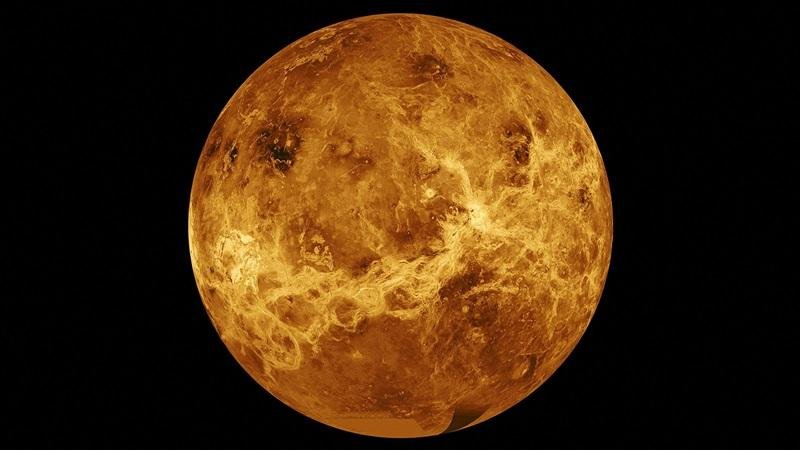
Did Venus Once Hide Oceans? Scientists Unveil the Answer.
WASHINGTON – The Earth is essentially an oceanic planet, with approximately 71% of its surface submerged under water. Venus, our nearest celestial counterpart, is occasionally referred to as Earth’s sister due to similarities in mass and structure. Despite its current scorched and desolate landscape, could Venus have originally possessed vast bodies of water like ours?
According to recent findings, which estimated the water content within the planet’s inner layers—a crucial factor in determining if Venus ever possessed vast bodies of water—the answer is negative. These scientists determined that the planet’s core likely lacks significant moisture, aligning with theories suggesting Venus became extremely arid following an initial period where its exterior was primarily made up of molten material—magma—and since then has maintained a bone-dry landscape.
Water is deemed essential for sustaining life, hence the research indicates that Venus has never been inhabitable. The new evidence does not back up earlier theories suggesting that Venus might contain subsurface water reserves from a vanished ocean.
Volcanic activity, through the release of gases into a planet’s atmosphere, offers insights into the composition of terrestrial planets’ interiors. When magma moves upward from a deep internal zone known as the mantle towards the crust, it brings with it various substances originating from lower layers within the Earth.
On Earth, volcanic gases consist of over 60% water vapor, suggesting a water-abundant interior. In contrast, studies found that the gases from Venusian volcanoes contain at most 6% water vapor, pointing towards an extremely dry inner composition.
“We suggest that a habitable past would be associated with Venus’ present interior being water-rich, and a dry past with Venus’ present interior being dry,” said Tereza Constantinou, a doctoral student at the University of Cambridge’s Institute of Astronomy and lead author of the study published on Monday in the journal Nature Astronomy.
“Atmospheric chemistry indicates that volcanic eruptions on Venus emit minimal amounts of water, suggesting that the planet’s interior—the origin of these eruptions—is also largely devoid of moisture. This aligns with the idea that Venus has maintained a consistently arid surface for an extended period and was never hospitable,” Constantinou noted.
Venus is the planet that orbits as the second closest to the Sun, with Earth following as the third.
“There are two contrasting theories about water history on Venus: one suggests it maintained a mild climate for eons with bodies of surface water, whereas the alternative proposes that an initially scorching-hot Venus never managed to form any surface liquids,” as stated by Constantinou.
The diameter of Venus, approximately 7,500 miles (12,000 km), is slightly smaller than Earth’s, which measures around 7,900 miles (12,750 km).
“Venus and Earth are frequently referred to as sister planets due to their comparable mass, radius, density, and proximity to the Sun. Nevertheless, their developmental trajectories took very different directions,” Constantinou stated.
“Currently, Venus boasts surface conditions that are vastly different from those on Earth, characterized by an atmospheric pressure 90 times higher, surface temperatures reaching approximately 465°C (869°F), and a hazardous atmosphere filled with sulfuric acid clouds. These significant differences highlight the distinct difficulties involved in comprehending Venus beyond merely considering it as Earth’s twin,” stated Constantinou.
It seems the narrative was distinct on Mars, which is the fourth planet from the sun.
Mars shows signs of having once possessed vast oceans filled with liquid water billions of years back. In contrast, similar characteristics haven’t been observed on Venus. Research from August, which analyzed seismic information gathered by NASA’s automated InSight rover, suggests that Mars might contain a significant underground body of liquid water trapped beneath layers of fragmented volcanic rock. This accumulation could potentially flood the whole planet as one enormous sea.
Although Venus hasn’t received as much attention as Mars, upcoming missions aim to change this. In the 2030s, NASA’s proposed DAVINCI mission intends to study Venus thoroughly—from its atmosphere all the way to its surface—by employing both flybys and a descending probe. Similarly, during the same decade, the European Space Agency plans to launch their EnVision orbiter which will focus on conducting detailed radar imaging of Venus along with comprehensive atmospheric research.
“Venus serves as a natural lab for examining how conditions suitable for life—or the absence of them—develop,” stated Constantinou.
— Reuters
This article
Was there ever water on Venus? Scientists now know for sure.
was originally published in
GMA News Online
.