



The robotics start-up co-founded by former Huawei ‘Genius Youth’ recruits has an ambitious 5,000-unit production target, far exceeding 2024 output
Agibot, a robotics startup based in Shanghai co-founded by a former
Huawei Technologies
“Genius Youth” recruits, is targeting production of up to 5,000 robots this year, according to a senior executive, matching Elon Musk’s Optimus plans.
The company, also known as Zhiyuan Robotics, plans to deliver between 3,000 and 5,000 robots this year, a significant increase from the fewer than 1,000 units shipped last year, according to Yao Maoqing, a partner at Agibot and president of the company’s embodied intelligence unit. The production surge reflects the eagerness among Chinese robotics start-ups for expansion amid a domestic boom in the industry.
In the first two months of the year, industrial robot production in China saw a 27 percent increase compared to the previous year, reaching 91,088 units. Meanwhile, service robot output surged by 36 percent to hit approximately 1.5 million units, as reported by official statistics.
Are you looking for insights into the most significant issues and global trends? Find your answers here.
SCMP Knowledge
Our latest platform offers carefully selected content including explainers, FAQs, analyses, and infographics, all provided by our acclaimed team.
Established in 2023, Agibot has quickly emerged as a prominent figure in Shanghai’s robotics industry, having set up operations in the Lingang New Area. The company intends to launch a new factory in the Pudong district aimed at boosting its monthly output to over 400 robots, Yao stated.
“This year, we aim to deploy new products in industrial scenarios, replacing humans in specific tasks to create tangible customer value,” Yao told the South China Morning Post.
It will probably be about another five years before households widely adopt humanoid robots, he mentioned.
Agibot was co-founded by Peng Zhihui, a former member of Huawei’s high-profile “Genius Youth” programme that recognises top young talent in China. Peng, along with entrepreneurs such as
Xingxing Wang from Unitree Robotics
He is considered pivotal in positioning China as a leading force in the field of robotics.
Yao, a veteran of the autonomous-driving industry with stints at
Google
‘s Waymo and Chinese electric vehicle maker
Nio
, said the country has advantages in humanoid robotics, including a comprehensive hardware supply chain and abundant
artificial intelligence
talent.
The field of human-like robots is still in its early stages, with numerous potential uses yet to be explored, and current manufacturing expenses are quite steep,” Yao stated. He anticipates that these costs will significantly drop as production increases, allowing the expense of essential parts like motors, gearboxes, and modules to be distributed over greater quantities, thus enhancing cost-efficiency through better yield rates.
Yao mentioned that broad acceptance will likely occur when the cost per unit drops to around 50,000 yuan (US$6,900).
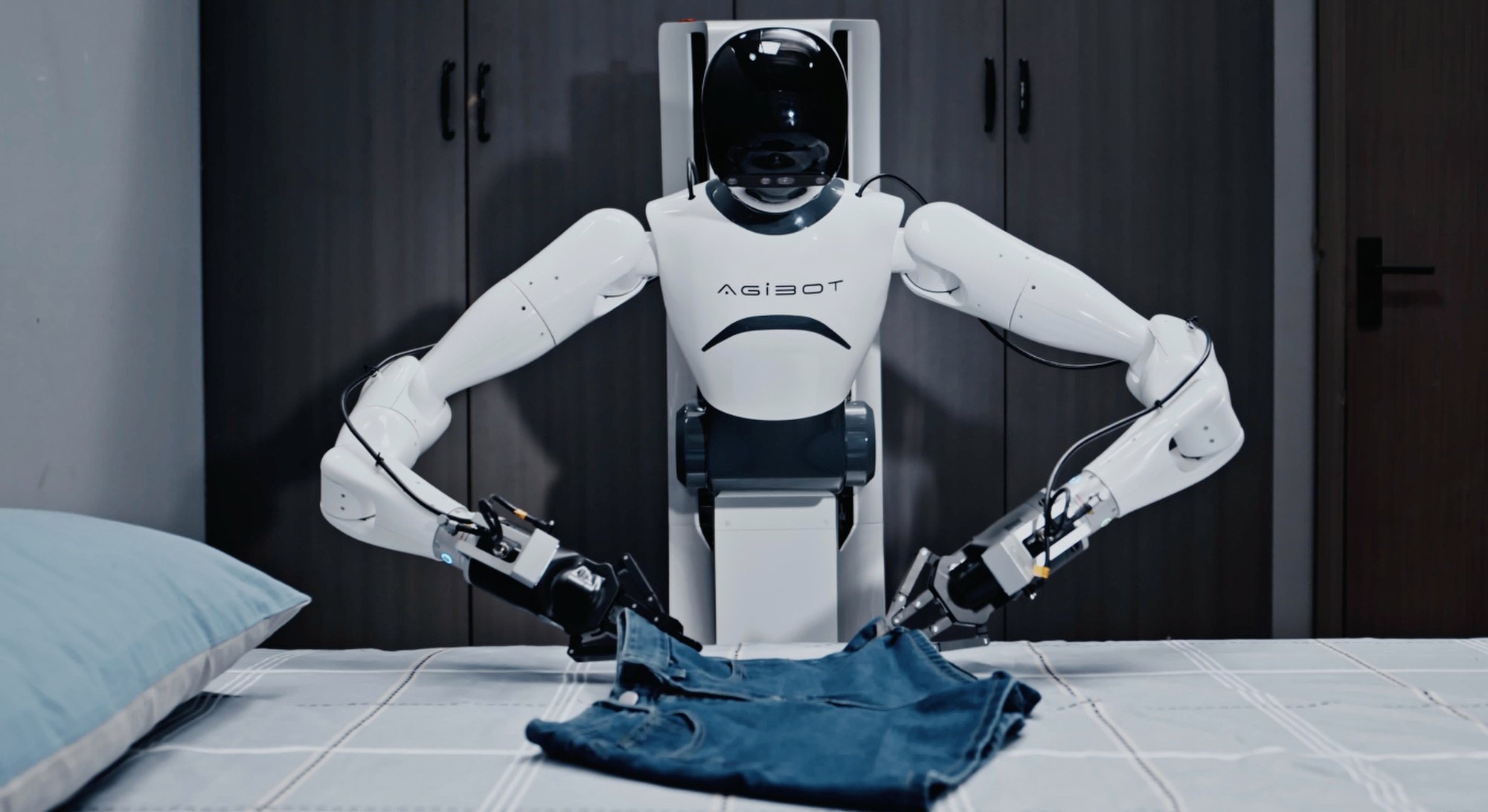
Currently, Agibot manages three primary product lines: Yuanzheng, a two-legged human-like robot intended for business applications; Genie, an agile wheeled robot equipped with two arms; and Lingxi, a compact humanoid aimed at both developers and general consumers. Earlier this year, the company celebrated reaching their 1,000-unit production mark, comprising of 269 mobile models and 731 walking bots. Peng has taken charge of advancing the Lingxi line, which just released its newest iteration—the X2 version.
Agibot has successfully concluded at least eight financing rounds, drawing investments from notable venture capital firms including GL Ventures, Lanchi Ventures, HongShan Capital Group, and CAS Star, an entity supported by the Chinese Academy of Sciences. The company also counts several industry leaders among its backers.
BYD
Beijing Automotive Group Company (BAIC) along with city-supported funds like Lingang’s Sci-Tech Fund have also invested, according to Chinese corporate database Tianyancha.
Yao mentioned that the start-up is presently estimated to be worth around 10 billion yuan.
Similar to other robotic companies, Agibot encounters difficulties due to limited data availability. In contrast to the extensive online textual information used for training big language models, robots necessitate multimodal models capable of interpreting their physical environments.
Agibot has established a data collection centre in Shanghai, where around 100 robots generate about 50,000 high-quality motion data records daily within a 2,000-square-metre facility. Each record contains tens of thousands of tokens.
“To attain general intelligence, robots need much larger datasets to confirm scaling laws and anticipate new abilities when data hits billions of tokens,” stated Yao. He highlighted Agibot’s dedication to utilizing open-source datasets, working together with industry colleagues and end-users, as well as generating additional data via simulations.
Earlier this month, Agibot introduced “Genie Operator-1”, a general-purpose embodied foundation model that it claimed can enhance robots’ multitasking abilities.
More Articles from SCMP
China declares shared naval exercises with Thailand close to a South China Sea harbor.
Shares in Hong Kong declined as investors liquidated their positions due to the absence of significant drivers.
‘Duplicity in Diplomacy’: China Pledges Peace Before Pursuing Japan’s Fishing Vessel
Taiwan has ordered three individuals from mainland China to depart after they promoted the idea of a military takeover of the island.
The article initially appeared on the South China Morning Post (www.scmp.com), which is the premier source for news coverage of China and Asia.
Copyright © 2025. South China Morning Post Publishers Ltd. All rights reserved.