


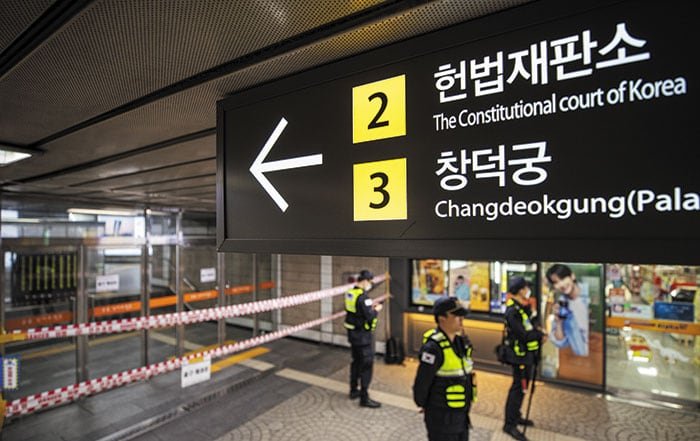
On April 4th, Seoul plans to enforce an unparalleled security measure near the Constitutional Court due to President Yoon Suk-yeol’s impeachment verdict scheduled for that day. The subway stations, fueling stations, and building sites within proximity will shut down temporarily, along with local educational institutions suspending their activities. Authorities stated that they would establish a barrier encompassing a hundred meters from the courthouse boundary, forming what has been termed as a “no-go zone,” excluding everyone without exception—even legislators won’t be allowed entry. Renowned cultural landmarks such as palaces, art museums, and exhibition halls will also cease operations. Businesses located in this region are advising staff members to opt for remote working arrangements instead.
On April 1, authorities stated that Anguk Station on Seoul Metro Line 3, situated close to the Constitutional Court, would remain shut throughout April 4, with trains bypassing this station without halting. Three days prior to the decision, four out of its six exits had been sealed off. Depending on circumstances, Seoul Metro might collaborate with law enforcement to make additional stations such as Gwanghwamun, Gyeongbokgung, Jongno 3-ga, Jonggak, City Hall, and Hangangjin pass-by stops as well.
The Seoul Metropolitan Police Department has implemented traffic limitations beginning at 1:00 PM on April 1st. They have completely blocked off Yulgak-ro near the Constitutional Court under a 24-hour urgent measure. Should gatherings increase, street closings might expand to include Sajik-ro and Sejong-daero.
On April 4, the National Palace Museum and surrounding cultural landmarks proximate to the Constitutional Court will be shut down, with 15 government employees designated for their security. In an effort to ensure student safety amid possible demonstrations, the Seoul Metropolitan Office of Education has mandated the closure of 11 educational institutions located in the vicinity; this includes kindergartens, elementary, middle, high, and specialized schools.
In order to minimize disruptions, the Seoul Metropolitan Government plans to station up to 1,350 crowd management personnel in crucial locations such as Gwanghwamun, Anguk Station, and Yeouido during the three-day period preceding and following the event. Additionally, the city has requested mobile service providers to install additional temporary cell towers to prevent network issues due to high pedestrian traffic.
A significant police deployment is scheduled for the day of the impeachment verdict, involving 20,000 riot police from 338 units across the country, with 14,000 officers stationed in Seoul. At midnight, the National Police Agency plans to declare a “Gapho” emergency, enabling complete activation of law enforcement resources. Additionally, on April 3rd, a “Eulho” emergency declaration will take effect specifically for Seoul and national-level policing efforts, deploying half of their personnel. Meanwhile, local police agencies throughout the regions will face a “Byeongho” emergency status requiring the involvement of 30 percent of their workforce.
The Korea Heritage Service’s Royal Palace and Tombs Center stated that visits to Gyeongbokgung, Changdeokgung, and Deoksugung palaces will be limited on April 4 due to safety concerns and efforts towards cultural conservation. Additional closures might occur based on circumstances preceding and following this decision. Notably, Changdeokgung, which holds the status of a UNESCO World Heritage site, lies merely 600 meters away from the Constitutional Court, whereas Gyeongbokgung has often served as a focal point for demonstrations.
A number of local museums and art galleries, such as the Seoul Museum of Craft Art, will remain closed on April 4. Additionally, the Unhyeongung Royal Residence, situated roughly 300 meters away from the Constitutional Court, will not accept visitors that same day.
A number of businesses close to the Constitutional Court are modifying their work schedules. The finance and public relations personnel at HD Hyundai, situated approximately 100 meters away from the court, have been instructed to either telecommute or go to the company’s Pangyo branch. Similarly, workers at Hyundai Oilbank within the same complex are making comparable adjustments. Additionally, both Hyundai Engineering & Construction and Hyundai Engineering are contemplating implementing remote working options for all team members; definitive choices will be finalized by early next month.