


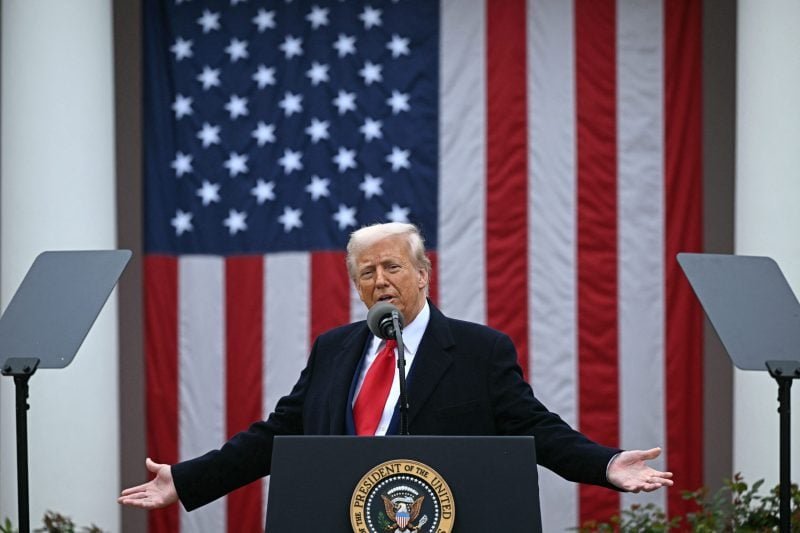
President Donald Trump sparked what could become a devastating worldwide trade conflict on Wednesday when he imposed 10% tariffs on goods imported globally and introduced stringent additional duties on major trading allies.
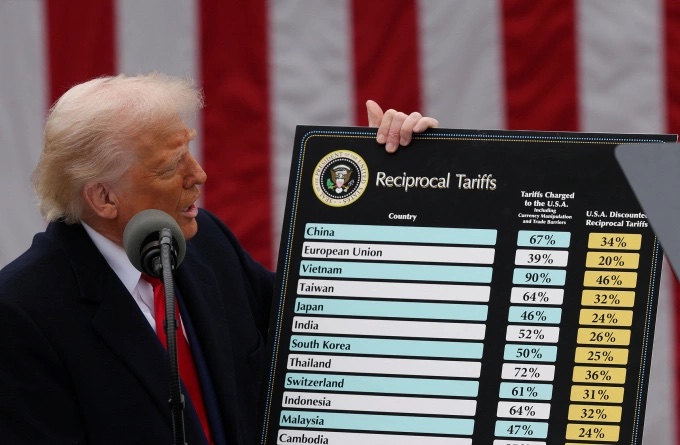
Displaying a chart detailing extensive measures in the White House Rose Garden, Trump announced stringent tariffs targeting key trading partners such as China and the European Union, referring to the day as “Liberation Day.”
|
|
U.S. President Donald Trump announced a series of tariffs on trading partners and rivals. The image was provided by AFP. |
In my view, this is one of the key dates in American history,” stated Trump. “Today marks our declaration of economic independence.
The announcement sparked instant outrage — with the United States’ ally Australia denouncing the tariffs as “not the gesture of a friend” — and prompted vows of reprisal from various countries worldwide.
The stock market appeared poised for significant fluctuations upon resuming trading on Thursday. American futures dropped sharply, and safe-haven gold reached an all-time high as investors grew wary.
Trump directed his harshest criticisms at countries he accused of mistreating the U.S., imposing tariffs such as 34% on products from geopolitical competitor China, 20% on items from the European Union, and 24% on goods from Japan.
As for the others, Trump stated that he would implement a minimum tariff of 10%, which would also apply to another major ally, Britain.
The 78-year-old Republican dismissed concerns about potential unrest, asserting that the tariffs would bring back a once-lost “Golden Era” for the U.S. economy.
“For many years, our nation has faced theft, destruction, rape, and plunder at the hands of countries close and distant, whether allies or adversaries,” Trump stated.
‘Make America wealthy again’
A carefully selected crowd consisting of cabinet members along with employees wearing hard hats from sectors such as steel, oil, and natural gas clapped and shouted enthusiastically when Trump stated that the tariffs would “bring wealth back to America.”
The broad auto tariffs of 25%, which President Trump declared earlier this week, were scheduled to come into force at 12:01 am (0401 GMT) on Thursday.
Trump labelled Wednesday’s tariffs “reciprocal” but many experts say his administration’s estimates for levies placed on US imports by other countries are wildly exaggerated
For several weeks, the U.S. president had hinted at this action, which raised concerns about an economic downturn domestically due to increased costs being borne by American consumers, along with potential harm from a trade conflict internationally.
US Treasury Secretary Scott Bessent cautioned countries against implementing retaliatory measures, stating on Fox News: “Should you choose to retaliate, it will lead to further escalation.”
Several Asian countries heavily impacted as trading partners included drops such as 49% for Cambodia, 46% for Vietnam, and 44% for Myanmar, under military rule and recently struck by a severe earthquake.
A White House official stated that Russia wasn’t impacted since it is already under sanctions related to the Ukraine conflict, which “rule out any significant trade.”
The tariffs will also reinforce fears that Trump is backing even further away from US allies towards a new order based on a vision of American supremacy.
‘Fight’
On Thursday, Australian Prime Minister Anthony Albanese stated that the tariffs were “completely unjustified.”
Italian Prime Minister Giorgia Meloni, who has aligned closely with former U.S. President Donald Trump, stated that the tariffs imposed on the European Union were “incorrect.” However, she affirmed her commitment to collaborate with Washington to reach an agreement.
The UK emerged largely unscathed following a diplomatic effort that saw Prime Minister Keir Starmer visiting the White House to present an invitation from King Charles III for a state visit, yet they still aimed to “alleviate” the imposed tariffs.
Canada and Mexico are exempt from the new tariffs because Trump has already penalized these two neighboring countries over his claims regarding their inadequate efforts to combat fentanyl drug smuggling and illegal migration.
The Canadian Prime Minister, Mark Carney, pledged to combat the current tariffs on steel, aluminum, and vehicles and to introduce retaliatory measures.
Brazil’s Congress responded by passing legislation permitting the government in South America’s biggest economy to address trade barriers.
Trump’s declaration just three months into his second term marks the end point of a longstanding romance with tariffs, which he has viewed for years as a panacea for America’s trade deficits and economic problems.