


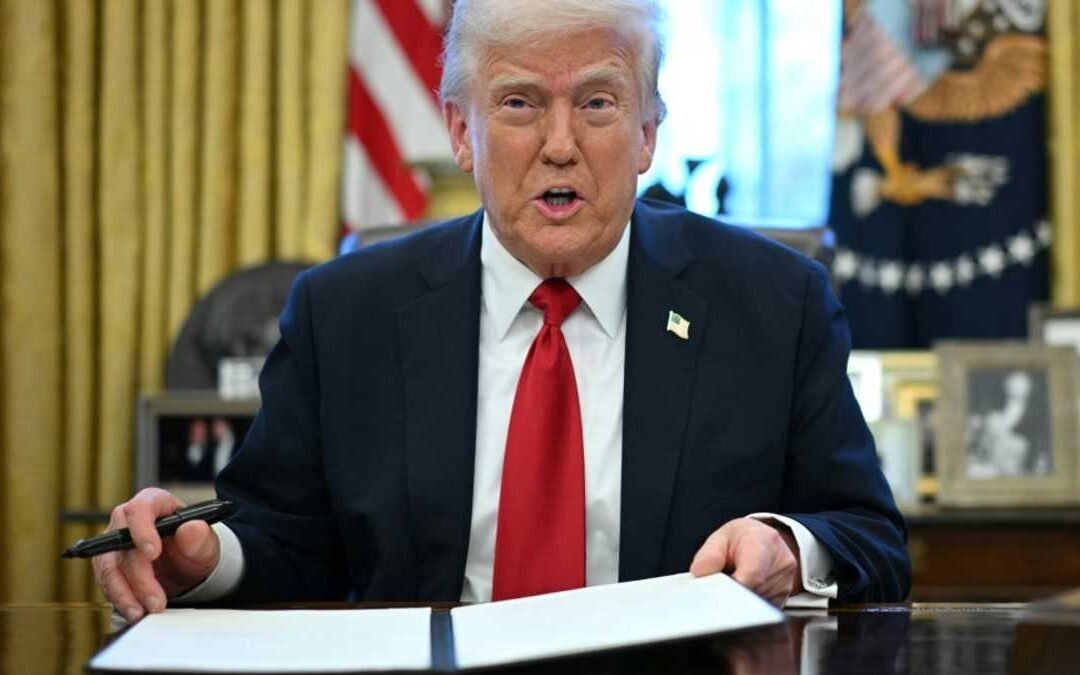

On Thursday, major global powers condemned U.S. President Donald Trump’s significant tariffs imposed on imported cars and auto components, threatening countermeasures as trade disputes escalate and potential price increases loom ahead.
Germany, a major car exporter, called for strong action from the European Union, whereas Japan stated it will “examine every possible option.”
On Thursday, Canadian Prime Minister Mark Carney stated that the traditional partnership characterized by strong economic, defense, and military connections with Washington has ended. He also mentioned anticipating conversations with Trump within the coming days.
The 25 percent tariffs imposed by the U.S., set to begin on April 3 at 12:01 am (0401 GMT), will affect imported automobiles, light trucks, and car components.
Specialists caution about increased expenses for vehicles, with the Italian automotive company Ferrari announcing price hikes of up to 10 percent on numerous models sold in the U.S., effective next week.
The global stock market experienced a significant downturn, with major car manufacturers such as Toyota, Hyundai, and Mercedes leading the decline. On Wall Street, General Motors’ stocks dropped sharply, followed by declines in both Ford and Stellantis shares.
The French Finance Minister Eric Lombard stated that the sole solution for the European Union is to “impose higher duties on goods coming from America as a countermeasure.”
Carney, who previously described the tariffs as a “direct assault” on his nation, stated that he organized a gathering to explore various trade possibilities. Meanwhile, Mexico’s Economy Minister Marcelo Ebrard mentioned that he aimed to secure “special consideration” for his country.
Trump intensified his warnings overnight, stating on social media that Canada and the EU might encounter “much higher” tariffs if they collaborated “to inflict economic damage upon the USA.”
Price surge
According to JPMorgan analysts, the tariffs imposed on vehicles and components might lead to an uptick in average car prices ranging from $4,000 to $5,300.
Approximately 82 percent of Ford’s U.S. sales come from vehicles made domestically, compared to Stellantis with 71 percent and General Motors with 53 percent.

The American Automotive Policy Council, which represents the major three car manufacturers, cautioned that tariffs should be imposed in a manner that “does not increase costs for customers” and maintains the sector’s competitive edge.
Brian Kingston, the president of the Canadian Vehicle Manufacturers’ Association, stated that these measures would result in increased expenses for both manufacturers and consumers, along with “an industry that is less competitive.”
Although Trump utilized emergency economic measures for previous tariffs, his automobile duties expanded upon an investigation concluded in 2019.
‘Cheaters’
Approximately fifty percent of vehicles purchased in the United States are domestically produced. When it comes to imported cars, roughly half originate from Mexico and Canada, while Japan, South Korea, and Germany remain key exporters as well.
The White House suggests that for American-manufactured vehicles, the typical domestic content probably hovers around 40 percent.
On Wednesday, top trade advisor Peter Navarro criticized “foreign trade cheats,” accusing them of transforming America’s manufacturing industry into a “low-wage assembly line for imported components.”
He targeted Germany and Japan for keeping the production of more valuable components within their own borders.
After reassuming the presidency in January, Trump has levied tariffs on goods imported from key trade allies such as Canada, Mexico, and China, along with a 25 percent tax on steel and aluminum products.
The newest tariffs build upon those previously imposed on vehicles.
However, the White House also noted that cars coming into the United States as part of the US-Mexico-Canada Agreement (USMCA) could be eligible for a reduced tariff based on the percentage of American-made components they contain.
USMCA-compatible automotive components will stay exempt from tariffs as authorities set up a method to address their non-US origin materials.
The Mexican President, Claudia Sheinbaum, stated that imposing tariffs went against the North American trade agreement. However, she mentioned that Mexico would hold off on taking action until early April.
‘Devastating impact’

Ambiguity surrounding Trump’s trade strategies and concerns that these might prompt an economic decline have unsettled financial markets, coinciding with a drop in consumer confidence.
Trump has supported tariffs as a means to increase governmental income and rejuvenate American manufacturing.
Aiming at imported vehicles might put pressure on relationships with Washington’s partners, though.
“Wendy Cutler, who serves as the vice president at the Asia Society Policy Institute and previously worked as a US trade negotiator, stated that levying 25 percent duties on imported vehicles would severely affect numerous key trading allies of ours,” she explained.
In addition to cars, Trump is mulling over specific industry tariffs, which could include those on medicines, chips, and wood.
He has pledged a “Freedom Day” for April 2nd, during which he plans to introduce proportional tariffs aimed at various trade counterparts, designed to counteract what are considered unjust practices.