by admin | Mar 30, 2025 | military, military aircraft, russian, russian armed forces, russian politics
On Thursday, a Russian surveillance plane was spotted close to the northeastern coastline of Germany and subsequently accompanied by two German Air Force Eurofighter fighter jets.
Spotted over the
Baltic Sea
, the Russian aircraft (a model IL-20) was not emitting a transponder signal, which is utilized for identification purposes, according to reports.
Le Figaro
The inactive state of the aircraft’s transponder indicates
a significant threat to non-military aviation,
says the German daily
Bild
.
As a result, two Eurofighter jets were dispatched to intercept the “unidentified” aircraft originating from the Rostock-Laage airbase. This event underscores the rising geopolitical strains within the area.
A swift response
In order to maintain the security and integrity of its airspace, the German Air Force responded quickly. Following interception, the Russian Ilyushin IL-20 altered course and moved toward Kaliningrad, which is where it had initially been identified.
As a reminder, in mid-March, the prospective German Chancellor
Friedrich Merz
claimed that the substantial military funding program to rebuild Germany’s armed forces was warranted due to the necessity of combating the “war against Europe” initiated by Moscow.
(MH with Manon Pierre – Source: Le Figaro/Bild – Illustration: ©Unsplash)

by admin | Mar 30, 2025 | art, artwork, culture, exhibitions, poland
Over 150 pieces such as paintings, drawings, and prints from the 19th and 20th centuries are currently being exhibited in Japan. This collection has been referred to as a ‘treasure trove’ featuring some of the most renowned instances of Polish Modernism.
The exhibition holds significant importance for Polish-Japanese cultural ties. For the first time in the Land of the Cherry Blossoms, it offers an opportunity to display artworks that form the core of our national heritage,” stated Polish Minister of Culture and National Heritage Hanna Wróblewska at the formal unveiling ceremony.
Dr. Andrzej Szczerski, the director of the National Museum in Krakow, where many examples of artisanal crafts are displayed regularly, commented that this event marked “the biggest exhibition of Young Poland’s art ever held in Japan.”
“The numerous audience and media representatives who attended the opening emphasised the artistic importance of the works on display and the significance of the exhibition, showing how the art of Young Poland was able to express both national content and speak the universal language of art,” he said.
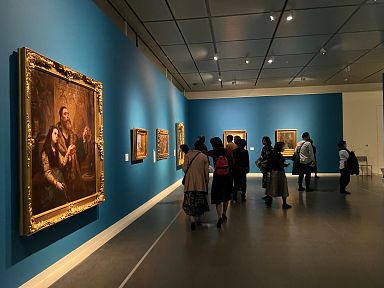
The exhibition takes up the whole floor at MOMAK (The National Museum of Modern Art, Kyoto), and it is organized around various themes that touch upon inspirations derived from nature, history, Japanese culture, and Polish national style.
Polish modernist masterpieces in the center of Japan
“The narrative presented here revolves around Polish history; its opening chapter is depicted through the creations of Jan Matejko and Artur Grottger. However, most importantly, this period is illuminated by the contributions of Young Poland’s artists. During the transition from the 19th to the 20th century, these artists were instrumental in forging a sense of national identity and ensuring that Poland remained prominent and influential within European artistic circles, even when it was absent as a nation-state on world maps,” states the exhibition catalog.
Included among the displays are creations by esteemed Polish artists like Olga Boznańska, Jacek Malczewski, Józef Mehoffer, Władysław Podkowiński, Józef Pankiewicz, and Stanisław Wyspiański.
Among the artworks visitors can enjoy are Włodzimierz Tetmajer’s “The Artist’s Family,” Leon Wyczółkowski’s “Stańczyk,” and Józef Pankiewicz’s “Czeszysta.” Also featured are several works by Jacek Malczewski such as his ‘Portrait of Feliks Jasieński,’ ‘Girl with Chrysanthemums’ and ‘Florists’ created by Olga Boznańska. Additionally, you’ll find pieces like Alphonse Karpinski’s “Jane with a Japanese Doll” along with various paintings from Wojciech Weiss including “Musicians on the Bridge”, “Poppies,” and “Fears”. Lastly, there is “The Bearded Woman” painted by Władysław Ślewiński.
At the MOMAK exhibition, you can also see two previously unexhibited works by Boznanska: “Tulips” and “Mrs. L’s Portrait.” These pieces were acquired during the artist’s lifetime by Magosaburo Oohara, a renowned Japanese businessman, art collector, and benefactor. Today, they form part of the holdings at the Ohara Museum of Art in Kurosaki, Japan, which houses the entirety of Mr. Oohara’s collection.
The ‘Young Poland’ movement – characterized by revolt, liberty, and self-expression
As art historian and founder of the ‘Outside the Frame’ platform, Maja Michalak points out that Young Poland represents a distinctive and highly varied era in painting. Similar to movements like Young Germany or Young Scandinavia, various regions across Europe adopted analogous names for their artistic trends, aiming to highlight the novelty and pioneering spirit inherent in these styles at the time.
“During this period, the hallmark was the expression of defiance, the urge for liberty, and the aspiration to view art from a new perspective. This also enabled them to showcase what mattered most to each individual artist,” explains Michalak.
“The artists focused more on expressing their personal uniqueness by incorporating the multiple overlapping styles from that era: Art Nouveau, Impressionism, Symbolism, as well as Expressionism. Each artist displayed these influences in somewhat distinct manners,” she explains.
The allure of ‘Japonism’ — a passion that bridged two civilizations.
One distinctive feature of the exhibition in Kyoto is the chance to explore how Japanese aesthetic principles impacted Polish artists over a hundred years ago.
Michalak points out that we must discuss the prevalent Japonisme during this period, an intense attraction to East Asian artistic styles, which captivated many artists. They incorporated various aspects like fans and kimonos—items being brought over and depicted in their works—as well as themes such as dragonflies and peacocks, symbols closely linked to Asian traditions. Additionally, they adopted compositional techniques involving diagonals and increased asymmetry, concepts borrowed from Japanese woodblock prints.
Urszula Kozakowska-Zaucha, the curator of the Kyoto exhibit, highlights the significant contribution made by a prominent Polish art critic and collector toward introducing Japanese art to Poland: “These exceptional artworks are displayed alongside Japanese woodblock prints, illustrating the connection between Polish art and Japan. A key figure featured prominently in this exhibition is Feliks ‘Manggha’ Jasieński, an influential art collector whose personal collection merits its own segment. His enthusiasm for gathering such pieces and his close ties with the Young Poland artists from Kraków helped popularize Japonisme within their circle.”
Jasieński gathered exemplary pieces of Japanese art for his collection, making these works accessible to artists who could borrow them when needed. Ultimately, in 1920, he contributed his complete art collection to the National Museum in Krakow.
He also enlisted artworks from artists influenced by Japan, whom he adored, notes Michalak. The pairing of Young Poland and Japan in this exhibit is intentional. This arrangement could facilitate interaction between the Japanese audience and these pieces since they would recognize cultural components familiar to them.
‘Girl with chrysanthemums’ – the symbol of the exhibition and Boznanska’s renaissance
The promotional materials for the exhibition showcased Olga Boznańska’s painting ‘Girl with Chrysanthemums,’ which stands out as one of the era’s most renowned pieces from the Young Poland movement. This selection appears intentional—Boznańska enjoys renewed acclaim after her passing, and her nuanced, introspective portraits resonate well with modern audiences. Notably, within the animated promotion for the exhibit, the once somber young girl depicted in the artwork now beams joyfully.
Olga Boznańska stands among those female artists who dedicated their entire lives to artistic creation,” says Michalak. “She sought equal chances for creativity just like men do and wished to receive similar treatment from society.” The art critic further notes, “Her career was her top priority, showcasing her strong resolve in this pursuit.
Boznańska lived primarily in Paris, where she gained significant recognition for her emotionally charged portraits that were rich with psychological insight.
“The style of painting is highly distinctive and symbolic of Boznańska’s work. Her skillful technique captures an intimate closeness to the subjects depicted, infused with deep emotional resonance. This approach can be likened to how the Baroque painter Diego Velázquez wielded his brush; indeed, Boznańska drew inspiration from him as well as contemporaries like Édouard Manet, James McNeill Whistler, or Berthe Morisot. Such psychologically nuanced portraiture is quintessential to Olga Boznańska’s legacy,” explains Michalak.
“Generally speaking, I believe that the period known as Young Poland represents one of the finest eras in our country’s artistic history, particularly within Polish painting,” states Michalak. “This era boasts an impressive array of artists whose work is captivating both for its historical significance and the messages they sought to communicate, as well as for its aesthetic value and visual appeal. Be it works by Boznańska, Pankiewicz, Mehoffer, or Ślewiński—these masterpieces exemplify exceptional artistry. In my view, such talent ought to serve as our nation’s cultural ambassador and become synonymous with high-quality Polish paintings internationally.”
The exhibition titled “Young Poland: Polish Art 1890-1918” will remain open in Kyoto up until June 29th.

by admin | Mar 30, 2025 | benjamin netanyahu, gaza israel conflict, israel and the gaza strip, news, politics
The Israeli Prime Minister stated that military actions against Hamas were proving effective, yet he noted some fissures appearing within the negotiation process. He further emphasized that Israel would guarantee safety in Gaza to facilitate President Trump’s contentious proposal.
Israel’s Prime Minister Benjamin Netanyahu stated on Sunday that the country’s ongoing military pressure against the Palestinian militant organization Hamas in Gaza has proven effective.
During a Cabinet meeting, Netanyahu stated that the organization, which is considered a terrorist group by Israel, the United States, Germany, and other countries, needs to disarm.
The remarks from the Israeli prime minister were made against the backdrop of ongoing mediation attempts by Egypt, Qatar, and the United States aimed at securing a truce in Gaza. These negotiations also seek to ensure the liberation of the remaining captives still being held by Hamas.
On Sunday, Israel carried out attacks in Gaza as Muslims marked the beginning of Eid al-Fitr, resulting in at least eight fatalities in the southern region of Khan Younis, among whom were five children.
Netanyahu states that talks for the hostages’ liberation are continuing.
Netanyahu refuted claims that Israel wasn’t involved in talks intended to free hostages seized by Hamas following their assaults on southern Israel starting October 7, 2023, which resulted in the deaths of 1,200 Israelis and left 251 individuals captive. According to Israeli authorities, out of the 59 remaining captives, approximately 24 are believed to be alive.
“Negotiations are underway amid intense pressure,” Netanyahu stated, asserting that their approach to talks has proven effective. “Signs of fissures are starting to emerge” regarding the demands made by the group during discussions.
Israel has conducted aerial and subsequent ground operations in Gaza, where health officials under Hamas control report that more than 50,200 Palestinians have lost their lives since the attacks of October 7.
A delicate truce emerged, bringing about several weeks of comparative peace in Gaza—the region’s first such lull in more than twelve months—along with the freeing of numerous Israeli captives.
collapsed on March 18
When Israel restarted its aerial and land assaults on the Palestinian territories.
On Saturday, a high-ranking Hamas representative stated that the organization had endorsed a fresh truce suggestion presented by intermediaries, calling upon Israel to back it.
Netanyahu’s office subsequently verified that they had received the proposition, stating that Israel had presented a counter-proposal “in close cooperation with the United States.”
Netanyahu states Israel will secure Gaza to facilitate Trump’s proposal.
Netanyahu additionally stated that Israel would guarantee overall security in Gaza and “facilitate the execution of
the Trump plan
— the voluntary migration plan.”
“The plan is clear; we aren’t hiding it, and we’re prepared to talk about it whenever,” stated Netanyahu, who also mentioned that “leaders of Hamas will have permission to exit Gaza.”
The contentious proposal was introduced by U.S. President Donald Trump soon after he assumed office. The initiative seeks to relocate the Palestinian inhabitants of Gaza to nearby nations, primarily Egypt and Jordan, with the ultimate objective of transforming the war-torn territory into an American-managed tourist destination.
A week ago, Israel’s Cabinet agreed to propose the creation of a new unit aimed at facilitating the “voluntary relocation” of Palestinians from Gaza.
Trump’s proposal has faced broad rejection, particularly from Palestinian groups.
neighboring Arab countries
.
Egypt has taken the lead in launching a campaign
to present an alternative plan that ensures Gaza’s rebuilding without causing the relocation of its residents.
The people of Gaza assert their determination not to abandon their homeland, whereas the United Nations has cautioned that the U.S. proposal might lead to ethnic cleansing and contravene international law.
rmt/sms (AFP, Reuters)
by admin | Mar 30, 2025 | controversies, news, politics, politics and law, protests
Economic hardship and authoritarian rule: The widespread demonstrations in Istanbul are not only due to the detention of Mayor Ekrem İmamoğlu; they also reflect increasing dissatisfaction with Turkey’s financial downturn.
Was the detention of Istanbul Mayor Ekrem İmamoğlu the final straw? This past weekend, tensions escalated further.
mass protests in Turkey
with millions showing their
resentment towards President Recep Tayyip Erdogan’s administration
.
“We’re battling not only for Ekrem but for the whole of Turkey,” he stated.
Dilek Imamoglu
, whose husband is an incarcerated opposition politician, with tears welling up in her eyes.
We need to support one another; we form a vast family of 86 million individuals. Justice should not be confined.
Economic situation unbearable
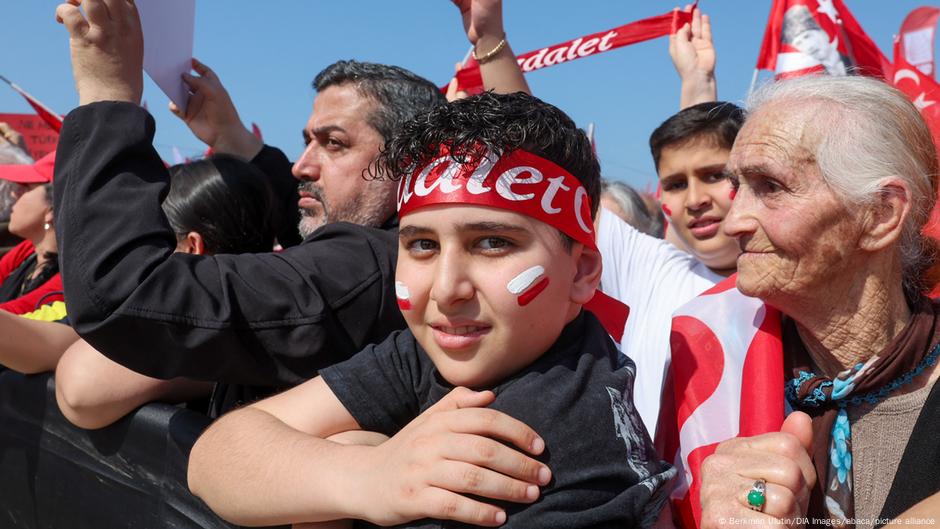
An older demonstrator highlighted the economic downturn, stating: “Individuals from various socioeconomic backgrounds are joining the protests. A key factor is the lack of food in their kitchens.”
The financial circumstances have grown intolerable for numerous people across Turkey. The nation has been grappling with an economic downturn for quite some time now. As a result, citizens face escalating prices and steep housing costs.
As reported by the Turkish Statistical Institute (Tuik), the yearly inflation rate was recorded at 42% in January this year. Moreover, the value of the Turkish lira has decreased. Consequently, numerous senior citizens and retirees find themselves unable to cover their housing costs for the places where they reside.
Nearly 2,000 arrests
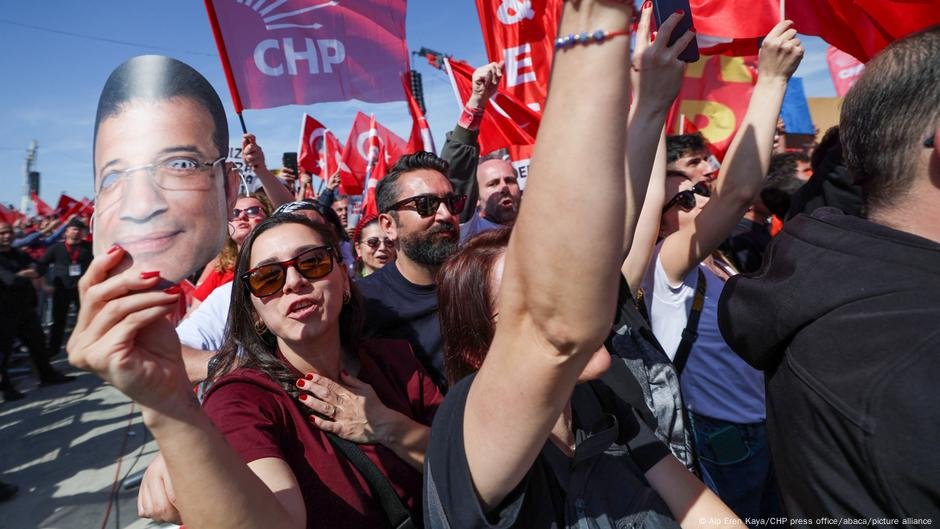
The demonstration scheduled for Saturday was organized by the Republican People’s Party (CHP), an opposition group of which Imamoglu is part. The attendees alleged that Erdogan aimed to remove Imamoglu from politics using judicial means.
![]()
Ever since the start of demonstrations following Imamoglu’s arrest on March 23, a cumulative total of
1,900 individuals have been detained
According to the Turkish Interior Ministry, most of those detained were students. Among them were journalists, such as Swedish reporter Kaj Joakim Medin from the daily newspaper Dagens ETC, who intended to cover the protests in Istanbul. Previously, BBC correspondent Mark Lowen was also held.
At the rally, which reportedly attracted over two million attendees, CHP leader Ozgür Ozel stated that this struggle is for Turkey,” he clarified. In contrast, Turkish President Recep Tayyip Erdogan characterized the demonstrators as “minor fringe groups.
The national anthem to symbolize unity
Even after the conclusion of Ramadan, crowds took to the streets in protest. An elderly woman, aged 85, shared with SANGGRALOKA, “In all my years, I’ve never faced such tyranny.” She continued, “I’m protesting for the republic, for Atatürk, for the well-being of the people, to advance our era, and to break free from poverty.”
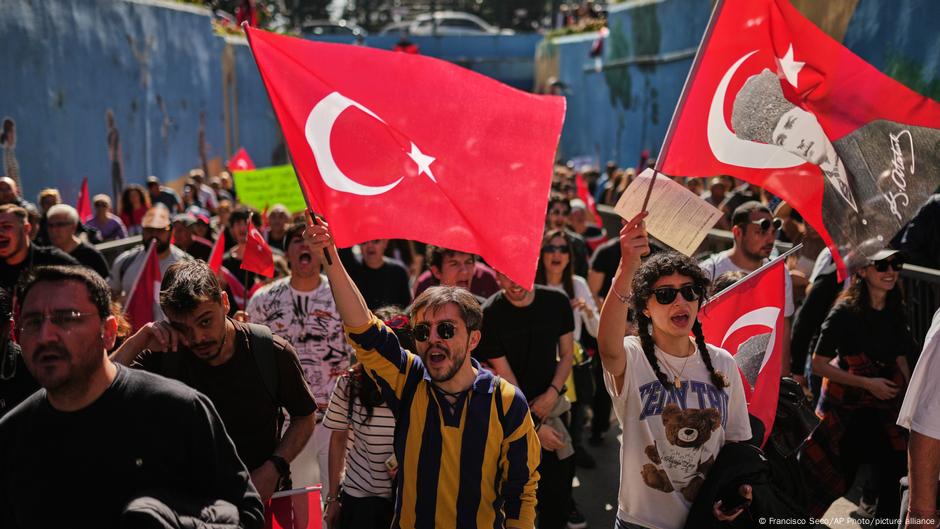
By performing the Turkish national anthem, demonstrators aimed to demonstrate their solidarity. In addition to Turkish flags and CHP party banners, placards from allied political groups, labor unions, and various civic associations were displayed. Participants included university students, retirees, employees, educators, and public sector workers.
A 17-year-old student participating in the rally alongside his father and other family members shared with SANGGRALOKA, ‘We are receiving unfair treatment.’ He continued, ‘Our future is being stripped from us, and our youth is disappearing. This is why I am here.’
Various political parties joined the demonstrations, among them being the pro-Kurdish DEM Party. A member stated to SANGGRALOKA: “Our struggle is for the liberation of Ekrem Imamoglu, Selahattin Demirtas, Figen Yuksekdag, and all those held as political prisoners.” They added, “The fight continues for the release of incarcerated students too.”
It appears clear that one significant development this year is the massive protests occurring in Turkey. Nearly 22 years since Erdogan assumed his role as Turkish Prime Minister back in 2003, the struggle for democracy and legal justice within the nation has reignited once more.
The original version of this article was penned in German.
Author: Erkan ARIKAN, Pelin ÜNKER gıda

by admin | Mar 30, 2025 | cricket, indian cricket, indian cricket players, international cricket, sports
By Vivek Prabhakar Singh
On Sunday, Indian fast-bowling legend Umesh Yadav commented on the removal of the saliva ban in the Indian Premier League (IPL). He mentioned that this change would be beneficial for bowlers in one-day games, particularly when using a brand-new ball. This statement was made from Greater Noida, Uttar Pradesh, India, as reported by ANI on March 30.
Umesh attended an AstroLawn event in Greater Noida.
Regarding the saliva ban, Umesh commented, “It could have an impact on white-ball cricket. However, it may vary depending on circumstances, as some evening games see the ball become damp from dew, making saliva irrelevant then. Yet when the ball is fresh, spit can be quite significant… Therefore, I believe this return is a positive move. It will greatly benefit fast bowlers.”
Regarding Jasprit Bumrah, the leading fast bowler for India, Umesh stated that he is presently the finest cricketer of this era, entirely due to his “dedication, training, and strategic mindset.”
“When you possess such talent, it’s crucial to display it effectively. Since Bumrah joined us, and as he has developed over time, he has consistently aimed to improve himself. This dedication is what places him at this elite level today. His success stems from his relentless efforts, rigorous training, and strategic mindset. Ever since he began participating in the IPL and collaborated with Lasith Malinga, his Yorkers became even more formidable. In just a brief period, he absorbed numerous lessons which helped elevate him to become the finest fast bowler of our era,” explained Umesh regarding his colleague.
Regarding the concern that T20 matches have turned overly favorable for batsmen, Umesh stated that this format will inherently favor batters since the ball doesn’t wear down significantly and rarely exhibits reverse swing.
“Short-format games like T20 have consistently favored batsmen. During these matches, the ball rarely swings or reverses after just 20 overs. Additionally, with only limited overs played, the cricket balls aren’t subjected to enough wear and tear to alter play significantly. White balls tend to behave similarly throughout the innings without much movement off the pitch. Poor performance can lead to conceding many runs quickly in such formats. However, precise execution along with accurate lines and lengths usually yields positive outcomes. A total of 280 might indicate subpar bowling efforts rather than exceptional batting alone. This format will likely continue being dominated by bat-wielding players. Teams participating in leagues like the IPL aim primarily at scoring high totals,” explained Umesh.
Regarding MS Dhoni batting at number nine during a Chennai Super Kings (CSK) home game against Royal Challengers Bangalore (RCB), Umesh stated, “The decision rests with either the team or Dhoni personally. They determine his spot.” (ANI)
Provided by Syndigate Media Inc. (
Syndigate.info
).