



Switzerland’s Mammogram Ban: Fact or Fiction?
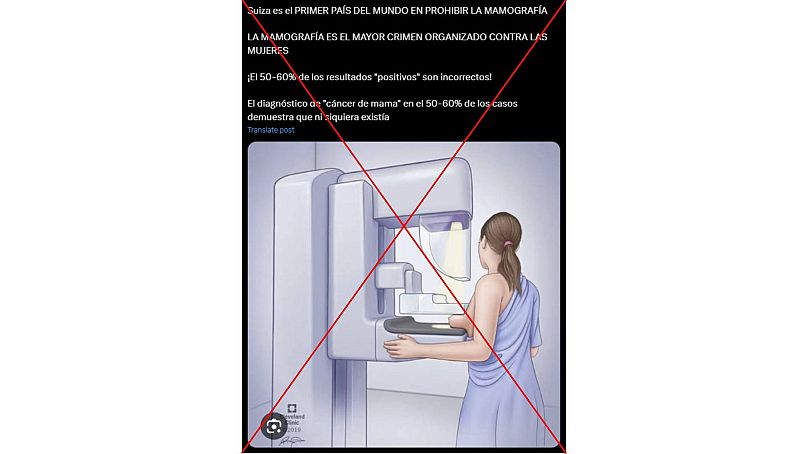
Misunderstandings are proliferating on the internet due to strange rumors regarding an alleged prohibition of mammography exams in Switzerland.
For several months, social media users have maintained that the nation has banned the procedure out of worries about its safety. One common assertion is that mammograms lead to breast cancer because patients are exposed to radiation during the examination.
Furthermore, numerous social media posts claim that 50% to 60% of mammography results yield false positives, causing undue stress and unwarranted medical intervention.
All of these statements are untrue.
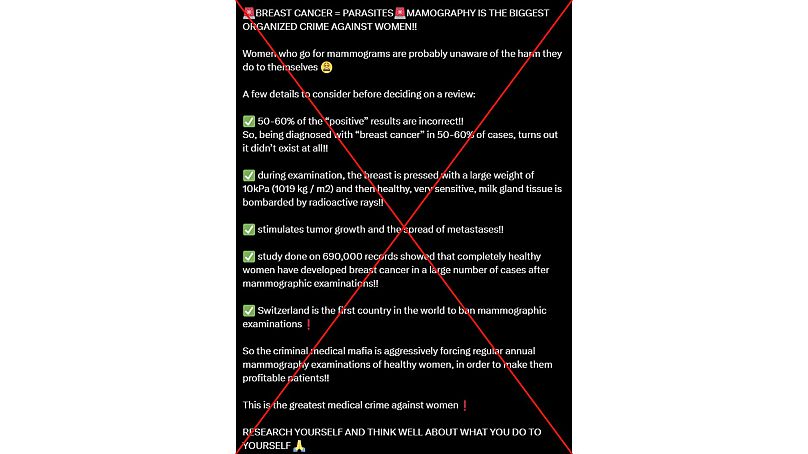
EuroVerify contacted the Swiss Federal Office of Public Health, which verified that there isn’t a ban on mammography exams in Switzerland.
“A representative from the office stated via email, ‘The screening programs are organized by the cantons,’ adding that mammogram recommendations start at age 50,” the communication read.
Various fact-checkers from different news organizations have also refuted these claims when they surfaced on social media in earlier months.
What do you make of the assertions that mammograms can be harmful?
A major misrepresentation circulating on social media is the claim that the radiation involved in mammograms substantially raises the risk of cancer among women.
According to the experts EuroVerify consulted, this assertion does not hold true.
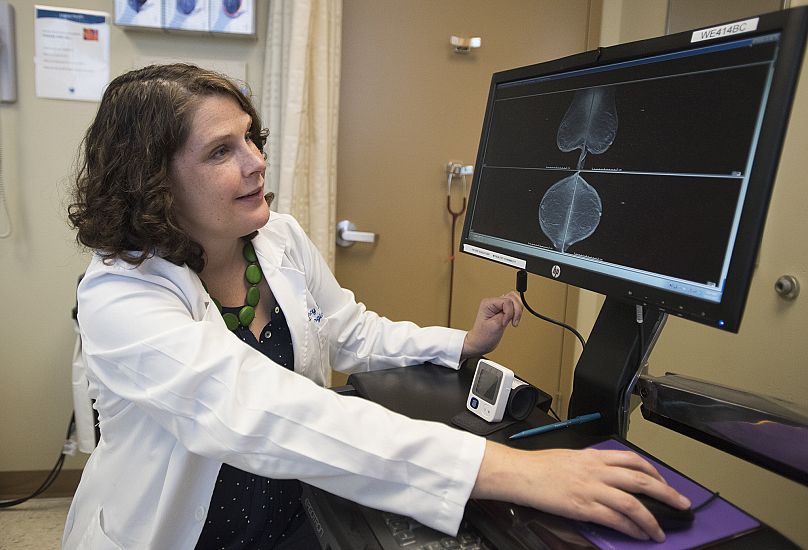
Dr. Evandro de Azambuja, who leads the Medical Support Team at the Jules Bordet Institute in Anderlecht, clarified that mammograms actually expose patients to very little radiation.
“If they adhere to the stringent guidelines suggested by [… ] agencies, the dosage will be minimal,” he stated. “Therefore, there’s no danger of developing cancer due to the radiation from the mammogram.”
Although certain research indicates that excessively frequent testing might marginally raise the risk of cancer, regular screenings typically do not present an issue.
To provide some context, Julia Schwarz, an expert in early detection at the Swiss Cancer League in Bern, pointed out that there are cases where “a flight attendant might be exposed to more radiation over the course of a single year than what you would receive from a mammogram.”
Are the screening tests known for producing a lot of false positive results?
A frequently shared assertion on the internet suggests that as much as 60% of mammography outcomes result in false alarms, prompting additional examinations and medical interventions unnecessarily. However, this figure is deceptive.
As stated by Dr. Partha Basu, who leads the Early Detection, Prevention and Infections Branch at the World Health Organization’s International Agency for Research on Cancer in Lyon, encountering false positives during screenings is common, but receiving one does not equate to a definitive diagnosis.
“He explained that we must recognize the distinction between a screening test and a diagnostic test. A diagnostic test, such as obtaining a biopsy, requires an extremely high degree of precision,” he stated.
“A screening test is merely intended to pinpoint individuals with a heightened likelihood of having a disease from those with a lower probability,” he explained. “This is precisely why it’s crucial for women who receive a positive result on their mammogram to undergo further investigation at the earliest opportunity.”
According to Schwarz, women should be informed about the possible risk of receiving a false positive result prior to having a mammogram.
She mentioned, ‘They should be aware that there’s a possibility.’ It may not be a high probability, but it could occur […]. One positive aspect of early detection is that the likelihood of recovery is quite significant.’
Why are mammograms important?
Certainly, it’s the early detection provided by mammograms that makes them so effective, as stated by the experts interviewed by EuroVerify.
Despite the incorrect assertions, mammograms remain among the most effective methods for detecting breast cancer at an early stage, as stated by Basu, who also pointed out that all medical procedures, though minor, come with a slight inherent risk.
Taking a paracetamol tablet still carries some risks,” he stated. “Thus, we always assess the risk against the benefits. The advantages of mammograms are significant: they decrease breast cancer deaths by 40%.
Azambuja reiterated this view, pointing out that mammography decreases the overall mortality rate since “early detection of cancer significantly improves the patient’s outlook.”
They similarly suggested performing self-examinations as an effective method for detecting breast cancer at an early stage, despite it being less dependable than a professional breast cancer screening.
“Combining mammography with breast self-examinations ensures that women receive an early diagnosis for breast cancer,” according to Basu.