by admin | Aug 31, 2025 | greece, hiking, hiking trails, Travel, travel destinations
Curving through the Aegean Sea and rugged hills, the Palia Strata provides an impressive route across the island of Amorgos, located in the Eastern Cyclades. This challenging yet memorable trek allows each step to uncover a landscape that remains wild and unspoiled.
The Palia Strata, a donkey path winding alongside the cliffs
On Amorgós, in the
Cycladic archipelago
The Palia Strata trail connects Chóra with Langada, traversing the island’s dry terrain and fertile hills emerging from the Aegean Sea. This ancient route has been traditionally utilized by shepherds to access remote settlements, running along the crest before slowly descending toward northern communities. Over a distance of 14.5 kilometers, you will travel through a network of dirt trails, terraces, empty highlands, and old agricultural properties. The blend of ocean vistas and interior landscapes turns this into one of the most enchanting hikes available in the Cyclades.
Beginning in Chora, at the center of the Amorgos mountains
The journey begins at Chora, situated 400 meters above sea level, located in the hilly heart of Amorgos. The trail starts from the main road heading toward the coastline, climbing old stone steps. Soon, structures transition into short walls, along with clusters of prickly pears and juniper bushes. From here, the Aegean Sea becomes visible below. The route gradually descends, passing through deserted farming areas and rocky enclosures, alongside some lone chapels, until arriving at a cliff face offering views of the southeastern shoreline.
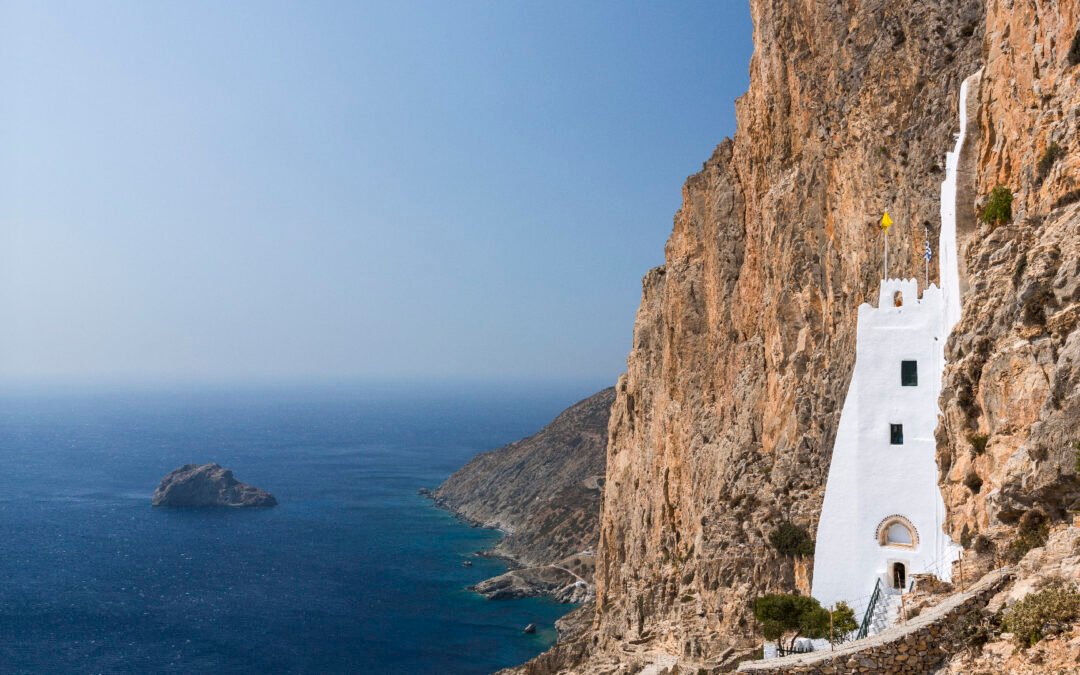
Chozoviotissa, a monastery situated above the ocean
After two kilometers, the trail arrives at
one of the most remarkable places in Amorgos
The Monastery of Chozoviotissa. Constructed in the 11th century.
th
A monastery perched on a cliffside, accessible through a steep staircase etched into the rock 300 meters above the ocean — the sense of solitude intensifies with each step upward. Within, a slender chapel, several small rooms, and some Byzantine icons bear witness to a continuous spiritual tradition spanning nearly a millennium. From the balcony, the panorama extends over the Aegean Sea, encompassing the islands of Nikouria and Keros to the north.
From Kapsala to Asfondilitis, following the path of Amorgos’ shepherds
Following the monastery, the Palia Strata heads further northeast. The trail ascends across rocky ground and passes the remains of Kapsala, once a high-elevation settlement featuring some ruined sheep pens. You will then arrive at Asfondilitis, an empty village famous for its dry-stone walls and simple carvings. From 1897 until 1943, a lone herdsman named Michalis Roussos chiseled images of women, flower patterns, crosses, and names onto the flat stones along the road.
While descending towards Potamós, a terrace offers a view of the Bay of Aegiali
The path follows the coastal road before easing into a more gradual climb as you near Potamós, a small settlement perched above the Bay of Aegiali. The scenery slowly transforms here, featuring short, neatly maintained stone walls, stepped agricultural areas, and clusters of olive trees. Down below, the harbor of Aegiali and its whitewashed homes create a busier section of the region. Potamós stays a peaceful hamlet, boasting some meticulously renovated buildings, tight stairways, and unbroken vistas across the northern hillsides of the island.
Last part of the coastline approaching the village of Langada
The final part traces the shoreline along a terrace all the way to Langada, located on the northeastern shore of Amorgos. As you follow the incline, you encounter groves and some farmland. The village gradually becomes visible, situated on the hillside and overlooking Mount Krikellos. Charming and famous for its great eateries, Langada maintains its classic design, featuring stone-paved roads, steps, and tiny churches. From the central plaza, you may descend towards the Araklos Gorge or ascend to the walled church of Agía Triáda perched atop a cliff.
Key details to consider before departing
The Palia Strata trail is ideally hiked from April through October, when the weather is most suitable. Plan for an outing lasting anywhere between four and a half to five and a half hours, based on your walking speed and how often you stop. The path isn’t consistently marked, making it advisable to carry a map or utilize a GPS application to ensure you remain on course. During summertime, temperatures along this route can rise rapidly without any shelter or access to water sources. Starting your journey early in the day, preferably before 9 am, helps you escape the peak heat. Wearing appropriate shoes is crucial too, since certain parts of the trail are quite narrow, others are steep, and many areas may be slick because of worn-out stone surfaces.
Amorgós
www.amorgos.gr

by admin | Aug 15, 2025 | disasters, greece, incident, natural disasters, tragedies
Three individuals, among them two visitors from Vietnam, lost their lives in Greece on Friday when strong winds fueled wildfires and caused disruptions to ferry services affecting tens of thousands of vacationers during the summer season.
Over 200 firefighters, supported by 11 aerial water tankers and seven helicopters, were fighting a fire near Keratea, south of Athens, according to Costas Tsigkas, president of the association of Greek firefighting officials.
ERT
state television.
“He mentioned it was a challenging blaze,” he stated, referring to strong winds and noting that multiple areas had been vacated.
Firefighters found the remains of an older individual within their scorched house in Keratea, with strong winds affecting the operation of aerial firefighting units, according to Vassilis Vathrakogiannis, a spokesperson for the fire department, during a media update.
An
AFP
A journalist from the neighboring town of Palaia Fokaia, approximately 45 kilometers (28 miles) south of Athens, witnessed flames engulfing a home and dense smoke filling the atmosphere.
Emergency responders were running quickly to position hoses and extinguish the fire, as a helicopter flew above to release water.
Previously, another fire on the island of Cephalonia had been contained, according to local authorities, whereas Vathrakogiannis stated that conditions “have improved” on the Peloponnese peninsula located west of Athens.
The Ministry of Civil Protection stated that wind speeds could peak at 88 kilometers per hour, particularly in the southern Aegean region and the Sea of Crete.
The National Weather Service EMY stated that the wind speeds would decrease after midnight, yet the Civil Protection Ministry issued the highest wildfire alerts for multiple regions on Saturday, such as the Attica area, which encompasses Athens.
Earlier, the coast guard reported that a Vietnamese man and woman from a cruise ship tour group had passed away at Sarakiniko Beach on the tourist island of Milos in the Cyclades.
“A man and a woman were discovered lying unconsciously in the water and were transported to the nearby medical facility,” stated a spokesperson from the coast guard.
A woman slipped into the water, and the man seemingly attempted to rescue her.
‘Left stranded’
Strong winds forced numerous ferries to remain in port, disrupting the primary means of transportation that links thousands of islands and supports their vital tourism industry.
The coastguard stated that the majority of ferry services could not leave on time from Piraeus and other Athenian harbors, particularly heading towards the Cyclades or Dodecanese islands. Some trips were cancelled while others were delayed.
In Piraeus, many passengers gathered outside a boat heading towards the Cyclades’ islands of Paros and Naxos, hoping for updates about an upcoming sail.
Close by, travelers who were stuck gathered around backpacks and luggage, forming a long line outside a ticket counter, making urgent phone calls in an attempt to change their plans and salvage their trips.
“there are long queues, lots of chaos, everyone is waiting under the sun and it’s a really difficult situation,” said Philip Elias, an American visitor.
Maritime links with the Saronic islands close to Athens, such as Aegina, Hydra, Poros, and Spetses, along with the Ionian Sea remained undisturbed, according to the coastguard.
Greece typically experiences strong winds during this season, with fire crews having dealt with multiple significant fires this summer, such as those on the islands of Evia and Chios, along with incidents in the western part of the Peloponnese.

by admin | May 3, 2024 | beaches, beautiful places, greece, islands, travel destinations
Greece, with its numerous islands and islets organized into various archipelagos, offers an array of stunning locations. Whether you’re planning a short break or an extended stay, we’ve compiled a selection of the loveliest Greek islands across different groups — ranging from the well-known Cycladic gems like Santorini and Mykonos to the captivating spots such as Rhodes and Patmos in the Dodecanese.
The Saronic Islands, the island group at the entrance to Athens
Situated in the Aegean Sea, between Attica and the Peloponnese, lie the Saronic Islands, which are the ones nearest to Athens. The closest island can be reached within just under 40 minutes via hydrofoil from Piraeus, while the farthest takes no more than 2 hours and 30 minutes.
Hydra, the sophisticated and artistic island of the Saronic Gulf
In this vehicle-free haven, exploration is possible via a mule ride or a taxi boat journey. Otherwise, simply meander at will through undulating terrains adorned with traditional whitewashed fishers’ cabins, elegant manors, tiny monastic retreats, alongside sprawling pine and olive forests. Combining genuine charm with opulent comforts,
Hydra
enhances its sophisticated, international reputation, making it a favorite spot for celebrities and artists ranging from Brigitte Bardot to Mick Jagger.
Spetses, the elegant aristocrat of the Argolic Gulf
This bicycle-friendly island has been a favoured holiday destination for the Greek aristocracy for several centuries now. Land-wise, its vast pine forest offers some great walks, with hidden coves, isolated little churches and, on the higher ground, a 360° panoramic view of the Argolic Gulf. Sea-wise, the well-maintained beaches are very popular throughout summer, but the coves do not enjoy a similar popularity. In the evening, the best place to go is the harbour, home to the island’s main bars, hotels and clubs.
The Sporades are dispersed along the eastern coast of the Pelion peninsula.
Located northeast of Athens and situated off the eastern coast of the Pelion peninsula in the Aegean Sea, the Sporades island group can be accessed via ferry from the mainland cities of Agios Konstantinos and Volos, which are found in Thessaly.
Skiathos, the coastal haven of the Sporades
Skiathos, the tiniest gem among the Sporades islands, thrives during peak tourist season and boasts an abundance of attractions. Known for its bustling ports, crystal-clear bays, and numerous pristine sand beaches, the island’s primary allure stems from its coastal delights, sailing excursions, and vibrant evening scenes.
Skyros, an untamed, traditionally charming island
More isolated and untamed than its siblings, this one
A Greek island located in the Sporades group
It possesses a special allure. In the hillside town of Chóra, you can stroll along the twisting paths beneath a Byzantine stronghold, while further inland lie extensive untouched areas that will undoubtedly enchant nature enthusiasts and trekkers alike.
The Cyclades island group, the quintessential representation of the southern Aegean Sea
Located in the southern Aegean Sea, situated between Athens and Crete, the Cyclades archipelago comprises an array of islands that encircle the holy island of Delos, which lies approximately 150 kilometers south of Greece’s main city.
The crown jewel of the Aegean Sea, Santorini stands out as the premier island.
Nestled against the slopes of an old volcano, white settlements with azure rooftops meet winding paths along cliff edges. From western shores covered in black sands to southern stretches boasting red or pristine white gravel beaches, this place offers stunning vistas. You can relish locally sourced seafood on picturesque terraced areas, shop at chic stores, and lose yourself in nightlife at trendy bars until dawn.
Santorini
It stands as the most popular among the 24 inhabited islands of the Cyclades, and rightfully so!
The timeless ancient island of Delos remains unaltered by the passage of time.
This small island at the heart of the Cyclades boasts neither residents nor accommodations; visitors’ sole purpose for coming here lies in exploring this sacred site, believed to be the legendary birthplace of Artemis and Apollo. Throughout the island, one can uncover remarkable archaeological treasures such as the remnants of Apollo’s sanctuary, the imposing lion statues on Lion Hill, and the opulent mansions within the Theater Quarter—all testaments to the grandiose Hellenistic legacy of Delos.
Mykonos, the chic and lively party destination within the Cyclades archipelago.
Boasting whitewashed buildings converted into upscale hotels cascading towards the ocean, a maze of streets filled with vibrant bars, and bustling beaches teeming with life around the clock, Mykonos reigns as the ultimate party destination in Greece. However, this Cycladic island also offers additional attractions such as two intriguing museums (the Archaeological Museum and the Maritime Museum of the Aegean), stunning monasteries, and delightful hiking paths perfect for exploration.
Páros, Greece’s haven for water sports
For windsurfers and kitesurfers, Paros serves as an ideal destination, offering numerous attractions: a vibrant and bustling main city, harbors filled with fishing boats surrounded by terraced areas perfect for enjoying seaside lunches, countless beaches and secluded coves, plus interiors showcasing stunningly beautiful scenery. This enchanting island will surely captivate your heart!
Folegandros, the island nestled between sea and sky
Perched on the rocky cliffs with its whitewashed buildings and towering churches hanging above the precipice, Folégrandros appears to balance precariously between the sea and the sky when viewed from the Aegean Sea. This tiny island near Milos offers opportunities for hiking across harsh, mountainous terrains, snorkeling in the pristine waters of several bays such as Agios Nikolaos and Katergo, and marveling at one of the
most spectacular views of the Cyclades
from the picturesque town of Hora.
The islands of the Northern Aegean, historically situated along the Turkish shoreline,
Located approximately one hundred kilometers northeast of Athens in the Aegean Sea, this cluster of eight significant islands stretches along the coastlines of Greece and Turkey from Thrace to İzmir.
Lesvos, an island boasting a vibrant natural and cultural legacy,
A sprawling desert plateau scoured by strong winds, rugged mountain ranges interspersed with lush valleys, oozo famous globally, one of the biggest fossilized wood deposits in the world located at Sigri, numerous historical sites from ancient times through Ottoman and Genoese periods, along with some quieter shores… Lesvos, close to Turkey’s coastline, makes for an excellent destination.
Thassos, with its ancient urban centers and heavenly shoreline, stands out.
Overlooking the Thracian shore, Thassos stands as the most northerly Greek island. Its mountains rise from the crystal-clear Aegean Sea, forming a striking backdrop against a verdant terrain dotted with pines. The shoreline features an array of golden sands, craggy cliffs, and secluded bays. Nature enthusiasts can revel in this haven, but so too will those captivated by history—thanks to the captivating ruins found in ancient settlements like Limenas and Aliki.
Samos, the small island with a thousand vistas.
Although Samos is relatively small, its scenery boasts an impressive diversity. Within the island’s interior, picturesque villages perch precariously on rugged inclines, towering peaks conceal dense pine woods interspersed with scrublands and scattered terraced vineyards. By contrast, along the shoreline, you will encounter stark white limestone cliffs, stony coves, and expansive sandy beaches. To the southern part of the island stands the ancient Temple of Hera, a significant Greek sanctuary constructed some 27 centuries past, which continues to attract many visitors even today.
The Dodecanese, the island chain off the Turkish coastline
Bathed by the waters of the Aegean Sea, the Dodecanese island chain lies southeast of mainland Greece, just offshore from the Turkish region of the Aegean. This makes it the most easterly group of islands in Greece.
Rhodes, which is the biggest island in the Dodecanese group.
Renowned for its former Colossus, one of the lost Wonders of the Ancient World, Rhodes offers everything you might desire: an enchanting old town encircled by walls, magnificent ancient ruins in Líndos and Kamiros, a remarkable variety of architectural influences (including Italian, Byzantine, and traditional Greek), countless beaches, and perfect conditions for kitesurfing. This island caters to every preference!
Discover our
complete handbook for Rhodes, the biggest island in the Dodecanese group
Patmos, the enigmatic island in the Aegean Sea
On this island within the Dodecanese archipelago, life moves at an unhurried rhythm. Meander through its twisting paths and uncover the unexpected Cave of the Apocalypse, alongside the majestic Monastery of Saint John the Theologian—a UNESCO World Heritage site. Afterward, delve into the island’s scenic allure featuring extensive stone terrains, sandy shores, and rugged bays.
Discover our
complete handbook for Patmos, the most enigmatic island in the Dodecanese
Symi, the gem of the Dodecanese
Close enough to swim from Turkey’s coast lies the island of Symi, renowned for its harbor at Gialos. This picturesque inlet is framed by neoclassical buildings and vibrant homes perched on the hillsides. However, nature remains the main attraction here—think expansive bays, dramatic cliff faces, and trails adorned with chapels running across ridge lines. Get ready to explore an untouched gem where wilderness thrives despite its manageable size.
The Ionian Islands, a natural haven located in western Greece.
Extending over three bodies of water (the Adriatic, Ionian, and Aegean Seas), the Ionian Islands start just below Albania (Corfu) and stretch down parallel to Greece’s western coastline, finally ending west of the Peloponnese (Kythera).
Corfu, an island offering all one could desire.
Located west of mainland Greece, Corfu offers a distinctive blend of secluded bays and shores, rich with ancient Byzantine and Venetian history alongside charming traditional villages. Additionally, one must highlight the delectable local dishes, exquisite olive oil, vibrant community festivities, and countless attractions.
water sports activities
Available on the island. Your very own slice of heaven right here on Earth!
Discover our
complete handbook for Corfu, the gem of the Ionian archipelago
Kefalonia, with its stunning landscapes along the Ionian Sea, stands out as a remarkable destination.
Kefalonia stands as the premier natural getaway. Characterized by stunning landscapes, this remarkable island features peninsulas, rugged promontories, sprawling pine woods, golden sands like the beautiful Mýrtos Beach, secluded bays, and submerged caverns. Hiking paths up Mount Ainos provide breathtaking vistas over the Corinthian Gulf. In the southern region, one encounters lush olive orchards, fruitful tree plantations, and extensive vineyards, adding an exquisite finishing touch to Kefalonia’s charm.
Discover our
complete guide to Kefalonia, the gem of the Ionian Sea
Zakynthos (or Zante), an island boasting an extraordinary shoreline
Observe the expansive plain bounded by beaches to the east, where the terrain features dramatic cliffs dotted with caves lie to the west. The island is blanketed with pine forests, olive orchards, and vineyards. Zakynthos presents a striking variation in landscapes. A maritime excursion around the island allows exploration of some of its most stunning cliffs, caves, and coves, which remain mostly unreachable overland.
Discover our
complete handbook for Zakynthos, the island with a thousand coves
lines


