by admin | Aug 19, 2025 | driving, highways, roads, transportation
The Thai Expressway Authority (EXAT) has decided to exempt toll charges along three highway corridors within Metropolitan Bangkok, covering 63 toll stations, on Mother’s Day, which falls on August 12, between 12:01 AM and midnight.
The toll-free routes are:
Chalerm Maha Nakhon Highway (21 toll stations)
Sri Raya Expressway (32 checkpoints)
Udon Rathayaburi Highway (10 toll stations)
On August 12, we celebrate the birth of Her Majesty Queen Sirikit the Queen Mother and observe National Mother’s Day, recognized as an official public holiday announced by the Prime Minister’s Office.
This effort demonstrates the transportation ministry’s strategy, outlined in the updated concession contracts involving EXAT, Bangkok Expressway and Metro Public Company Limited, and Northern Bangkok Expressway Co., Ltd.
The initiative seeks to lower transportation expenses for citizens and assist in reducing traffic jams at toll stations, according to EXAT.
Supplied by SyndiGate Media Inc. (
Syndigate.info
).
by admin | Mar 31, 2025 | border security, government, roads, safety, transportation
The Balochistan administration has prohibited late-night travel—primarily for public transportation—on key highways across multiple districts due to worsening security conditions. This decision was communicated through advisories released by district deputy commissioners within the province.
This decision follows an increase in terrorist activities throughout Balochistan, with several events occurring this year involving gunmen targeting travelers. Notifications prohibiting nighttime travel have been issued by the deputy commissioners of Gwadar, Kachhi, Zhob, Noshki, and Musakhel districts. Additionally, the authorities in Quetta mandated that all public transportation leaving the city must cease operations during the night hours.
The Quetta Commissioner, Hamza Shafqaat, informed the press that during a meeting he led, it was determined that public transportation would be banned from using the Karachi-Quetta highway (N-25), often referred to as the RCD Highway, after dark. This decision effectively severs connections between Balochistan and Sindh provinces.
It was emphasized as well that buses and coaches should leave punctually to prevent any hold-ups during the trip.
“Trackers and CCTV cameras on all buses and coaches must remain operational, and transport companies have been instructed to comply with the government’s instructions,” Shafqaat stated.
On March 28, Gwadar District Commissioner Hamoodur Rehman announced in an official notice that all public transportation along the Makran Coastal Highway (N-10) would be prohibited during nighttime hours until further notice.
The statement added that considering the safety of the passengers, both the administration and the private transportation association agreed to impose restrictions on departure times from Karachi, Gwadar, and Quetta. This was done to guarantee that travelers reach their destinations prior to nighttime.
Every transportation moving from Karachi or Quetta towards Gwadar would leave between 5 am and 10 am, whereas those departing from the port city of Gwadar to either of these two cities would set off between 6 am and 1 pm.
As stated in a notice issued by Kachhi DC Jahanzaib Langove, both public and private transportation were instructed not to use the Quetta-Sukkur highway (N-65) during nighttime hours—from 5 pm until 5 am—starting March 28th onwards unless otherwise notified. This effectively isolates Balochistan from Sindh after dark.
Cars traveling from Sibi to Quetta during the specified hours will be detained at the Nari Riverbank in Sibi, whereas vehicles arriving from the provincial capital will be held at Kolpur, the notice further stated.
A distinct directive issued by Zhob Deputy Commissioner Mehboob Ahmad prohibited public buses and coaches from traveling via Zhob along the N-50 National Highway – which connects Quetta to Khyber Pakhtunkhwa’s Dera Ismail Khan – during nighttime hours.
The drivers were instructed not to operate between 6 pm and 6 am starting March 27 until additional instructions are provided.
DC Noshki of Amjad Soomro and DC Musakhel of Juma Dad Mandokhail similarly released directives prohibiting public transportation from using the Quetta-Taftan (N-40) and Multan-Loralai (N-70) highways during the hours of 6 pm to 6 am.
As stated by Shahid Rind, the spokesperson for the Balochistan government, national highways have been shut down 76 times for different reasons starting from January 1st.
Recently, militants in Balochistan have stepped up their assaults, with the proscribed group Balochistan Liberation Army (BLA) becoming a prominent actor behind terrorist activities in Pakistan during 2024.
Recently, armed individuals obstructed the Coastal Highway in Gwadar and murdered six people, all of whom were from Punjab, after removing them from a bus heading towards Karachi.
Earlier this month, a Jaffar Express train was seized by attackers, resulting in 26 fatalities among the captives, of whom 18 were security officers. Additionally, five further security personnel died during the rescue mission.
A few weeks ago, insurgents obstructed several key locations along the Quetta-Sukkar N-65 highway in Bolan and took hold of weaponry belonging to the protection detail of Balochistan’s Parliamentary Secretary Mir Liaquat Ali Lehri.
Last month, seven individuals traveling to Punjab were removed from a bus and killed in Balochistan’s Barkhan district.
Last August, when BLA carried out multiple assaults throughout the region, 23 passengers were removed from vehicles and killed in the Musakhail district.
In April 2024, nine individuals were removed from a bus and subsequently killed by gunfire after assailants blocked the Quetta-Taftan Highway N-40 close to Noshki.
Provided by Syndigate Media Inc. (
Syndigate.info
).
by admin | Mar 30, 2025 | government, politics and government, public policy, roads, safety
Dagoretti North Member of Parliament Beatrice Elachi is experiencing an unbearable grief that no parent could ever fathom, as she mourns the devastating loss of her son, Elvis Namenya. Numerous leaders expressed their condolences both online via social media and offline in person.
People of good will from Kenya also extended their sympathies to Mheshimiwa, much as they would to their closest relatives whenever their loved ones are affected by road accidents.
The departure of a youthful talent such as Elvis is a significant blow to any nation.
We must ensure that young individuals, who hold great potential within them, do not meet an untimely end; instead, they ought to have the chance to thrive and reach their utmost capabilities.
This clearly indicates that the relevant authorities in the country, specifically Kenya, must implement stringent measures to reduce avoidable fatalities.
In his lifetime, the late Transport Minister John Michuki dedicated himself to enforcing order on the roadways, implementing policies that rescued numerous individuals from fatal accidents.
His legacy stands as proof of what robust policies and strict implementation can accomplish.
Actually, phrases like ‘Michuki roads’ and ‘Michuki rules’ referred to the safety regulations and measures specifically aimed at enhancing public transportation security. These were introduced by him in 2003 with the intention of improving road safety.
However, many years have passed since then, yet road safety continues to be a major crisis, resulting in the tragic loss of countless young and promising individuals.
No parent should ever have to experience the death of their child.
The sorrow runs deep, and the void remaining cannot be measured.
For Elachi, this goes beyond being merely a political issue as many Kenyans claim; instead, it’s a profoundly personal loss that underscores the vulnerability of life and highlights the critical need to work towards safer streets for everyone.
As leaders, policymakers, and citizens, we should consider the fact that each avoidable traffic incident represents a significant lapse in law enforcement, inadequate investment in infrastructure, and a disregard for the sanctity of human life.
Mourning alone is insufficient. Sending sympathies is not adequate either. We have to take action, and we must do so promptly.
A large number of young Kenyan individuals who have tragically lost their lives on our nation’s highways.
This could be attributed to vehicles not meeting roadworthiness standards, negligent drivers, some lax law-enforcing officers, and insufficient strictness in holding traffic violators responsible for their actions.
By commemorating Elvis and numerous other average Kenyans affected by hazardous road conditions, we should advocate for measures that safeguard the country’s young people.
Since no mother or father should ever question what might have been.
Provided by SyndiGate Media Inc.
Syndigate.info
).

by admin | Mar 25, 2025 | highways, infrastructure, politics and government, roads, transportation
Proposals for a £9 billion road tunnel connecting Kent and Essex have officially received governmental approval.
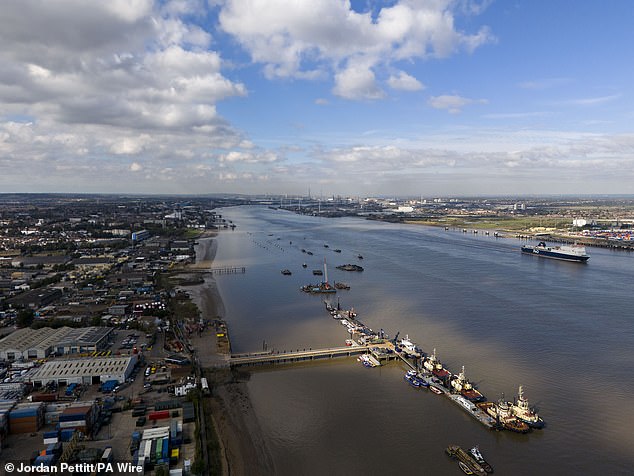
The much-discussed Lower Thames Crossing, featuring a 14.5-mile roadway with a 2.6-mile tunnel under the River Thames, received development consent from Transport Secretary Heidi Alexander on Tuesday morning, as stated by the Planning Inspectorate.
The work on the project has been continuing since 2009, having consumed more than £1 billion of public funds. The efforts have faced numerous delays and controversies from start to finish.
The objective of the Lower Thames Crossing project is to ease the congestion at the Dartford Crossing by developing a new motorway-standard route.
This connection between the A2 and M2 in Kent with the A13 and M25 in Essex would occur through what could become Britain’s longest road tunnel.
It is anticipated that this could almost double road capacity across the Thames east of
London
.
National Highways said the government is ‘currently exploring private finance options for the project’.
The construction might begin next year, with the anticipation of the new road opening in the early 2030s.
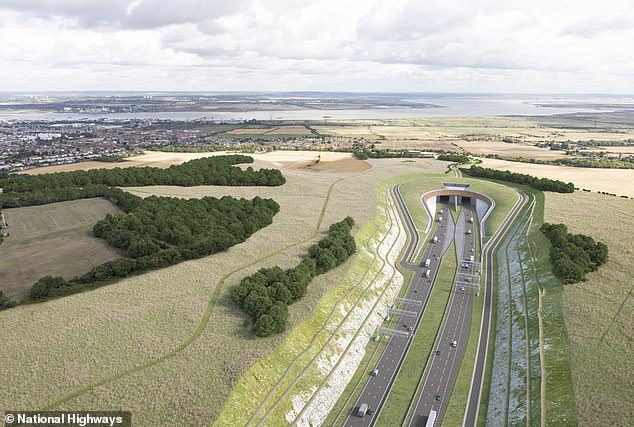
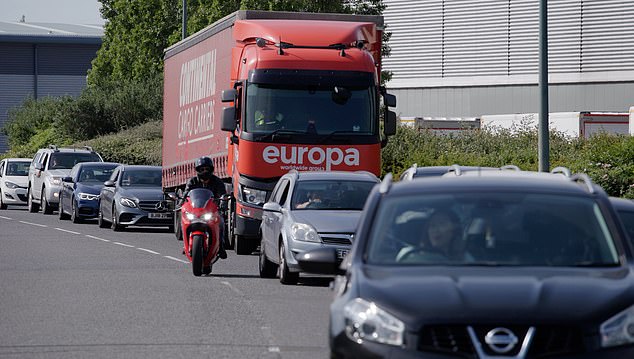
This route aims to ease traffic on the orbital M25, connecting with it close to South Ockenden in Essex. Additionally, it will link up with the M2 near Rochester in Kent.
Matt Palmer, who serves as the national highways executive director for the Lower Thames Crossing project, referred to it as “one of the most significant infrastructure initiatives in the United Kingdom.”
He said: ‘It will unlock growth with quicker, safer and more reliable journeys, and redraw the blueprint for building major projects in a net-zero future by scaling up the use of low-carbon construction, and leaving a legacy of green spaces, green skills.
‘Ours plans were crafted based on input from the local community and then fine-tuned through thorough scrutiny conducted by impartial specialists.’
Mr Palmer stated that National Highways is dedicated to ‘collaborating with our neighbors’ to construct the crossing in a manner that provides them ‘chances to work and acquire new abilities while minimizing negative effects.’
“We are prepared for immediate action and have secured our delivery partners. Today’s decision enables us to collaborate with the government on securing funds and begin thorough planning, which will allow us to commence construction at the earliest opportunity,” he stated.
David Wells, CEO of the trade association Logistics UK, stated that the announcement came as welcome news for businesses nationwide “held back by bottlenecks when navigating the Thames,” he commented positively.
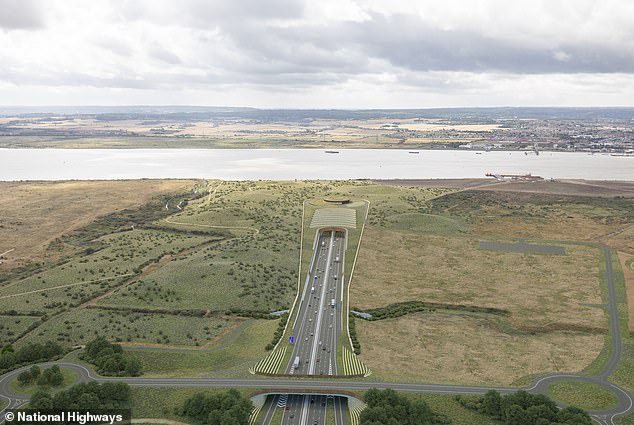
‘The industry stands unified in its support for this crucial trade route,’ stated Mr Wells.
Jim Dickson, the Labour Member of Parliament for Dartford, stated that his constituency has been plagued by ‘constant traffic jams’ due to former administrations ‘avoiding’ the choice regarding the Lower Thames Crossing.
“This choice will unleash economic expansion throughout the nation and at last provide a resolution to the traffic turmoil confronted by my constituents every day,” he stated.
The Thurrock Council in Essex has persistently objected to the initiative, highlighting adverse effects on economics, society, and the environment. However, the head of Dartford Borough Council in Kent supports the plan.
Local activists from the Thames Crossing Action Group assert it would be ‘extremely damaging and detrimental,’ and an unnecessary expenditure of funds.
Read more
by admin | Mar 24, 2025 | construction, government, highways, infrastructure, roads
The federal government has started building a 17.5-kilometer dual carriageway to improve access to the Second Niger Bridge.
The ceremonial ground-breaking occurred on Monday, marking considerable advancement in tackling the area’s transport issues.
At the event, President Bola Tinubu was represented by Delta State Governor Rt. Hon. Sheriff Oborevwori, who underscored their commitment to enhancing road infrastructure, ensuring public safety, and boosting trade and economic activities across Nigeria.
The inauguration of the Second Niger Bridge for public use in December 2022 was a crucial milestone in improving connectivity between the Southeast region and other parts of Nigeria.
President Tinubu stated that this bridge is a significant infrastructural development essential for connecting the Asaba-Benin and Onitsha-Enugu dual carriageways, which are vital highways in Nigeria.
He emphasized that the access road initiative highlights the government’s dedication to promoting infrastructure advancement and boosting economic progress.
“A strong and adaptable economy depends on up-to-date infrastructure, improved public facilities, and enhanced social services,” he noted.
The President additionally pointed out that advanced transportation systems improve mobility, generate employment prospects, boost tourism, ease the circulation of products and services, and raise general quality of life.
Highlighting the significance of investing in infrastructure, Tinubu pointed out that governments across the globe acknowledge the necessity of strong infrastructures to foster economic and industrial growth.
He admitted that Nigeria’s present infrastructure falls short of its development goals and restated the administration’s commitment to upgrade highways, rail systems, and water routes under the New Hope Initiative.
Upon launching the initiative formally, President Tinubu praised the Delta and Anambra state administrations for working together effectively.
He requested patience and collaboration from drivers throughout the construction phase, guaranteeing that the contractors have the competence to finish the work punctually and with top-quality outcomes.
During his introductory speech, Governor Oborevwori praised President Tinubu’s commitment to developing infrastructure throughout Nigeria.
He pointed out the concurrent launch of the Benin-Asapa Expressway rehabilitation project, highlighting the key significance of these initiatives for enhancing regional connections and boosting trade.
“These infrastructure advancements are crucial for enhancing trade and economic activities. On behalf of the residents of Delta State, I express our sincere appreciation to the President for his outstanding leadership and dedication to revitalizing infrastructure,” said Oborevwori.
The Minister of Works, David Umahi, commended Governor Oborevwori for his commitment to sustaining tranquility and fostering development within Delta State.
He recognized the state government’s efforts as crucial additions to the federal highway upgrades, substantially lightening the load on the federal administration.
“Your commitment to the well-being of your constituents and your remarkable initiatives showcase your forward-thinking leadership. Delta State has transformed into a bustling hub of activity, and I am pleased with the continuous progress,” noted Umahi.
Engineer Olufunsho Adebiyi, who serves as the Permanent Secretary at the Federal Ministry of Works, stated that the new access road will establish an essential transport connection between Delta State and Anambra State.
He characterized the pathway as a crucial link that will boost interconnectivity among various communities, easing traffic jams and fostering eco-friendly growth within the area.
Provided by SyndiGate Media Inc.
Syndigate.info
).

by admin | Mar 24, 2025 | business, commerce, government, roads, transportation
By Michael Foli Jackidy
Dzodze (V/R), March 23, GNA – In an effort to reduce congestion, the Ketu North Municipal Assembly, working alongside the Motor Traffic and Transport Department (MTTD) and local transport unions, has initiated a significant clearance operation aimed at removing vendors from principal roadways in Dzodze during market days.
The program, launched on March 21st, Friday, seeks to establish Dzodze as one of the ten municipalities selected for the Smart SDG Cities project.
This aligns with the government’s Resetting Ghana Agenda, aiming to enhance urban management and infrastructure.
In an interview with the Ghana News Agency (GNA), Mr. Jasper Adenyo, the Coordinating Director of the Assembly, stated that this step was crucial for updating Dzodze and organizing the town’s structure more effectively.
Despite being constructed for many years, our town can still be updated. In a smart city, it’s not acceptable for streets designed for both vehicles and pedestrians to become occupied by marketplace vendors on busy trading days. This practice of setting up merchandise along the primary routes makes effective traffic control extremely challenging.
He emphasized that Dzodze marks the beginning of the Trans-ECOWAS Highway, which is essential for large lorries coming from Niger, Mali, Nigeria, Côte d’Ivoire, and Senegal.
The existence of merchants on the routes presents a significant danger, since a braking system malfunction in one of these lorries might result in catastrophe.
We can’t just let this hazardous circumstance continue unchecked. It’s our duty to take action immediately, lest we risk losing lives.
Mr. Adenyo stated that the decongestion initiative is in line with the government’s plan for transforming cities.
Even without the Metropolitan, Municipal, and District Chief Executives (MMDCEs), the Assembly remains committed to moving forward with the plan.
We don’t need to wait for our MMDCE appointments to start making essential improvements. People would be impressed today to witness how the principal road in Dzodze on market days is now so clean that vehicles can easily pass through. Earlier, because of traffic jams, motorists struggled to travel at speeds over 20 km/h.
He mentioned that vacant spots are readily available in the marketplace, and thus, vendors have no justification for using the streets as their trading grounds.
We have requested all vendors to move their operations within the market premises. While some are cooperating, others are being unyielding. In response, we’ve utilized our DRIP units to dismantle their stands. Additionally, these devices deter unauthorized vehicle parking.
He stated that this initiative won’t just be a short-term activity; rather, it will require an ongoing commitment until the dream of transforming into a meticulously planned, modern metropolis becomes reality.
Mr. Adenyo mentioned that meetings have been arranged with motorcycle drivers to guarantee complete adherence to the updated traffic regulations.
motorcyclists must likewise follow these new regulations. we will reach out to them to make sure everybody contributes towards making dzoze a safer place.
Mr. Edward Seke, who leads the Assembly, supported the proposal as well, highlighting that street vendors endanger themselves by operating on roadsides.
We do not hope for calamity, yet consider what might occur if a moving vehicle’s brakes were to fail. Numerous individuals could perish as a result.
He pointed out an additional hurdle: some local merchants hold onto market spots that they no longer utilize, thereby blocking new entrepreneurs from establishing their ventures.
Some traders have inherited their marketplace spots from their great-grandmothers, but they no longer conduct business. In contrast, vendors from Denu, Sogakope, and Aflao visit these markets solely on market days and often find themselves competing for space. This change will provide much-needed respite for all.
Mr. Seke similarly urged the local market vendors to permit visiting sellers to operate, since various enterprises help boost economic development.
Each community that progresses does so with the support of outsiders. By limiting commercial activities to just local residents, our town won’t expand. I urge our ladies to permit other merchants to vend.
He recognized that change can initially be challenging, but encouraged the traders to conform, promising them that the result would be advantageous for everyone.
The start of any change can be challenging, yet ultimately, we will all have reason to rejoice. Let’s join hands and ensure this endeavor thrives.
Several traders voiced their approval of the program, stating that it has enhanced both security and vehicular movement.
“The roads were extremely crowded, making it risky to traverse them. Occasionally, we would have to wait up to 10 minutes merely to locate a secure place to cross or face the danger of colliding with a motorcycle,” stated a merchant to GNA.
A fellow trader commented, “I genuinely appreciate this initiative. It would be ideal if it could remain unchanged indefinitely.”
This activity is anticipated to carry on over the next few weeks, with rigorous monitoring to guarantee that traders and transportation providers adhere to the newly implemented rules.
GNA
MA/AD
Provided by Syndigate Media Inc. (
Syndigate.info
).


