
by admin | Apr 16, 2025 | africa, business, technology, technology companies, technology industry
On April 14, 2025, Addis Ababa — The third installment of GITEX Africa kicked off today in Marrakesh, Morocco. This event is expected to highlight Africa’s potential in innovation, artificial intelligence, and digital leadership.
The highly anticipated event is scheduled to occur across three successive days, running from April 14 through April 17, 2025.
This event is recognized as the biggest and most significant assembly for technology and startup ventures on the continent. It highlights innovations and encourages cooperation at an unparalleled level, as reported by ENA.
This exceptional assembly will bring together an outstanding collection of attendees, including 1,450 exhibitors, 740 startup companies, and upwards of 45,000 guests hailing from more than 130 countries.
GITEX Africa showcases leading industry experts, cutting-edge technologies, fintech solutions, e-commerce platforms, cybersecurity measures, and in-depth talks on AI among other topics.
This year’s edition will place a strong emphasis on strategic sectors that are pivotal to Africa’s development and digital transformation. These include Education Technology (EdTech), Agricultural Technology (AgriTech), Healthcare Technology (HealthTech), and Sports Technology (SportsTech).
Through highlighting these sectors, the event emphasizes Africa’s increasing significance as a center for innovation and technological progress globally. GITEX Africa aims to position the continent as a leading global digital focal point. This gathering acts as an exceptional forum for sharing insights, promoting cooperation, and shaping the digital future.
Given its extensive scope and proactive methodology, the exhibition aims to spur the development of an interconnected and progressive digital Africa, thereby opening up revolutionary possibilities across various sectors.
Significantly, global technology entities will be making their first appearance at the third iteration of GITE, aiming to capitalize on expansion prospects over the course of three days. They intend to establish fresh collaborations and display their most recent technological advancements.
As mentioned, these companies encompass major players such as Cisco, Ericsson, Nokia, China Mobile, and Salesforce.

Provided by Syndigate Media Inc. (

Syndigate.info
).

by admin | Mar 27, 2025 | artificial intelligence, machine learning, technology, technology companies, technology industry
As I reflected on the past year marked by the devastating Israel-Hamas conflict and, more recently, China’s rapid advancements in artificial intelligence (AI)—highlighted by a lengthy CNBC video posted on YouTube titled “How China’s new AI model DeepSeek is challenging U.S. supremacy” on January 25—I also noted an article from The Economist dated January 23 called “Chinese AI is closing the gap, putting pressure on former President Trump.” This topic has sparked extensive discussions about the traditional high-capital investment approach seen in Silicon Valley versus the cost-effective strategy employed by models like DeepSeek.
This debate has driven significant growth within the technology sectors of both mainland China and Hong Kong stock exchanges. However, it simultaneously triggered corrections or pauses among AI-related equities traded in the United States, impacting not just those specific companies but spreading across wider segments of the American financial markets as well.
Moreover, one cannot overlook Malcolm Gladwell’s influential piece originally featured in the New Yorker on May 11, 2009, later developed into his book “David vs. Goliath: Underdogs, Misfits, and the Art of Battling Giants.” I strongly suggest reading either version; they offer profound insights worth considering.
The most striking example of lopsided triumph in warfare during my time would be Vietnam’s remarkable defeat of the U.S., following their earlier victories against France and lesser-known Japan. The latter withdrew plans to occupy Vietnam just as the Pacific part of World War II was concluding.
When one party is significantly stronger or weaker compared to the other, both sides typically adopt distinct tactics or strategies to secure victory or prevent loss. This often involves the dominant entity leveraging extensive resources to overpower competitors, whereas the less potent side employs alternative methods without directly challenging the superior force head-on. A case in point would be how Vietnam countered French and American forces during conflicts by adhering to their own strategic approaches rather than those dictated by these nations due to their substantial military superiority. Similarly, as mentioned in Malcolm Gladwell’s essay, an underdog girls’ basketball squad managed to consistently outperform their formidable rivals through relentless application of a full-court press throughout games.
The recent developments in artificial intelligence are largely centered around the competition between the United States and China, which stand out as the leading economic powers and hubs of technological advancement. Both nations have adopted distinct strategies towards harnessing AI opportunities.
In Western markets, prominent technology firms such as Microsoft, Google, and Meta along with several others are developing exclusive AI systems and products. For instance, Microsoft features an extensive segment dedicated to its AI-driven assistant named Copilot on their website. The platform offers individual access via Copilot alongside organizational use through 365 Copilot. Customization options include utilizing Copilot Studio or constructing personalized applications using Azure AI Foundry’s resources, services, or solutions. Similarly, Google boasts technologies like DeepMind coupled with comprehensive training tools. Meanwhile, Meta operates under its banner known as Meta AI. Notably, Google faces significant pressure since traditional search functionalities could be overshadowed by emerging platforms similar to ChatGPT unless bolstered by advanced AI capabilities; this concern was highlighted in Bloomberg’s podcast released on March 24th discussing these issues.
In China, developments extend beyond DeepSeek. If possible, check the Bloomberg piece from March 25 titled “After DeepSeek’s Success, China Massively Expands Global Reach With AI Models.” You might also find value in reading a synopsis and key points provided by Bloomberg AI for insights. According to the report, over the past couple of weeks alone, leading entities have unveiled “at least ten significant new product launches or upgrades.” It seems neither prominent U.S. nor Chinese technology firms became reactive to AI suddenly; instead, they foresaw its significance and had been proactive—often participating in ongoing AI projects—to develop exclusive AI technologies and offerings.
Recently, several significant artificial intelligence projects have been unveiled by prominent Chinese tech companies. As mentioned in a Bloomberg report: Baidu Inc. launched the Ernie X1 to rival DeepSeek’s R1. In response, Alibaba Group Holding Ltd. introduced new AI entities along with an enhanced reasoning model. Within just one week, Tencent Holdings Ltd. presented their strategic plan for AI development alongside a counter-proposal to the R1. Additionally, Ant Group Co. disclosed research indicating that domestic semiconductor improvements could reduce expenses by 20%. Meanwhile, DeepSeek advanced its V3 version. Interestingly, even Meituan, renowned globally as the largest food delivery platform, declared investments amounting to billions of dollars into AI technology.
The primary distinction between American and Chinese AI models lies in their approach. Leading Western companies develop advanced and exclusive technologies. In contrast, China tends toward open-source solutions that are frequently offered for free or at minimal costs, aiding these models in capturing more of the market and establishing new benchmarks and standards.
This situation has compelled American and Western strategies to adjust their models once again. As stated in the same piece—“For instance, OpenAI is currently attempting to find a delicate equilibrium. Following DeepSeek’s successes using an open-source method, the creator of ChatGPT mentioned they’re considering sharing certain technologies. Simultaneously, OpenAI continues to contemplate significantly increasing prices for their advanced offerings. Should this cost-effective blueprint set forth by DeepSeek be imitated widely, it could potentially diminish profit margins for companies like Nvidia, which focuses on high-priced AI processors,” explained Amr Awadallah, CEO and founder of Vectara Inc.
In recent years, Chinese firms have edged out international competitors across various sectors such as electric vehicles and solar panels by producing more efficiently and offering lower prices. This trend appears to be repeating itself in the field of artificial intelligence.
It seems similar to what’s going on with electric vehicles from Tesla and BYD.
by admin | Mar 24, 2025 | business, cloud computing, cloud services, technology, technology companies
By Kehinde Ogundare, National Director, Zoho Nigeria
The entrepreneurial zeal in Nigeria is unmistakable. Despite operating within a vibrant yet fiercely competitive marketplace, companies here have immense promise, ready to emerge as major players regionally and globally. Yet, actualizing this potential involves tackling a difficult environment characterized by scarce IT assets, intricate operational challenges, and entrenched conventional business methods. To achieve lasting expansion, Nigerian enterprises must embrace digital change, where cloud technology plays an essential role in facilitating progress.
As Nigeria’s middle class grows and its populace becomes more technologically adept, the country presents a promising environment for creativity and growth. However, numerous companies still rely on outdated, hands-on methods, which hampers their potential for expansion and competitive edge. In this scenario, cloud solutions and advanced digital resources prove essential.
The requirement for digital evolution
Conventional growth strategies struggle to adapt quickly enough to changing markets. Relying on manual procedures creates inefficiencies, insufficient data analysis impedes well-informed decisions, and constrained IT capabilities impede creative progress. To surmount these challenges, companies should embrace digital solutions that simplify processes, mechanize routine tasks, and offer practical analytics.
The process of digital transformation doesn’t revolve around implementing new technologies just because they’re available; rather, it focuses on achieving efficient expansion. For companies aiming to grow within the current digital landscape, scalability is essential as it allows them to broaden their audience, stay ahead in competition, and address shifting consumer expectations. By leveraging digital resources, organizations can enhance their influence, boost income generation, and streamline expenses, thus securing enduring stability.
The strength of cloud-based systems
Cloud-based platforms remove the necessity for significant capital expenditures on infrastructure, providing companies with advanced technological tools that are both adaptable and expandable. These systems automate routine processes, optimize work procedures, and boost efficiency, thereby freeing up important assets so enterprises can concentrate on their strategies and interactions with customers.
A comprehensive SaaS platform provides a cohesive environment for overseeing every aspect of a company’s operations. Through an centralized collection of tools, this system streamlines processes, minimizes manual input, and enhances teamwork among staff members. This leads to decreased overhead expenses and quicker strategic choices, facilitating swifter growth into emerging markets.
Zoho’s focus with their software lies in contextual intelligence, utilizing AI to deliver real value to customers. Given that customer experience holds significant importance in today’s market, Zoho’s AI-driven analytics empower companies to customize engagements, predict requirements, and enhance connections with clients. Additionally, Zoho remains dedicated to protecting customer privacy, ensuring that enterprises can use data ethically which helps build confidence and enduring allegiance.
An all-encompassing strategy for expanding a business
Zoho’s strategy of refining every part of the technological framework—from infrastructure to applications—guarantees smooth interoperability and peak efficiency. This comprehensive method leads to superior tech solutions for companies in Nigeria, allowing them to concentrate on what they do best without getting bogged down by intricate technical challenges.
For businesses in Nigeria, digital transformation is not an option but a must-have now. Adopting cloud-based solutions allows them to surmount conventional hurdles to expansion, grow more effectively, and realize their complete capabilities.
The future of Nigerian enterprises lies in digitization. By embracing the cloud, companies can turn obstacles into chances, thereby facilitating enduring expansion within a progressively cutthroat worldwide market.
Provided by SyndiGate Media Inc. (
Syndigate.info
).
by admin | Mar 24, 2025 | commerce, cybersecurity, internet security, investing, technology companies
By Stanley Senya
On March 24, Accra – The Ghana News Agency reported that Inveteck Global, a locally owned Ghanaian company specializing in cybersecurity training and services, was awarded the distinguished title of ‘Top Cybersecurity Firm in Africa’ during the recently concluded Africa’s Most Promising Small and Medium Enterprises (SME) Conference and Awards ceremony.
This accolade underscores Inveteck Global’s commitment to ensuring cybersecurity is both attainable and efficient for enterprises and people throughout Africa.
Throughout the years, the firm has put in significant effort to safeguard businesses against cyber threats via specialized training, cutting-edge solutions, and practical cybersecurity programs.
Its dedication to anticipating new challenges has established Invetek Global as a reliable frontrunner in the industry.
The Africa’s Most Promising Small and Medium Enterprises Conference & Awards stands as a prestigious event that honors remarkable companies significantly impacting different sectors throughout the continent.
Inveteck Global’s recognition as the Premier Cybersecurity Firm in Africa underscores its crucial part in bolstering cybersecurity measures within vital industries such as finance, government, and business entities.
Mr. Promise Gidisu, co-founder of Inveteck Global’s United States division, reiterated the firm’s commitment to enhancing Africa’s cybersecurity strength.
“Receiving this accolade underscores the dedication and enthusiasm of our team. Operating across Ghana, Liberia, and the USA allows us to provide premier cybersecurity services and empower professionals to tackle cyber threats effectively,” he stated.
He mentioned that their achievement was due to the committed team, reliable partners, and faithful clients who supported their vision to safeguard Africa’s digital future.
Mr. Blay Abu Safian, CEO, stated, “This honor serves as more than just an acknowledgment; it challenges us to elevate our efforts further. With our sixth anniversary occurring this year, it strengthens our commitment to continuous innovation and establishing superior benchmarks in the field of cybersecurity.”
He mentioned that Inveteck Global had built its reputation through providing premier cybersecurity solutions such as vulnerability assessments, penetration tests, managed services, red team simulations, cybersecurity consulting, threat intelligence, security audits, and tailored training programs.
Through its top-tier courses, the firm has educated many experts, empowering them to confidently address complex cybersecurity challenges.
Mr. Blay stated that securing the Leading Cybersecurity Company in Africa award reinforces Inveteck Global’s status as a pioneer in the field of cybersecurity.
The firm stays dedicated to broadening its presence throughout Africa, building alliances, and introducing services tailored to the distinctive needs of companies, educational bodies, and governmental organizations.
With cyber threats becoming more sophisticated, Inveteck Global is ready to guide Africa towards a secure digital era, safeguarding against emerging risks via education, innovation, and forward-thinking protection strategies.
GNA
GRB
Provided by Syndigate Media Inc. (
Syndigate.info
).

by admin | Mar 24, 2025 | business, machine learning, technology, technology companies, technology trends
VMPL
Gurgaon (Haryana), India, March 24: A new
Capterra study
highlights major trends likely to substantially affect SMB recruiters, talent scouts, human resources experts, and hiring authorities in the upcoming year. The research reveals a intricate connection between Indian job applicants and artificial intelligence within the recruitment process.
AI Adoption in Hiring
Although an overwhelming majority (87%) of Indian job seekers indicate
positive feelings
Regarding employers utilizing AI for recruiting, assessing, and prioritizing applicants, an impressive 65%, which represents the largest proportion across 12 investigated nations, might turn down a position if the hiring procedure excessively relied on automated systems. This underscores the essential requirement for equilibrium in integrating artificial intelligence technologies.
The research goes on to pinpoint particular domains where job seekers feel most at ease with AI incorporation, such as guaranteeing equitable chances (47%), conducting skill evaluations (49%), and assessing and ranking candidates (50%).
The Rise of AI-Enhanced
Job Applications
: A New Challenge
The growth of artificial intelligence in hiring extends beyond just companies; job applicants are also utilizing AI tools, as evidenced by 51% of participants who acknowledged employing these technologies during their present job hunt. Nevertheless, this development poses a fresh hurdle for recruiters. Astonishingly, 96% of Indian candidates engaging with AI in their job searches admitted to overstating or fabricating aspects of their abilities in application materials such as CVs, cover letters, online forms, or competency assessments.
Regarding the survey findings, David Jani, who analyzed the data, commented: “Artificial intelligence seems to be becoming a standard component in job searches for both candidates and recruitment teams. Nevertheless, how AI is utilized and its role within the hiring process could lead to issues if it relies heavily on automated skill assessments or personal attributes. Therefore, it’s crucial to strike a better balance—leveraging advancements in AI technology while also valuing the importance of human judgment in selecting new employees.”
Explore our catalog for HR management software options.
To learn more, kindly visit capterra.in
About Capterra
Capterra stands as the top B2B marketplace where organizations can discover the ideal software. Their platform links purchasers with more than 2 million authenticated user reviews covering products across 1,000 different categories. It also provides practical, unbiased information and guidance to assist these businesses in selecting the most suitable solution tailored to their particular requirements.
Press Contact
Palash Bhattacharjee,
[email protected]
(ADVERTORIAL DISCLOSURE: The aforementioned press release has been supplied by
VMPL
ANI shall not bear any responsibility whatsoever for the content thereof.
Provided by Syndigate Media Inc. (
Syndigate.info
).

by admin | Mar 24, 2025 | artificial intelligence, business, machine learning, technology, technology companies
Startups from South Korea that focus on enhancing images and videos through artificial intelligence (AI) technology are achieving significant global recognition. These companies are excelling in specific sectors within AI where major U.S.-based corporations have typically held sway.
LVMH, a luxury group, employs AI for spotting fakes from their premium labels. This artificial intelligence monitors online marketplaces and social platforms, pinpointing illicit luxury items, gathering proof, and flagging breaches. Developed by MarqVision—a firm started in 2019 by South Korean entrepreneur Lee In-sup in America—the tech aids over 300 international brands and content providers globally. Led by this ex-McKinsey advisor, MarqVision’s platform identifies both knockoff products and unapproved merchandise transactions like stolen comics and videos. In just last year, they uncovered more than 50.41 million instances of infringement and piracy activities, amassing approximately $17 million ($25 billion KRW) annually across the globe.
Although major players in large language models (LLMs) include prominent US-based technology corporations such as OpenAI, Google, Microsoft, and Meta, South Korean start-ups boasting extensive knowledge in visual artificial intelligence have carved out a niche for themselves in specific sectors. Industry experts anticipate that AI-powered imaging and videography capabilities will be crucial components in areas such as self-driving vehicles.
The South Korean startup Twelve Labs, which was the first to secure significant funding from AI hardware company NVIDIA, has garnered notice for its advanced AI-driven video search capabilities. This technology enables the identification of particular scenes—such as “a person grasping a pen inside an office”—within extensive recordings in merely one second. Major entities like MLSE, the leading sports entertainment organization in North America, along with the NFL, utilize this AI system developed by Twelve Labs to examine game videos, extract pivotal instances, and produce fresh material.
Korean artificial intelligence firms are advancing significantly in the field of medical imaging, which relies heavily on non-verbal data such as MRIs and CT scans. AIRS Medical, an AI-driven healthcare firm, has created specialized software designed to improve MRI clarity, expedite scanning processes, and enhance overall image quality. This innovative solution is utilized by over 460 health facilities spanning 26 nations worldwide—including locations in the United States, United Kingdom, Germany, and Japan—with international earnings accounting for more than fifty percent of their total income.
Another Korean startup named Inocras specializes in using AI to scrutinize individuals’ complete genetic makeup for both diagnosing cancers and tailoring treatments accordingly. They collaborate closely with the Broad Institute—a renowned genomics institute linked to MIT and Harvard—to reassess information derived from what is globally recognized as one of the most extensive databases dedicated to cancer patients’ genomic profiles known as The Cancer Genome Atlas (TCGA).
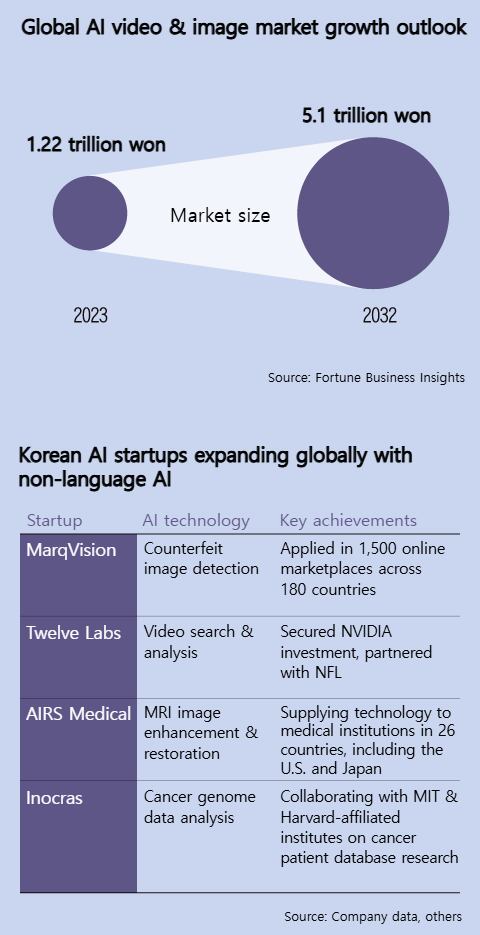
The achievements of Korean start-ups in non-language-based artificial intelligence (AI) can largely be credited to easier development processes relative to those involving language models. Unlike language-focused systems, these do not require large volumes of textual information—often available predominantly in English—which presents obstacles for nations lacking abundant resources of this type of content. According to Lee Kang-joon, CEO at Dunamu & Partners—an investor in companies like AIRS Medical and Inocras—the advantage lies in Korea’s ability to leverage centrally managed healthcare datasets sourced from leading institutions within Seoul along with the national Health Insurance Review & Assessment Service; conversely, American counterparts face greater complexity due to needing dispersed collections from various regional facilities.
Additionally, focusing specifically on industry-oriented AI solutions has shown significant advantages. As stated by a spokesperson from MarqVision, “Asian markets characterized by robust online retail sectors gain an edge through their capability to compile comprehensive databases related to counterfeiting images.” This approach enables them to develop advanced technologies much earlier than competitors—in MarqVision’s case even prior to platforms similar to ChatGPT gaining prominence—and achieve global recognition today.


