
by admin | Aug 21, 2025 | international relations, politics, politics and government, ukraine politics, warfare
Posted on, Aug. 19 — August 19, 2025 at 6:58 AM
On Monday, the White House hosted one of the most significant and controversial summits related to the conflict in Ukraine. Volodymyr Zelenskyy traveled to Washington hoping for confirmation that American support remains steadfast. He was accompanied by several European leaders—up to seven in total—who made a powerful demonstration of solidarity. Their clear message was simple: Ukraine should neither be nor have to accept a peace agreement that compromises its independence.
Donald Trump seems to have followed an alternative approach. Following his discussion with Vladimir Putin in Alaska, he again proposed that Zelenskyy could “bring the conflict to a close very quickly.” However, what he refrained from stating openly was the implication: disregarding NATO, ignoring Crimea, and acknowledging that certain areas of the Donbas would stay under Russian authority. Essentially, achieving peace through the loss of territorial integrity. For Moscow, this would amount to a triumph in every way except for official recognition.
This was not a minor dispute. It exposed the significant rift between Washington and Europe regarding the way ahead. European officials united behind Kyiv, cautioning that appeasing Russian aggression would merely encourage further actions. To them, an agreement that allows Putin to gain territory is, in short, a clear signal for additional conflicts in regions like Moldova, the Baltic states, or beyond.
In turn, Zelenskyy showed no hesitation. He informed Trump that Ukraine’s constitution prohibits the relinquishment of its territory, emphasizing that hundreds of thousands of Ukrainians have lost their lives protecting it. Surrendering land at this point would amount to a betrayal of both those who perished and the concept of a free Ukraine. While his stance might appear extreme, it highlights a straightforward reality: Russia initiated this conflict, and it must not be permitted to alter boundaries through coercion.
The harsh truth is that Trump’s stance mirrors a shift in America’s approach to international relations. Support for Ukraine within the United States is becoming more divided and influenced by internal political struggles. Observing this instability, Europe has started to take action. Through military supplies and economic aid, the European Union and NATO are preparing a framework for a Europe capable of supporting Ukraine should Washington lose momentum.
The Washington meeting aimed at bridging divides. However, it revealed underlying tensions instead. One perspective leans toward an easy solution: halt the conflict, grant Putin his gains, and label it as peace. The alternative path involves taking a stronger stance, supporting Ukraine financially, and maintaining that the concepts of sovereignty and territorial boundaries must not be compromised.
The decision for the global community should be clear-cut. A peace enforced according to Putin’s terms is not genuine peace. *
by admin | Aug 15, 2025 | armed forces, incident, military, military aircraft, warfare
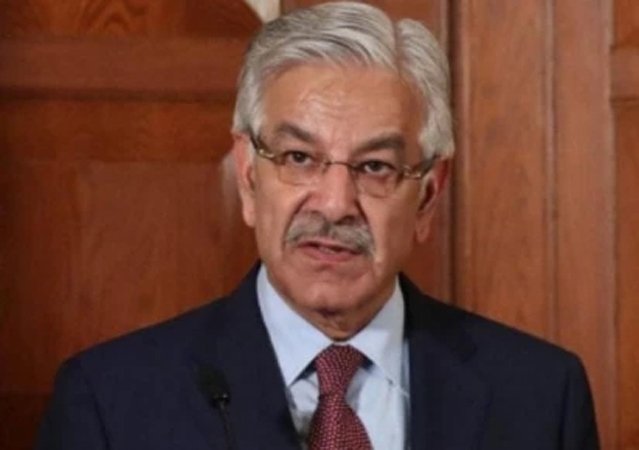
Pakistan, August 10 – Defense Minister Khawaja Asif firmly dismissed statements made by the head of the Indian Air Force alleging that India had downed six Pakistani fighter planes during a clash in May, labeling these reports as “unbelievable” and “inopportune.”
Asif stated in a release, the late claims by the head of the Indian Air Force about supposed damage to Pakistani planes during Operation Sindoor are both unlikely and poorly timed.
The defense official’s statement was accompanied by comments from India’s Air Force commander, who stated on Saturday that India had destroyed five Pakistani fighter planes and an additional military plane during skirmishes in May, marking the nation’s initial public assertion of this nature following its most severe armed confrontation with its neighbor in recent years.
During a gathering held in the southern Indian city of Bengaluru, Indian Air Chief Marshal A.P. Singh stated that the majority of Pakistani planes were shot down by India’s Russian-built S-400 air defense system. He referenced electronic monitoring information as proof of the attacks.
“At least five combatants have been confirmed dead, along with one major aircraft,” he stated, noting that the large aircraft, possibly a reconnaissance plane, was brought down from a distance of 300 kilometers (186 miles).
Singh did not specify the kind of combat aircraft that were shot down, but mentioned that aerial attacks also targeted another reconnaissance plane and “several F-16s” that were located in hangars at two airfields within Pakistan. Pakistan-specific travel guide
Unlike the remarks made by the Indian air chief, during a confrontation with India in May, the Pakistani Air Force reportedly downed six Indian military planes, among them three Rafale fighters, as an act of vengeance for India’s missile strike. The following day, a high-ranking French intelligence representative also told CNN that one Indian Air Force Rafale fighter was brought down by Pakistan, which may represent the initial documented battlefield loss of the French-built aircraft.
The defense chief remarked, “It’s ironic that high-ranking Indian military officials are being portrayed as symbols of major failures resulting from the short-sighted strategies of Indian political leaders.”
Asif mentioned that for three months following the conflict, no similar allegations were raised. He stated that Pakistan provided “comprehensive technical presentations” to the global press right after the event, with independent witnesses confirming the destruction of several Indian planes, including Rafale fighters.
This recognition, he stated, originated from “global leaders, top Indian officials, and foreign intelligence evaluations.”
The minister stated, “Not one Pakistani plane was damaged or destroyed by India,” adding that Pakistan had taken down six Indian fighter jets, S-400 missile systems, and drones, as well as disrupted multiple Indian airfields. He claimed that casualties among Indian troops near the Line of Control were significantly higher.
“If authenticity is at stake, let both parties disclose their aviation fleets for impartial inspection—although we believe this could reveal the actual situation that India aims to conceal,” Asif stated.
He cautioned that “conflicts are not achieved through lies but through ethical leadership, national determination, and skilled execution,” noting that “humorous stories designed for local political gain heighten the serious dangers of mistaken strategy in a world with nuclear weapons.”
Warning New Delhi not to breach Pakistan’s sovereignty, Asif stated, “As shown during Operation Bunyanum Marsoos, any infringement upon Pakistan’s sovereignty and territory will lead to immediate, certain, and appropriate retaliation, with all blame for subsequent tensions lying solely with those myopic leaders who risk South Asia’s stability for short-term political benefits.”
The Indian government led by Prime Minister Narendra Modi has been strongly criticized by opposing political groups for not showing sufficient determination to address issues during the May conflicts and for failing to stop the Pahalgam incident.
The dispute in May began with New Delhi accusing Islamabad of involvement in a fatal incident in Pahalgam, an area under occupation in Kashmir. These claims lacked proof and were firmly denied by Pakistan. Following intense fighting on May 7 and reciprocal attacks on military bases, U.S. mediation led to a truce between the two parties on May 10.
by admin | Apr 3, 2025 | israel, israel and the middle east, military, syria, warfare
The Syrian Foreign Ministry characterized Israel’s assaults on five areas throughout the nation as an “unwarranted escalation.”
On Thursday, Syria denounced the lethal Israeli attacks throughout the nation as a “blatant infringement” of its sovereignty, following Israel’s statement that it had targeted “military assets.”
The Syrian government’s news outlets stated that the airstrikes took place near a defense research facility in Damascus, along with several other locations. Meanwhile, an independent monitoring group claimed that at least four people were killed in this recent Israeli assault on Syria, which comes after extremist factions, following their overthrow of longtime leader Bashar al-Assad, gained control.
The Syrian Foreign Ministry stated in aTelegram message that Israeli forces conducted aerial attacks on five different areas throughout the nation, blatantly breaching both international law and Syrian sovereignty.
Are you curious about the most significant issues and global trends? Find out here with
SCMP Knowledge
Our latest platform features handpicked content including explainers, FAQs, analyses, and infographics, all provided by our esteemed team of experts.
This unwarranted intensification is an intentional effort to undermine Syria’s stability and increase the hardship faced by its population.
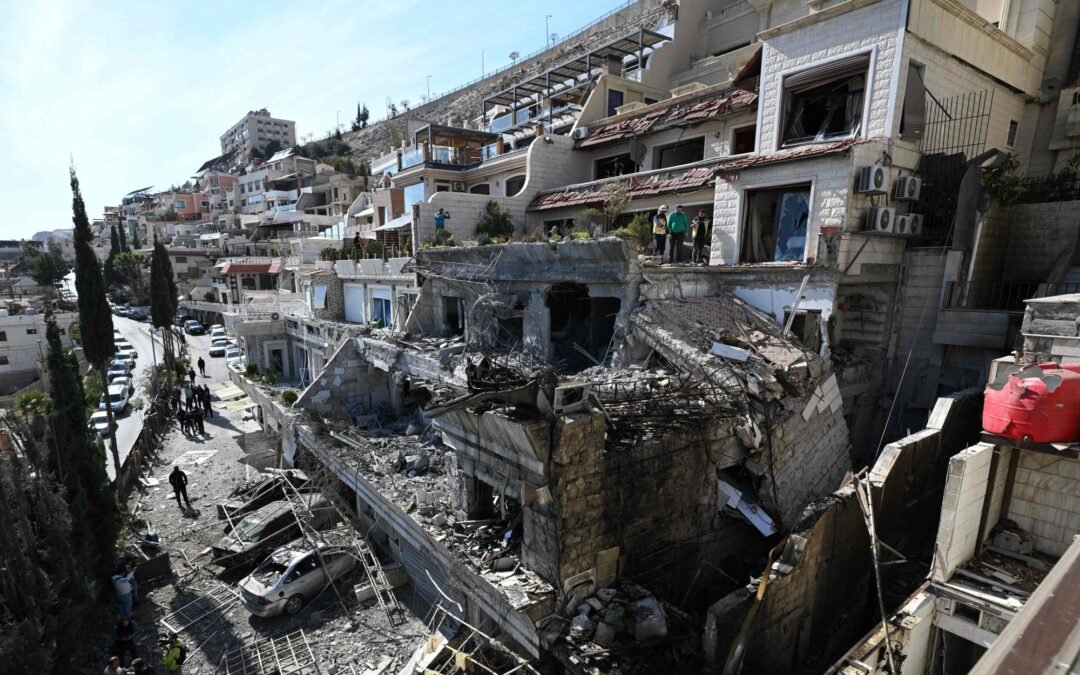
The report indicated that the airstrikes led to the “almost complete devastation” of a military airbase in the central Syrian province of Hama, resulting in injuries among numerous civilians and troops.
The Syrian state-run SANA news agency reported a strike that “hit the area near the scientific research facility” in Damascus’s northwestern Barzeh neighborhood, as well as a raid in the vicinity of Hama, though they did not specify exactly what was struck.
The Israeli military stated in a release that their forces targeted “remaining military assets at the Syrian airbases of Hama and T4, as well as further residual military installations around Damascus.”
Israel has stated its desire to stop weapons from being obtained by the new leadership, which it views as extremists.
The Syrian ministry stated that these attacks occurred while the nation was attempting to reconstruct itself following 14 years of conflict, describing it as an attempt to “normalize violence within the country.”
A few weeks ago, Israel reported that it had attacked the T4 military base in central Homs province two times, aiming to strike military assets located there.
The Syrian Observatory for Human Rights reported that “four individuals lost their lives and several others sustained injuries, among them staff from the Syrian defense ministry, as a result of the attacks on Hama military airport.”
The monitoring group stated that these attacks, aimed at “the leftover aircraft, runways, and control towers,” rendered the entire airport non-operational. Additionally, they reported that the strikes in Damascus were focused on the research center located in Barzeh.
Following Assad’s downfall on December 8, the Britain-based Observatory noted Israeli attacks aimed at the center of the area.
In 2018, Western nations such as the United States had attacked the defense ministry site, claiming it was connected to Syria’s “chemical weapons facilities.”
Additionally, following Assad’s downfall, Israel has stationed soldiers in a United Nations-monitored neutral area within the strategically significant Golan Heights. They have also advocated for full disarmament in southern Syria, an area adjacent to the Israeli-occupied Golan region.
The authorities in southern Syria’s Daraa announced via Telegram late Wednesday that multiple Israeli military vehicles had entered a region in the western part of the province. They also reported that “three Israeli artillery shells” were fired at the area.
The Observatory has noted multiple instances of Israeli military intrusions into southern Syria, extending past the demarcation line, over the last few months.
Last month, when visiting Jerusalem, the European Union’s top diplomat Kaja Kallas stated that Israel’s attacks on Syria were “unwarranted” and could potentially escalate tensions further.
More Articles from SCMP
How Malaysia’s Data Centers Became the Driving Force Behind China’s AI Goals
Beijing urges HSBC to aid in enhancing Sino-British relations and improving Hong Kong’s reputation.
Jumbo Legend clears its first stewards test as Caspar Fownes secures a double at Happy Valley.
Hong Kong shares drop to their lowest point in six weeks due to Trump’s tariffs, with exporters leading the decline.
The article initially appeared on the South China Morning Post (www.scmp.com), which serves as the premier source of news covering China and Asia.
Copyright © 2025. South China Morning Post Publishers Ltd. All rights reserved.

by admin | Apr 2, 2025 | military, military history and wars, soldiers, warfare, world wars
The
University of Oxford
is urging council officials to permit the inclusion of five soldiers on a war memorial, despite their conflict with Britain during the
First World War
.
Queen’s College has submitted an application to the planning authorities with the intention of including ‘members of the college community’ among the 121 individuals already listed on the memorial situated on High Street in Oxford.
However, critics argue that this change, permitting the addition of three German soldiers, represents ‘woke’ ideology.
Created by Sir Reginald Blomfield and revealed in October 1920, the monument honors those who served with the Allied forces. However, a recent submission to the Oxford City Council seeks to have all affiliated with the college commemorated instead, regardless of their national origin.
The additions will feature Carl Heinrich Hertz, born in Hamburg, Germany, along with Gustav Adolf Jacobi, hailing originally from Weimar.
Erich Joachim Peucer, born in Colmar which was part of the German Empire at that time and passed away in
Italy
In 1917, this is also included among the supplementary names.
The remaining two individuals include Hungary’s Paul Nicholas Esterházy, who enrolled in 1901 and passed away in 1915.
Poland
, and Emile Jacot who sustained wounds during combat, ultimately succumbing to his injuries in 1928.
The monument adorned with two large stone slabs, each crowned with a bronze garland, bears the inscriptions: “They yielded their lives to the Commonwealth and gained eternal remembrance,” along with “A praise that shall endure forever.”



The planning document mentioned: “The World War I monument located outside the library excludes individuals who were not part of the British forces.”
This was typical for the period when the monument was built (1921). When colleges initially constructed their memorials, they usually did not honor individuals who had fought against the Allies—whether this omission resulted from a conscious choice or simply due to oversight.
To sum up, we believe that these suggestions represent a suitable and discreet approach considering the surrounding architecture. They are warranted by the necessity to honor every member of the college community who perished in the First World War, regardless of their national origin.
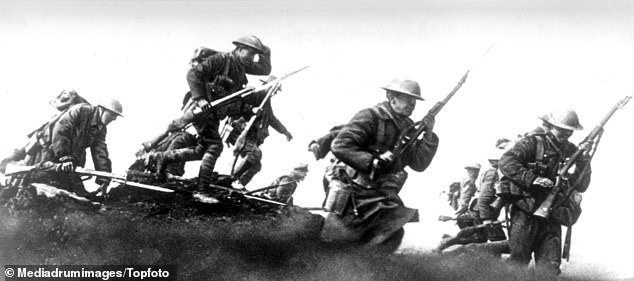
However, Richard Tice, the deputy leader of Reform UK, stated that the monument should solely act as a tribute to those who battled for Britain and the Allied forces.
He stated to The Telegraph, “The war memorials in the UK ought to serve as a tribute to those who made the supreme sacrifice to safeguard and defend the Allied countries.”
Where will this nonsense stop?
Out of the 14,561 members from Oxford University who joined the armed forces, approximately one-fifth had lost their lives by the conclusion of the First World War.
Among those who lost their lives was the distinguished military leader Douglas Haig, 1st Earl Haig, along with the accomplished composer George Butterworth.
The Oxford City Council is anticipated to reveal its verdict within the coming several weeks.
MailOnline has reached out to Oxford University for their input.
Read more
by admin | Apr 1, 2025 | soccer, sports, warfare
Here’s what you should be aware of:
In a closely contested match, Kobs barely managed to defeat Hippos with a score of 24-23, due to Joseph Aredo’s thrilling last-minute drop kick.
Thank you for choosingNation.Africa
Show plans
The smallest details determine the outcome of major matches. This is evident from observing a closely fought battle in the Nile Special Rugby Premiership between Jinja Hippos and Kobs.
In a closely contested match, Kobs barely managed to defeat Hippos with a score of 24-23, due to Joseph Aredo’s thrilling last-minute drop kick.
The kick not only cleared the posts but also crushed Hippo’s morale, solidifying Kobs’ reputation as experts in decisive plays.
It marked the second occasion this season that Kobs clinched victory via a crucial drop goal, following their earlier success with a comparable win against Stanbic Black Pirates.
Right from the start, Hippos demonstrated their desire to take control of the game against their opponents. Early pressure led to a penalty opportunity, which they chose to capitalize with a kick at goal instead of a scrum. The reliable Yassin Wasswa successfully converted it, pushing his seasonal point tally above 100. However, this initial score served to rouse Kobs from their sluggishness.
Experienced player Ian Munyani took charge for Kobs, scoring two tries in rapid succession to shift the momentum in their favor. However, Aredo failed to convert both attempts, leading Kobs to assign the kicking responsibilities to Josiah Ssempeke instead.
The fullback answered back with three accurate penalty kicks, maintaining Kobs’ chances. In the meantime, Edrine Lameriga, who was later awarded man of the match, dominated the game for Hippos with two exceptional touchdowns, providing the home team a narrow 23-21 advantage at the halfway mark.
Unfortunately for Hippos, the second half began with a major blow as Lameriga suffered an arm injury and was rushed to the hospital. What followed was a tense, physical stanza punctuated by numerous medical breaks. Both sides fought tooth and nail, but Kobs kept pushing, determined to avoid a semifinal clash with Pirates.
As time ran out, Hippos closely guarded Ssempeke to prevent him from attempting a drop goal. Nevertheless, this defensive strategy opened up opportunities for Aredo, who delivered a precise drop kick that secured the victory.
The hippos had one final opportunity to snatch victory with their concluding move. Even though their supporters implored them to take advantage of their control during scrums, Wasswa decided upon a long-distance penalty kick originating slightly past midfield. This attempt missed its mark, allowing Kobs to end the game by booting the ball away.
“We have the knockout stages coming up, but this victory was essential for regaining our confidence,” stated Coach Timothy Mudoola of Kobs.
The Hippos’ coach, Edmond Quaresma, expressed disappointment over his team’s inability to finish the match but vowed for an improved performance during the playoff games.
In another part of the competition, Pirates concluded their regular season at the top of the leaderboard with 49 points, trailed by Kobs with 43 points, and Hippos with 40 points. Rounding out the top four was Heathens, who soundly defeated Eagles with a score of 52-9.
NILE SPECIAL RUGBY PREMIERSHIP
Buffaloes 55-3 Elgon Wolves
Provided by SyndiGate Media Inc.
Syndigate.info
).
by admin | Mar 30, 2025 | armed forces, government, military, politics, warfare
Earlier this week, the Rapid Support Forces militia were pushed out of their positions in the Sudanese capital by the national army. This shift in power represents a significant milestone in the ongoing two-year civil conflict.
The leader of the Rapid Support Forces militia acknowledged during a speech on Sunday that the
group has withdrawn
From Sudan’s capital, Khartoum, following their control of the city for almost two years amid the civil conflict.
The disclosure followed afterwards.
The Sudanese military announced on Thursday
that the capital was “free” from the control of militias that gained control of the city after the war broke out in April 2023.
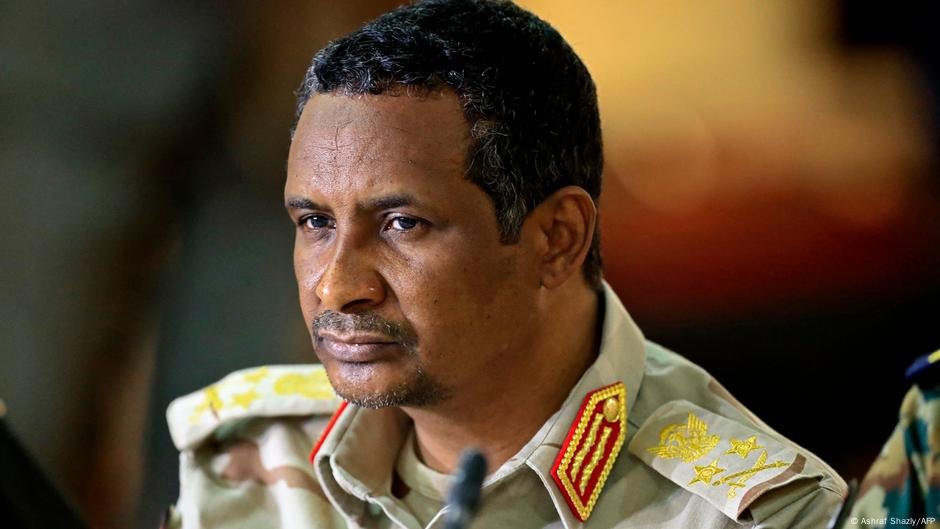
The leader of the Rapid Support Forces (RSF), Mohammed Hamdan Dagalo, stated three days prior that they would not withdraw nor yield, adding that their troops were “reequilibrated” following the recapture of the city by opposing army units.
The RSF pullout marks a symbolic shift in Sudan’s civil conflict.
Daglo shared on X saying, “I assure you that we have definitely departed from Khartoum, however… we shall return with an even firmer resolve.”
Those who believe that there are talks or accords underway with this nefarious group are incorrect,” he stated, referring to the Sudanese army. “We do not have any pact or dialogue with them; we communicate solely through military means.
Sudan in the grip of the world’s worst hunger crisis
The conflict has led to what the United Nations characterizes as the globe’s most severe food shortage and refugee crisis.
Over 12 million individuals have been displaced, tens of thousands have lost their lives, and a United Nations-supported evaluation has reported famine conditions in certain areas of the nation.
Nevertheless, Army Chief Abdel Fattah al-Burhan pledged on Saturday not to retreat, following a conclusive assault where his forces were instrumental.
recaptured the presidential palace, the airport, and other crucial locations in the downtown area
.
Forgiveness, concessions, and negotiations are off the table,” stated Burhan, emphasizing that true triumph would not occur until “every single rebel has been eliminated from every part of Sudan.
The US continues to be committed to facilitating peace efforts aimed at ending the conflict.
The United States Secretary of State Marco Rubio had earlier stated on Thursday that
Washington aimed to achieve more through diplomatic means to conclude the conflict in Sudan.
.
Rubio mentioned that he was actively involved in matters concerning Sudan and had recently conversed about the conflict with various global figures, such as Kenyan President William Ruto and Ethiopian Prime Minister Abiy Ahmed.
Blinken, who preceded Rubio, made significant efforts to try to bring the conflict to a halt but eventually expressed frustration over his inability to achieve this goal. He criticized both parties for their involvement in alleged war crimes.
The United States has enacted sanctions on both parties, alleging that the military attacked civilians and stating that the Rapid Support Forces (RSF) committed “genocide” in the western Darfur area.
Edited by: Roshni Majumdar


