


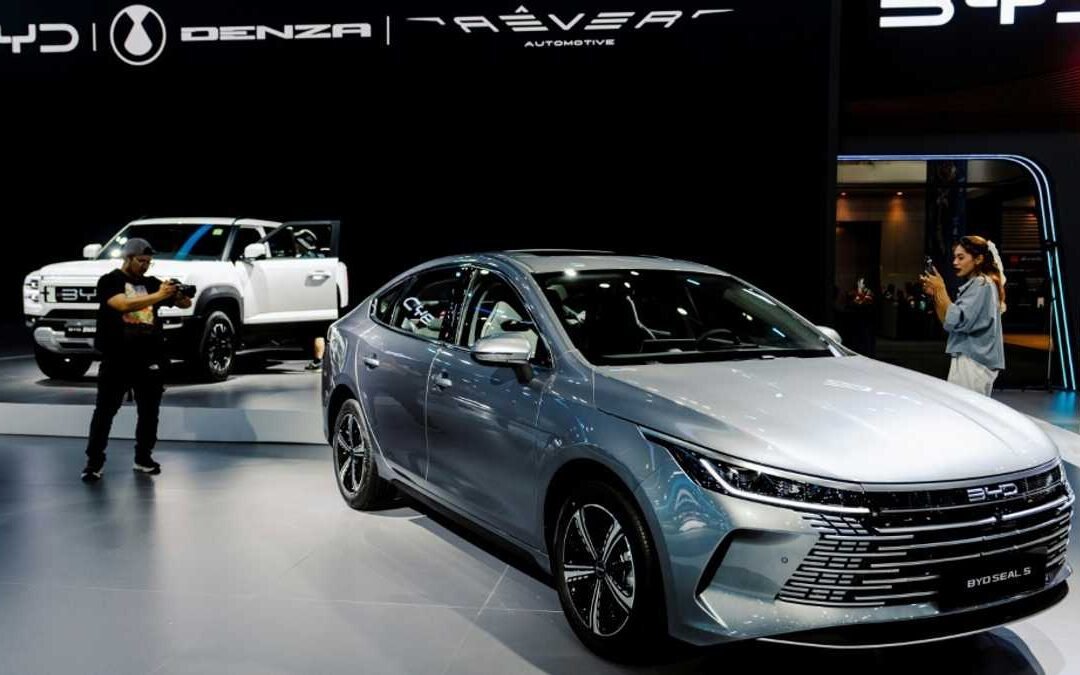

Last year, Chinese automaker BYD experienced a significant increase in revenue, crossing the $100 billion threshold and outperforming competitor Tesla as the electric vehicle leader pushes forward with its international growth strategy.
In recent years, the company based in Shenzhen has become the undisputed frontrunner in China’s fiercely contested electric vehicle sector, which boasts the biggest market globally.
The company is also actively pursuing new expansion opportunities overseas, pledging to dominate the European market with a sleek new electric vehicle and ultra-rapid charging technology to compete with major European manufacturers.
Tesla faces a difficult period as China’s major advancement into Europe coincides with a decline in the company’s sales across the continent, which has been exacerbated by CEO Elon Musk’s backing of extreme right-wing political organizations in the region.
The statement released late Monday at the Shenzhen Stock Exchange revealed that BYD generated 777.1 billion yuan ($107.2 billion) in revenue for 2024.
That amount surpassed the $97.7 billion in revenue reported earlier by Tesla for last year.
This marked a 29 percent rise compared to the prior year and surpassed a Bloomberg prediction of 766 billion yuan.
In contrast, BYD’s net profit for last year reached 40.3 billion yuan, marking a 34 percent increase from 2023 and setting a new all-time high.
BYD — whose motto is “Build Your Dreams” in English — has experienced an exhilarating period with rapidly increasing sales figures, numerous disclosures, and skyrocketing share prices.
In January, they reported selling almost 4.3 million vehicles in the past year, which represents an increase of over 40% compared to the prior year.
In February, monthly sales surged by 161 percent to reach 318,000 units, significantly surpassing the considerable drop experienced by Tesla during the same timeframe.
Charging ahead
This month, BYD’s stocks listed in Hong Kong reached an all-time peak following the company’s announcement of new battery tech that reportedly enables charging an electric vehicle as quickly as filling a gasoline-powered car.

The “Super e-Platform” battery and charging system claims to reach top speeds of 1,000 kilowatts and enables vehicles to cover up to 470 kilometers (292 miles) following a five-minute recharge, as stated by the firm.
In contrast, Tesla’s Superchargers presently provide charging rates of 500 kilowatts.
Last week, BYD Vice-President Stella Li stated that “registration figures will surge” in Europe for the months of March and April.
The organization has initiated significant advertising efforts through sponsorships such as supporting last year’s UEFA European Football Championship and by establishing several new showrooms throughout Europe.
Nevertheless, the strained relations and trade disputes between Beijing and western nations could potentially overshadow the firm’s international aspirations.
BYD stands out as one of the leading figures among China’s emerging automotive powerhouses, having thrived with significant backing from Beijing. The government has allocated substantial state resources toward this industry.
This strategy has provided local companies with a significant advantage in the competition to offer less expensive, more fuel-efficient electric vehicles compared to major American car manufacturers, who haven’t consistently benefited from similar government support.
The EU authorities are apparently looking into whether the Chinese government offered uneven subsidies for BYD’s initial plant in Europe, located in Hungary, with plans to begin electric vehicle manufacturing later this year.
Last week, Li informed AFP that the firm would maintain “extreme transparency” and expressed readiness to collaborate with any inquiry.
In the meantime, US President Donald Trump has recently introduced increased blanket tariffs on Chinese goods, exacerbating a previous measure enacted by his predecessor Joe Biden that essentially prohibits the utilization of Chinese technology in intelligent vehicles.
Following Tesla’s announcement of weaker-than-anticipated earnings for the fourth quarter of 2024 at the end of January, BYD released impressive financial figures.
The downturn marked a varied year for Tesla, where Trump supporter Musk’s significant investment in U.S. electoral politics faced challenges from profitability issues. This was compounded by the cessation of the company’s run of consecutive yearly increases in vehicle production.