


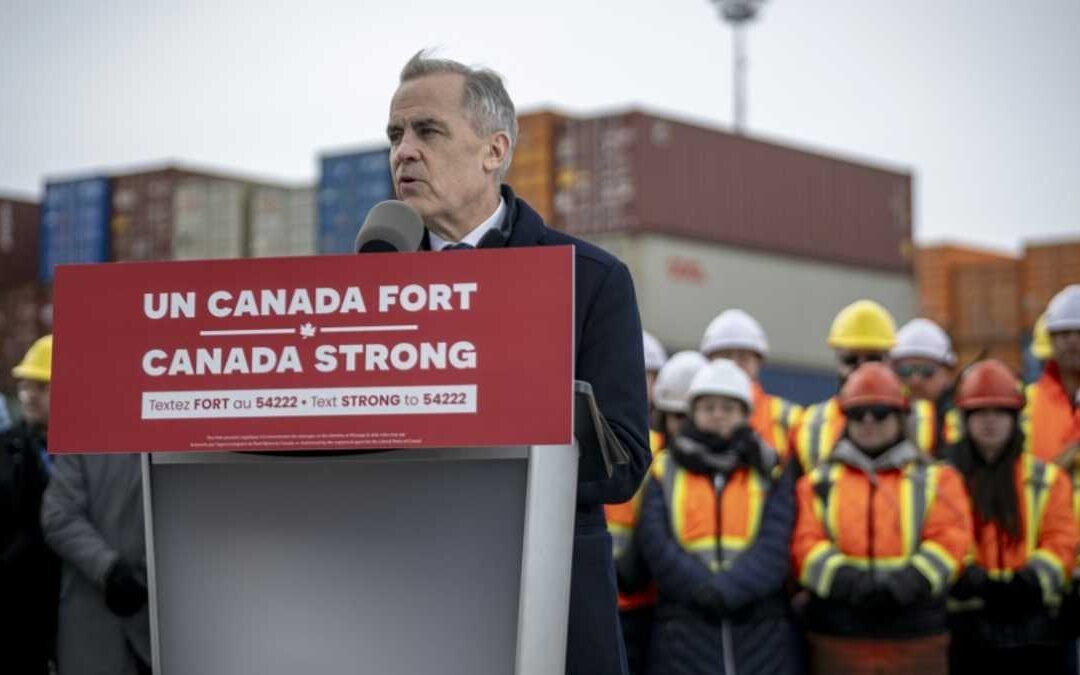

A month ahead of Canada’s general election, where U.S. President Donald Trump’s threats have become a focal point, Mark Carney has spearheaded a surge for the Liberals, putting them ahead in recent polls against their primary competitor, Conservative candidate Pierre Poilievre.
Since taking office in January, the U.S. president has threatened Canada’s economy with steep tariffs and frequently demanded that the nation relinquish its autonomy and merge into the United States.
Experts concur that the primary issue for Canadians voting on April 28 will be deciding between incumbent Prime Minister Carney and Poilievre to counterbalance Trump’s influence.
“The most important factor for me in this election is the economy, particularly the aspect of free trade with the United States,” said Ottawa resident Carol Salemi to AFP.
She stated that they require some form of negotiation with the U.S., and they need a robust leader to handle it.
Danielle Varga, 22, agreed with this perspective, stating that Canada requires “a leader who stands firm against America. It seems like everybody agrees on this point, which is positive.”
Currently, ex-central banker and political newcomer Carney, who succeeded Justin Trudeau as Prime Minister in mid-March, seems to be the right fit for the role.
The 60-year-old has swept the nation, entirely turning around the Liberals’ luck who, under a struggling Trudeau, seemed destined for a significant defeat at the polls.

Currently, he is at the top of the polls, and according to observers, he has a strong likelihood of establishing a majority government.
Carney stated to campaign supporters in Ottawa on Saturday, “This stands as the most crucial election of our lives,” emphasizing its significance for reshaping our connection with the United States and restructuring our economy according to our own conditions.
Carney cut short his campaign this week following Trump’s announcement to introduce 25 percent tariffs on car imports, which followed duties on steel and aluminum.
Trump said he had an “extremely productive” first call with Carney on Friday, adding that the two leaders “agree on many things.”
This marked a significant shift in tone for a U.S. president who previously had cool relations with Trudeau, and this development did not go unnoticed across the northern border.
‘Exceptional time for Canada’
The conservative leader Poilievre initiated his campaign by stressing tax reductions, accessible housing, and the exploitation of Canada’s natural resources.
The 45-year-old seasoned political figure has tried to counteract parallels drawn between himself and Trump — who are both right-wing populists — which have reduced his popularity in Canada.
“President Trump stated his desire for the Liberals to regain power. The reason being, they will maintain Canada’s weakness and ensure investments continue moving from this nation to the United States,” he remarked during a campaign event in Toronto on Sunday.
Other political groups like Jagmeet Singh’s left-leaning New Democratic Party and the separatist Bloc Quebecois headed by Yves-Francois Blanchet have found it difficult to gain attention, as voters concentrate their efforts on the top two contenders during this period of turmoil.
This is genuinely a remarkable period for Canada,” stated Professor Genevieve Tellier from Ottawa University, further noting: “Canada is seeking a savior.

As an indication of the growing strains, Carney stated on Thursday following Trump’s new tariff announcements that the period of extensive economic, security, and military cooperation between Canada and the United States has come to an end.
Tellier indicated that Carney’s “resolute stance” and his statement that “the relationship with the United States will never return to what it was before” appear to resonate strongly with the electorate.
These comments have ” encapsulated the prevailing sentiment in Canada,” she stated.
People are gravitating towards Carney due to their desire for stability and someone who can provide reassurance during tough times, as noted by Daniel Beland from McGill University in Montreal.
In a nation with a population of 41 million, 343 seats are up for grabs in this year’s unexpected election. The political party securing more than half of these seats will compose the new administration, with its head taking office as prime minister.
Should no political party secure an outright majority, the one with the highest number of seats will be asked to try forming a coalition government with assistance from minor parties.