oleh admin | Agu 22, 2025 | economics, financial services, fiscal policy, politics and government, tax policy and law
Posted on, Aug. 19 – August 19, 2025 at 7:24 AM
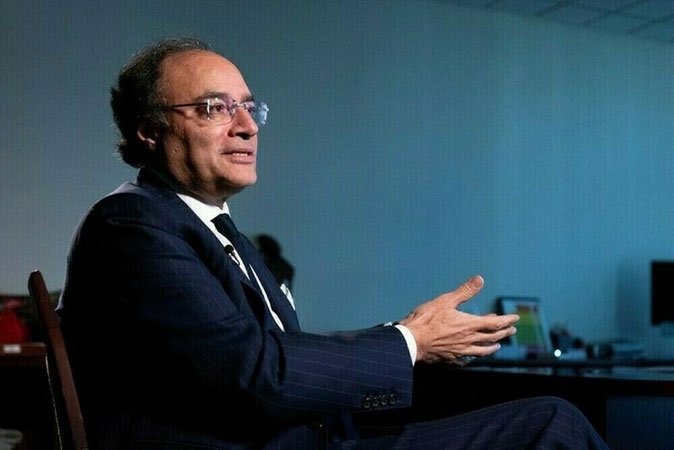
The “tax policy office” in Pakistan will cease to fall under the jurisdiction of the Federal Board of Revenue (FBR), according to an announcement made by Finance Minister Muhammad Aurangzeb on Monday. Instead, this department will now operate under the authority of the Ministry of Finance. As a result, the FBR will no longer have the key responsibility of drafting the annual budget.
“Tax policy office is now moved into the Finance Division. FBR has nothing to do with the policy. The next year’s budget to be presented in 2026 (for FY27) will be led by the finance and tax policy office and not by FBR,” Senator Aurangzeb said while speaking at a workshop titled ‘Unlocking Capital Market Potential for Banks’, organized by the Securities and Exchange Commission of Pakistan (SECP) and the Pakistan Banks Association (PBA).
Industrial strategy: He further mentioned that the government has been steadily developing an industrial plan set for release shortly, aimed at creating favorable conditions and boosting manufacturing growth within the nation.
“Haroon Akhtar (Special Assistant to Prime Minister) is working day and night to get that (industrial policy) through the cabinet and make an announcement. This is an important element of how we are going to move from stability to sustainable growth, because these underline pillars are going to be quite critical,” he said, adding that over the past couple of months the government has already announced policies for tarrifs, electric vehicles, creating a cashless economy and the digital sector.
Tariff Reforms: Delivering a speech on tariff reforms for businesses—especially those involved in exports—Aurangzeb stated that the government needs to lower customs taxes, extra customs charges, and administrative fees to a specific extent within the coming four to five years.
“This is essential to improve export competitiveness and also to take away the protection that we have provided certain industries for the longest time.”
In terms of the reforms, he said many institutions helped the government, including the World Bank.
“I just want to be very clear the IMF has nothing to do with it. Tariff reforms is very much a home-grown agenda of the government and this administration to make our industry more competitive as we go forward.” He said finance and FBR believe reducing tariffs will hurt the collection of revenue. “They say our revenue (collection) will fade away if we keep reducing duties.” However, “we have to get out of this short-term thinking and see what is the right thing to do for the country over the next four to five years if we are going to grow and move towards supporting competitiveness.”
Missing players: He noted that the corporate sector was largely missing from the workshop, even though they are key players in the development of the capital markets – as they are the one who mobilize funds (debt/equity) through the capital markets.
The minister proposed that the workshop coordinators establish a capital market advancement committee aimed at mobilizing resources for projects via local financial systems such as the Pakistan Stock Exchange (PSX). Key members of the committee might consist of the SECP, the State Bank of Pakistan, PBA, companies, banking institutions, and other relevant entities, along with input from different provinces—since significant implementation authority currently resides within them.
oleh admin | Mar 25, 2025 | budgets, fiscal policy, government, news, politics and government
Rachel Reeves
Is anticipated to unveil several billion pounds in expenditure reductions during her Spring Statement on Wednesday as she rushes to find ways to save money.
The Chancellor plans to tighten the budget for certain government departments as she aims to address a significant deficit in public funds.
At her
Budget
In October, Ms Reeves set aside nearly £10 billion as ‘buffer room’ in accordance with her fiscal guidelines.
However, fresh data from the Office for Budget Responsibility indicate that these gains have now vanished due to slow economic expansion and increasing lending expenses.
The Chancellor has already managed the implementation of cuts amounting to £5 billion from the increasing UK welfare budget, which involves restricting eligibility for disability benefits.
She has also been required to approve plans for slashing Britain’s foreign aid budget.
aid budget
, in order to finance an escalation in defense expenditure to 2.5 percent of GDP by 2027.
However, additional reductions are anticipated later this week, as Ms Reeves has ruled out any further ‘tax and spend’ policies following her £40 billion series of tax increases last October.
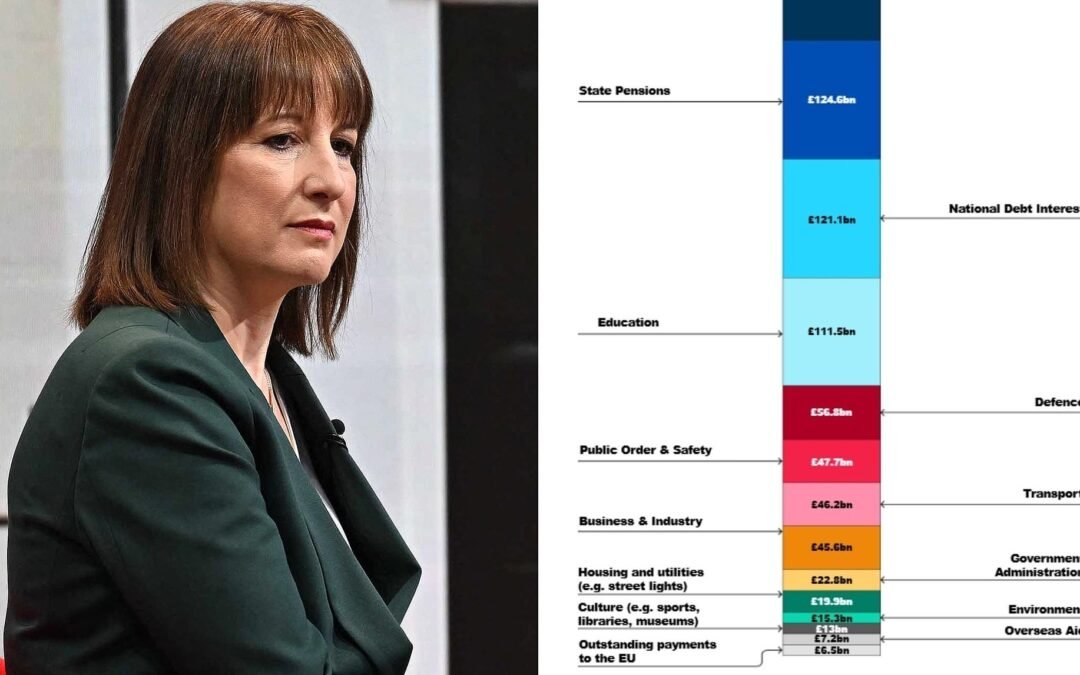
Data from public spending for the previous fiscal year indicates that a significant portion of tax money went towards social benefits, government retirement funds, and financing the National Health Service.
For instance, an individual earning approximately £37,000 per year in the United Kingdom would anticipate that about £1,920 of their taxes go towards welfare, £1,592 goes to the NHS, and roughly £1,013 funds state pensions.
Use our interactive tool below to check where your own taxes go…
Mrs. Reeves is already aiming at welfare as part of her effort to achieve savings, following Work and Pensions Secretary Liz Kendall’s announcement of proposals to tighten benefit conditions the previous week.
In the period of 2023-24, the government continued to allocate more funds towards debt interest payments compared to spending on education.
In the previous fiscal year, police and transportation were also significant spending categories. Moreover, billions of pounds were allocated to environmental initiatives, housing projects, as well as libraries, museums, and sports facilities.
The UK continues to make contributions to the EU under the terms of the Brexit agreement, and even though these payments have been reduced multiple times recently, £7.2 billion was still allocated for international assistance.
Given that Labour MPs are already displeased with the reductions in welfare and foreign aid, Ms. Reeves must proceed cautiously as she contemplates additional financial restrictions.
The Chancellor has confirmed that she will make reductions in the budget for Whitehall before presenting her Spring Statement, particularly focusing on cutting costs associated with running government departments.
She has detailed strategies to reduce civil service operational expenses by 15 percent by the end of the decade. Additionally, the Treasury is anticipated to introduce a fresh initiative against tax evasion.
Ms Reeves stated that Whitehall officials will be requested to identify savings of over £2 billion from administrative expenses, which would probably result in approximately 10,000 job losses.
However, trade unions have cautioned that the number might actually be closer to 50,000. Additionally, the Treasury is believed to require much larger cuts to achieve their financial goals due to declining growth projections.
The gap in the public funds might reach up to £15 billion, even after revealing plans to reduce benefit spending by £5 billion.
Even though budgets are anticipated to increase in actual value over the next few years, unprotected sectors will face reductions.
It has been asserted that the reduction in expenditures will amount to an average of 4.7 percent across most sectors, although the specific figures won’t be disclosed until the spending review scheduled for June.
Read more

oleh admin | Mar 24, 2025 | economics, finance news, fiscal policy, government, tax policy and law
Islamabad [
Pakistan
], March 24 (ANI): On this date,
International Monetary Fund
(
IMF
) has rejected
Pakistan
‘s
Federal Board of Revenue
‘s (
FBR
request to lower transaction tax rates
property sector
For now, The News International has covered this story.
Previously, high-ranking officials had indicated that the
IMF
had consented to decrease the withholding tax for property buyers by 2 percent starting April 1, 2025, contingent upon receiving written approval from the
IMF
. However, the
IMF
has now formally declared that it will not agree to reduce the transaction taxes for properties.
In addition, the
IMF
has declined to lower tax rates for tobacco and beverages and has recently turned down the proposal
FBR
request to reduce tax rates for the
property sector
. Meanwhile,
Pakistan
and the
IMF
are progressing towardFinalizing a Staff-Level Agreement (SLA). Nonetheless,
Pakistan
will need to furnish written commitments to the
IMF
that the provinces will not get involved in wheat purchasing activities.
The international financial institution has shown its readiness to increase the current $7 billion facility.
Extended Fund Facility
(EFF) with
climate finance
as part of the Resilience and Sustainability Facility (RSF) initiative. This plan will be submitted to the
IMF
‘Executive Board for ratification along with
Pakistan
The News International reported regarding the approval for the issuance of the second installment.
The precise amount of funding allocated through the RSF has not been disclosed; however, it is anticipated that as much as USD 1 billion may be made available via the Climate Resilience Fund (CRF).
Pakistan
Finance Minister Muhammad Aurangzeb expressed optimism on Friday that both parties would soon conclude the Staff Level Agreement.
The
IMF
‘s Resident Chief in
Pakistan
Mahir Binci said, “The
IMF
has not agreed on a lower withholding tax on property transactions and on lowering March 2025 targets,” The News International reported.
On reducing the March 2025 tax collection target, the official sources said that the
FBR
was unable to meet the continuous monthly targets under any circumstances and
IMF
agrees or not, it would experience a shortfall in achieving the desired target of
Pakistan
I have allocated Rs. (PKR) 1,220 billion for this current month.
According to the
FBR
According to their internal evaluation, revenues might decrease by PKR 60 to 80 billion because of a higher number of holidays towards the end of the month for Eid-ul-Fitr. Consequently,
Pakistan
‘Ministry of Finance and the’
IMF
were informed that this deficit of PKR 60-80 billion needs to be accounted for in the revenue collection targets for April and May 2025 instead of June 2025, as increased tax collections are anticipated during the final month of the present fiscal year. (ANI)
Provided by Syndigate Media Inc. (
Syndigate.info
).


