oleh admin | Agu 24, 2025 | aviation, cars, flying, technology, technology trends
August 19, Nepal – Excitement is growing across social media platforms and emerging websites in Nepal, where anticipation builds around the upcoming NADA Auto Show 2025 in Kathmandu. The event is set to feature a flying vehicle, officially referred to as an eVTOL (Electric Vertical Take-Off and Landing) aircraft. This groundbreaking innovation, part of the broader concept called Advanced Air Mobility (AAM), represents a major leap toward next-generation transport solutions. Such advancements appear crucial for Nepal due to its challenging terrain.
Exhibition and execution are quite different things. The opportunities it unlocks are exciting, while the path to operation is challenging. Meanwhile, a nuanced understanding of this novel technology, its developmental impacts and potential implementation challenges may turn expectations into reality.
Global landscape
AAM signifies a remarkable shift in aviation technology, with the potential to revolutionise the aviation sector. It can operate at lower altitude and shorter range, requires minimal infrastructure and maintenance, making it well-positioned to deliver cleaner, safer, quieter, flexible and cost-effective transport solutions compared to conventional means.
More than 267 cities and areas spanning 63 nations are either implementing or testing AAM programs. Commercial deployments are anticipated in countries including the United States, China, South Korea, France, Japan, and Saudi Arabia by 2026.
A wide variety of eVTOL aircraft types have already been developed. Alongside the setting up of vital infrastructures, such as vertiports, is also gaining pace. As of February 2025, 1,504 vertiports are planned globally, a sharp rise from 1,004 in September 2024, with China accounting for over 50 percent of all projects.
Leading aviation authorities of the world released a joint AAM roadmap in June 2025 to guide certification, coordination, regulation and social acceptance of air taxis and drone operations. South Korean company OPPAV’s manned-unmanned eVTOL ran a successful flight test in 2023 and Chinese Ehang’s EH216-S received certification for passenger use. This underscores the global momentum towards pilotless air mobility. Market forecasts also highlight substantial growth potential for AAM. The global AAM market was valued at USD 11.5 billion in 2024 and is expected to reach USD 73.5 billion by 2034.
Through regulated sandbox settings for trial flights and collaborations between private entities and government bodies involving leading eVTOL companies, world governments are backing advancements in Advanced Air Mobility. The bold NEOM urban development initiative in Saudi Arabia and Dubai’s preparedness through approved vertical takeoff and landing sites highlight the promise of this emerging technology.
Transformative potential
Connectivity in Nepal is severely hampered by its rugged and disaster-prone terrain. Dispersed rural settlements and unreliable transport infrastructures exacerbate the situation. Roads are often hard to build and maintain due to harsh topography and frequent disasters. Air travel remains crucial while affected by limited infrastructures, topography and weather constraints.
AAM offers a game-changing solution to the country’s transportation problems. It is an agile and environmentally friendly option that can bypass damaged or non-existent roads and operate in previously unreachable areas. It can improve healthcare, reducing fatalities via rapid deployment of medical supplies and personnel, including emergency medical evacuations.
The novel technology accelerates economic activities and growth, offering market access to local producers and farmers producing goods that often struggle to reach the market. It also supports tourism by establishing connectivity with previously isolated tourist attractions.
AAM can aid in disaster readiness and swift action through the rapid delivery of necessary supplies during emergencies. Aerial monitoring, real-time mapping, and fire-fighting abilities also improve efficient disaster management, reducing possible damages.
AAM vehicles produce zero emissions and operate more quietly, providing ecological benefits. In contrast to many nations that continue using harmful energy sources for power production, Nepal can utilize its rich hydropower resources to charge eVTOLs.
Apart from the transport revolution, AAM offers a platform for innovation and skills development. The youth population of Nepal makes it well-positioned to develop human capital in terms of AAM pilots, technicians and drone engineers.
Therefore, AAM presents groundbreaking possibilities for Nepal to surmount geographic challenges, enhance economic stability, and promote various Sustainable Development Goals.
Challenges to AAM adoption
Despite the promising prospects, the successful adoption of AAM in Nepal seems challenging. The absence of a legal and institutional framework, robust airspace management provisions and safety protocols, including pilot licensing for operating eVTOLs and autonomous aircraft, could hinder timely adoption.
Nepal might encounter difficulties when using eVTOLs at elevated altitudes to address its remote area accessibility requirements, since the majority of commercially available eVTOLs are built for use in city environments at lower elevations. In addition, factors like climate conditions and weather variations can influence both battery performance and lifting capability. Moreover, the restricted range and carrying capacity of present-day models could limit their effectiveness for extended or more demanding journeys across Nepal’s tough terrain.
The absence of essentials such as vertiports, reliable 5G connectivity, dedicated charging stations and robust electric grids, especially in rural and remote areas, could further delay the implementation and operation.
A lack of specialized knowledge and skilled personnel in AAM technologies poses a challenge for effective implementation. Developing local proficiency in cutting-edge aerospace technology, upkeep, and compliance matters will demand significant funding for learning and development programs.
In addition, as a relatively new technology, the initial expenses involved in acquiring airplanes, such as building facilities and educating staff, are anticipated to be substantial. This may influence financial choices and the ability of a nation with limited resources, like Nepal, to commit.
Limited public understanding of this new technology could lead to skepticism and hesitation in using air transportation services, whereas increasing knowledge will demand further financial resources.
What can Nepal do?
Given Nepal’s technical, financial and human resource constraints in the field of modern aviation, an incremental approach with extensive international collaboration is required to harness the full potential of AAM.
To ensure secure and effective implementation, it is essential to establish a specialized team within the Ministry of Culture, Tourism and Civil Aviation (MoCTCA), working alongside major sectoral departments to achieve coordinated efforts across different areas. A National AAM Strategy can outline an explicit schedule and arrange required resources. Utilizing existing reference documents such as the Asia-Pacific AAM Framework may aid in shaping regulations and oversight.
Global cooperation and involvement from the private sector are essential for unlocking the capabilities of AAM. Engaging regionally and globally with those who have adopted or pioneered AAM can drive progress. Collaborating with the private sector through tax benefits and legal frameworks may support technological innovation aligned with Nepal’s needs.
The government should focus on the implementation of pilot projects in collaboration between CAAN, Nepal Army, academic institutions and the private sector with regulatory sandboxes to ease testing in early stages. For initial deployment, we could prioritise medical logistics, disaster response.
To ensure preparedness of infrastructure, it is essential to design and fund vertiport facilities along with specialized charging points in key areas. Moreover, prompt funding of education initiatives for the required labor force is crucial for smooth implementation.
The anticipated display of eVTOL represents Nepal’s fascination with advanced transportation solutions, yet underscores the difference between ambition and preparedness.
oleh admin | Apr 21, 2025 | business, energy sector, investing technology, technology, technology trends
The engineers in Nigeria, through the support of the Nigerian Society of Engineers (NSE), have stated that the nation’s current food security issues might be addressed by utilizing digital technologies.
During her address at the third annual Engineer Lanre Sagaya Distinguished Lecture held by the NSE, Ilorin chapter, on Tuesday, with the theme “Addressing Food Security in Nigeria Through Digital Infrastructure: Prospects, Challenges and Way Forward,” Engineer Margaret Aina Oguntala, who serves as the President and Chairman-in-Council of the organization, highlighted how embracing digital technology could open up fresh avenues for expanding agriculture, optimizing distribution networks, and guaranteeing that food supplies reach all parts of the country.
The president of NSE mentioned that the topic of the lecture could not be timelier or more important, emphasizing that the matter of food security has become even more urgent amidst the worldwide economic downturn.
We can’t overlook the reality that food security stands as an essential cornerstone of national progress, and as engineers, it falls upon us to offer cutting-edge solutions to address this issue. The digital framework holds the power to revolutionize how we handle food production, distribution, and usage within Nigeria.
Through the use of digital technologies, we can uncover fresh chances for expanding agriculture, simplify logistics processes, and guarantee that sustenance arrives at all parts of our country.
Flooding from heavy rain causes destruction in Kogi districts of Edo: Group appeals to Ighodalo to retract challenge against Governor Okpebholo NMDPRA leader attributes drop in crude oil prices to Trump’s reinstated tariffs policy
The guest lecturer, Engineer Dr. Umar Bindir—a previous advisor to President Muhammadu Buhari—stated that achieving food security involves leveraging technology, skill, and information to produce sufficient quantities of high-quality food items for the public at reasonable costs.
Bindir further stated that the country needs to enhance its dedication to ensuring food security, emphasizing that this objective will be met when scientists, experts, agricultural entrepreneurs, and various professionals collaborate to generate sufficient quantities of both plant-based and livestock-derived food for the population.
Additionally, the Chairman of the NSE, Ilorin chapter, Engineer Dr. Olusola Ogunjirin, stated that the yearly event known as the Distinguished Lecture Series functions as an essential forum for intellectual discussions, exchange of knowledge, and strengthening collaborations between engineers, policy makers, and sector heads.
“Every year, this lecture offers us crucial perspectives on current engineering difficulties and advancements that propel our nation’s progress,” he stated.
Dr. Ogunjirin said that the event was not just a lecture but a celebration of excellence, professionalism, and the remarkable contributions of Engineer Sagaya to the field of engineering and national development.
FURTHER READING ON THE LATEST HEADLINES IN NIGERIA’S TRIBUNE
Provided by Syndigate Media Inc. (
Syndigate.info
).

oleh admin | Apr 16, 2025 | business, tech companies, technology, technology industry, technology trends
Pham Tien Thanh, who serves as both the co-founder and CEO of STS Software Technology JSC (Saigon Technology), brings more than 18 years of expertise in software engineering and tech leadership. Under his guidance, the organization has expanded from a modest group into a globally acknowledged supplier of top-tier software services.
What steps did you take to expand your team from just a handful of individuals to more than 200 within a decade?
Saigon Technology
We began with just a few engineers and concentrated on obtaining long-term agreements with international clients who prioritized both cost-effectiveness and quality, along with strong communication. Our commitment to an open delivery approach using agile methods combined with industry-specific expertise allowed us to consistently provide substantial value.
As time passed, we established an increasingly strong reputation, especially within the United States and Europe. We focused on lucrative markets like California, New York, Germany, Australia, and various other parts of Europe—each additional client offering new avenues for growth. Currently, our workforce consists of more than 200 experts who deliver comprehensive software development services spanning several time zones. This strategy enabled us to integrate ourselves thoroughly into our clients’ operational frameworks, fostering robust collaborations that drive their success forward.
In what ways has your membership in the Forbes Technology Council aided you in your path as an entrepreneur?
The Forbes Technology Council serves as an excellent forum for sharing knowledge with other technology executives. Through contributions focusing on software developments, outsourcing methods, and the changing landscape of artificial intelligence, I have managed to enhance our organization’s international visibility and remain at the forefront of new technological advancements and thought leadership roles. Membership in this council has provided opportunities to glean valuable insights from colleagues, aiding me in continually refining my skills as a leader within this rapidly progressing sector. Articles published under my name attract around 40K readers each time, significantly supporting start-ups and small-to-medium enterprises navigating their digital transition paths.

|
|
Pham Tien Thanh, co-founder and CEO at STS Software Technology JSC (Saigon Technology), shared this photo. The image was provided by Thanh.
|
How do you see AI being utilized within the small and medium-sized enterprise sector?
The potential of artificial intelligence for small and medium-sized enterprises (SMEs) is immense. Previously seen as a technology exclusive to large corporations, AI has become attainable for smaller businesses too. This powerful tool can optimize processes, improve customer interactions, predict revenue, and identify fraudulent activities. At Saigon Technology, our mission is to make AI readily available to SMEs. We’re developing bundled solutions designed for quicker implementation, affordability, and seamless integration. Our objective is to bring AI into mainstream use, turning it into an essential component for routine business choices.
How do you envision AI reshaping the healthcare sector?
The field of healthcare offers tremendous potential for advancements through artificial intelligence. In the last half-decade, our role has been central to developing a U.S.-based health information management platform, eventually purchased by an eminent venture builder in America. Through this initiative, we gained profound understanding into intricate issues like ensuring data compatibility across systems, safeguarding patient confidentiality, and enhancing clinical processes efficiency.
We see AI revolutionizing healthcare through predictive diagnostics, patient engagement, and operational efficiency. By automating administrative tasks, AI can reduce the burden on medical staff and assist with early disease detection. However, it’s essential to design these solutions with compliance and patient safety as top priorities.
In what ways is Saigon Technology contributing to the shaping of the future of financial services through artificial intelligence?
The evolution of Fintech is accelerating, with Artificial Intelligence playing a pivotal role in this change. Our team collaborates with clients to develop credit assessment tools, forecast consumer actions, and create anti-fraud mechanisms—all driven by AI technology. The pace here is swift: constructing, evaluating, and enhancing models occurs instantaneously, enabling us to offer advanced, expedient, and robust financial services. Through crafting expandable AI-driven answers, our objective is to assist fintech businesses remain prominent amidst growing competition.
What does the future hold for Saigon Technology?
Our priority is enhancing our research and development efforts in artificial intelligence and strengthening our proficiency. Concurrently, we aim to expand our footprint in major markets such as the United States, Australia, Germany, and northern parts of Europe. Despite being proud of our progress so far, our objective stays constant: providing top-tier software development services worldwide from Vietnam. This is only the start of an exciting voyage.

oleh admin | Apr 1, 2025 | agriculture, biotech & biomedical, biotechnology, technology, technology trends
During the latter part of the 20th century, genetic material from various organisms was inserted into seeds, resulting in what we now call Genetically Modified Organisms, or GMOs. This technological approach aims at cultivating plants that are more robust and capable of higher yields.
Roughly twenty years ago, the European Union established stringent regulations governing authorization, labeling, and risk evaluation. However, recently it has suggested loosening these controls regarding New Genomic Techniques, which alter the genetic makeup of plants themselves.
“The European Commission has opted to establish two classifications: one for items derived from these advanced methods and another for those produced using traditional approaches, which will adhere to current regulations. Nevertheless, certain individuals believe that these novel forms of genetically modified organisms may pose similar hazards as their predecessors, potentially leading to unforeseen consequences for the ecosystem,” says Robert Hodgson, reporting on this topic for Euronews.
The dispute is expected to heat up once more since the governments from the 27 member countries have come to an accord regarding the proposition this month. Now, these ministers must achieve a unified stance alongside the European Parliament, despite differing viewpoints on contentious topics like patents and labeling.
During a brief visit to multiple cities, Euronews gathered some European viewpoints. “I am not entirely opposed to it. Conducting comprehensive studies to assess whether it has any adverse effects would be crucial,” remarked a person from Berlin.
“Over the past few decades, significant progress has been made in this technology, yet we still lack complete mastery over it,” stated another individual from Warsaw (Poland).
“It is essential for them to be labeled so that consumers can make an informed decision. Personally, I would not purchase them,” stated a pedestrian in Lyon (France).
Experts in biotechnology contend that these plant varieties will exhibit greater resilience against drought, pests, and necessitate reduced use of fertilizers. They are also addressing health concerns like allergies by developing low-gluten grain options, for instance.
Critics highlight the dangers: interference with pollinators, potential pollution of organic crops, limited seed availability for small-scale farmers, and unknown impacts on human well-being.
Could patents result in the exclusion of small farmers?
The European Council was split regarding the approval of patents, with discussions centered around potential limitations these might impose on farmers’ options and the possibility of forming monopolies. It required nearly a year before they reached an agreement to permit patents, provided that certain specified reporting conditions were fulfilled.
One of the shadow rapporteurs overseeing the legislation stated that the European Parliament’s stance is to entirely prohibit patents.
“If several major global agricultural chemical companies monopolize seed production, farmers will face higher costs, lose their ability to make choices, and worst of all, genuine innovation in crop varieties will come to an end,” stated Christophe Clergeau, a French centre-left MEP.
Only a few member states have demonstrated significant interest in GM crops, with Spain being an outlier. Many nations have gone so far as to ban these technologies outright, allowing governments to exercise their choice to opt out. However, this might not remain possible for every category of such products.
Approximately ten years back, this matter turned into a significant political concern, particularly with considerable public resistance across Europe. The governments called for an exemption and received one,” clarifies Hodgson, further stating: “Since the plants in this new classification will essentially mirror typical naturally occurring plants, authorities won’t have the choice to prohibit their growth anymore.
Politician Clergeau emphasizes that they are just starting with this innovative technology, asserting that the EU needs to proceed cautiously since “intervening in nature can lead to chains of alterations which might threaten biodiversity.”
A whole new realm of opportunities is quickly emerging in the field of food production, as scientists are now investigating the application of generative artificial intelligence to this sector. As expected, this development has sparked some debate!
Watch the video here!
Journalist: Isabel Marques da Silva
Content creation: Pilar Montero López
Video production: Zacharia Vigneron
Graphism: Loredana Dumitru
Editorial coordination: Ana Lázaro Bosch and Jeremy Fleming-Jones

oleh admin | Mar 27, 2025 | ai chatbots, artificial intelligence, machine learning, technology, technology trends
With the latest release, OpenAI’s ChatGPT has transformed from a mere conversational agent into an advanced visual platform able to produce top-notch images and animations based on straightforward textual instructions. Leveraging OpenAI’s DALL·E technology along with sophisticated animation capabilities, this enhancement aims to revolutionize the way content producers, teachers, advertisers, and programmers carry out their tasks.
Picturing an energetic urban landscape, a cutting-edge device, or perhaps a brief animated sequence and seeing it come to life within moments—that’s what this innovative feature offers. It enables individuals to transcend mere descriptions, turning their concepts into images at remarkable speed.
What’s New?
OpenAI’s newest update adds built-in image creation and animation features right within the ChatGPT platform. This setup uses the advanced DALL·E model to allow users to provide detailed descriptions of scenes and get back top-notch, AI-produced images or brief animations in return.
This update grants access to advanced design features, thereby unlocking fresh creative processes across multiple sectors such as marketing, teaching, movie production, and visual communication.
Why It Stands Out as a Revolution
The capability to create images from written descriptions might transform creative workflows and reduce the entry barriers for individuals lacking formal design expertise. Creators can swiftly develop storyboards, marketers can instantly craft promotional graphics, and teachers can improve educational resources through customized visual aids.
Advantages of the Updated Functionality
• Graphics at Lightning Speed: Users have the ability to produce high-quality visuals and animations swiftly, dramatically enhancing their workflow efficiency.
• No Need for Design Software: The straightforward nature of the system enables individuals with no design experience to create visuals effortlessly, requiring no specialized training.
• Support for Content Creators & Educators: This tool promotes creative exploration with distinctive methods of expressing concepts.
Cons & Concerns
Even with all the enthusiasm, this update brings up significant ethical and practical issues. People worry about employment being affected in creative fields, the possibility of abuse leading to fake media production, and continuous discussions regarding creativity and intellectual property rights.
The availability of this kind of technology highlights the necessity for ethical guidelines and rules to stop improper use while promoting responsible development.
What’s Next?
OpenAI’s addition of visual features to ChatGPT is expected to encourage wider use in various settings such as classrooms, art studios, marketing firms, and more. Specialists anticipate AI evolving into a creative partner instead of just an instrument, emphasizing the significance of collaborations between humans and artificial intelligence.
As artificial intelligence progresses, the boundary separating human innovation from automated intellect grows more obscure. The way society decides to utilize this capability could tip the scales towards either an innovative upheaval or a significant disruption.
At present, ChatGPT’s latest incredible ability has arrived and it’s reshaping creativity as we understand it.
Stream Live Television in English
Watch Hindi Television Channels Livestreamed

oleh admin | Mar 26, 2025 | mobile phones, mobile technology, smartphones, technology, technology trends
The communications regulatory body in Kenya noted substantial growth in the usage of mobile phones within the country.

The CA report for the second quarter of the 2024/25 fiscal year indicates that Kenya’s smartphone market remains robust, reflecting how essential mobile technology has become in everyday activities, with approximately 72 million units circulating.
As noted by CA, the swift adoption of smartphones can be attributed to the extensive growth of mobile broadband networks nationwide, which now covers 97.0 percent of the population.
The governing body further noted that the enhanced accessibility and reduced costs of smartphones, along with a greater requirement for digital service usage, have contributed significantly to the surge in smartphone adoption within the nation.
CA, nonetheless, specified that these statistics reflect the count of mobile phones linked to the networks and must not be conflated with the rate of phone ownership within the nation.
Top mobile phone manufacturers in Kenya
The increasing demand for smartphones has led to a rise in the number of firms vying for supremacy in Kenya’s market.
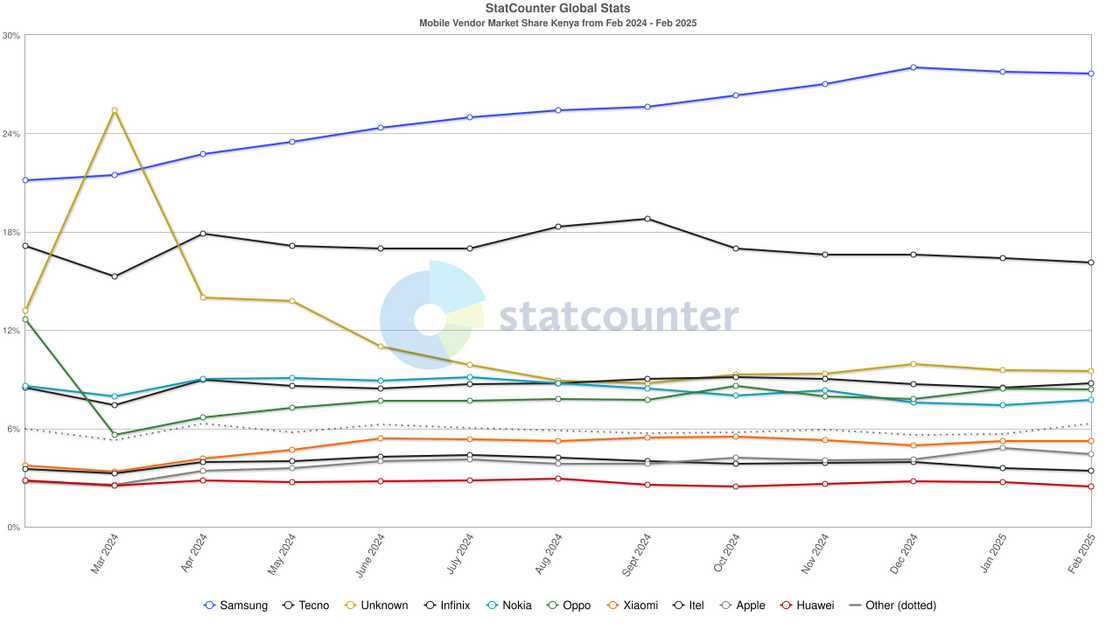
Based on recent data provided by Statcounter, Samsung dominates Kenya’s mobile market with around 28% of the market share as of early 2025.
The widespread appeal of this major South Korean technology company can be linked to its extensive lineup of products, spanning cost-effective options all the way up to high-end flagship smartphones such as the Galaxy S series, thus appealing to Kenya’s varied customer market.
Tecno, a subsidiary of Transsion Holdings that holds approximately 16.5% of the market share, ranks second. Following close behind is Infinix, another brand owned by Transsion, holding around 8%. Additionally, Itel, yet another brand within the Transsion family, secures a modest but significant portion of the market.
The Chinese technology innovator Xiaomi has similarly gained considerable ground, capturing around 5% of the market share in Kenya. This achievement can be attributed to the brand’s strategic growth in both physical retail outlets and online accessibility within the country.
-
Samsung – 27.66%
-
Tecno – 16.14%
-
Infinix – 8.75%
-
OPPO – 8.39%
-
HMD Global (Nokia) – 7.74%
-
Xiaomi – 5.23%
-
Apple – 4.43%
-
Itel – 3.41%
-
Huawei – 2.48%
-
Approximately 15.77% of the market is held by other brands and participants in the market.