oleh admin | Apr 3, 2025 | foreign policy, military, national security, politics, u.s. china relations
The visit of U.S. Defense Secretary Pete Hegseth to Asia has caused quite an uproar, with the blame falling squarely on the United States and its assertive approach. During his tour, he traveled to the Philippines and Japan—key U.S. allies that house many American military installations, likely positioning them as crucial players in any confrontation involving China. There, Hegseth seized the moment to heavily criticize Beijing and covertly bolster backing for Taiwan’s autonomy.
As a countermeasure, China carried out military exercises near Taiwan’s north, south, and east coast areas, serving as an explicit warning against secessionist tendencies. Additionally, Chinese authorities released a harsh critique labeling Taiwan’s leader as a ‘parasite.’ This action represents a significant intensification compared to earlier military practices, usually pre-announced and integrated into routine training schedules. In contrast, this recent move demonstrated Beijing’s immediate and unequivocal stance, indicating their readiness for prompt reprisals should provocative statements continue.
These events occur at a crucial time. U.S. President Donald Trump’s tariffs have estranged important partners such as Japan and South Korea, prompting them to seek increased economic collaboration with China in order to craft a coordinated strategy against Washington’s trade actions. The presumed solidarity within an anti-China coalition in Asia might prove weaker than what the United States expected, as local powers reconsider the hazards of aligning too tightly with America’s geostrategic objectives.
This is notably clear regarding Ukraine’s situation. Having once been a crucial Western partner, it has had its population and assets depleted, and has been utilized for its residual natural resources before being left behind. Aggressive moves by the United States will likely exacerbate divisions within the region and heighten the risk of unrest instead of solidifying the alliances they aim to preserve.
Provided by Syndigate Media Inc. (
Syndigate.info
).

oleh admin | Mar 24, 2025 | asia, business, energy sector, politics, u.s. china relations
The “regressive policy shifts” implemented by US President Donald Trump concerning China’s solar industry may inadvertently damage America’s clean energy sector by prompting Chinese companies to divert their investments elsewhere, as stated in a recent report.
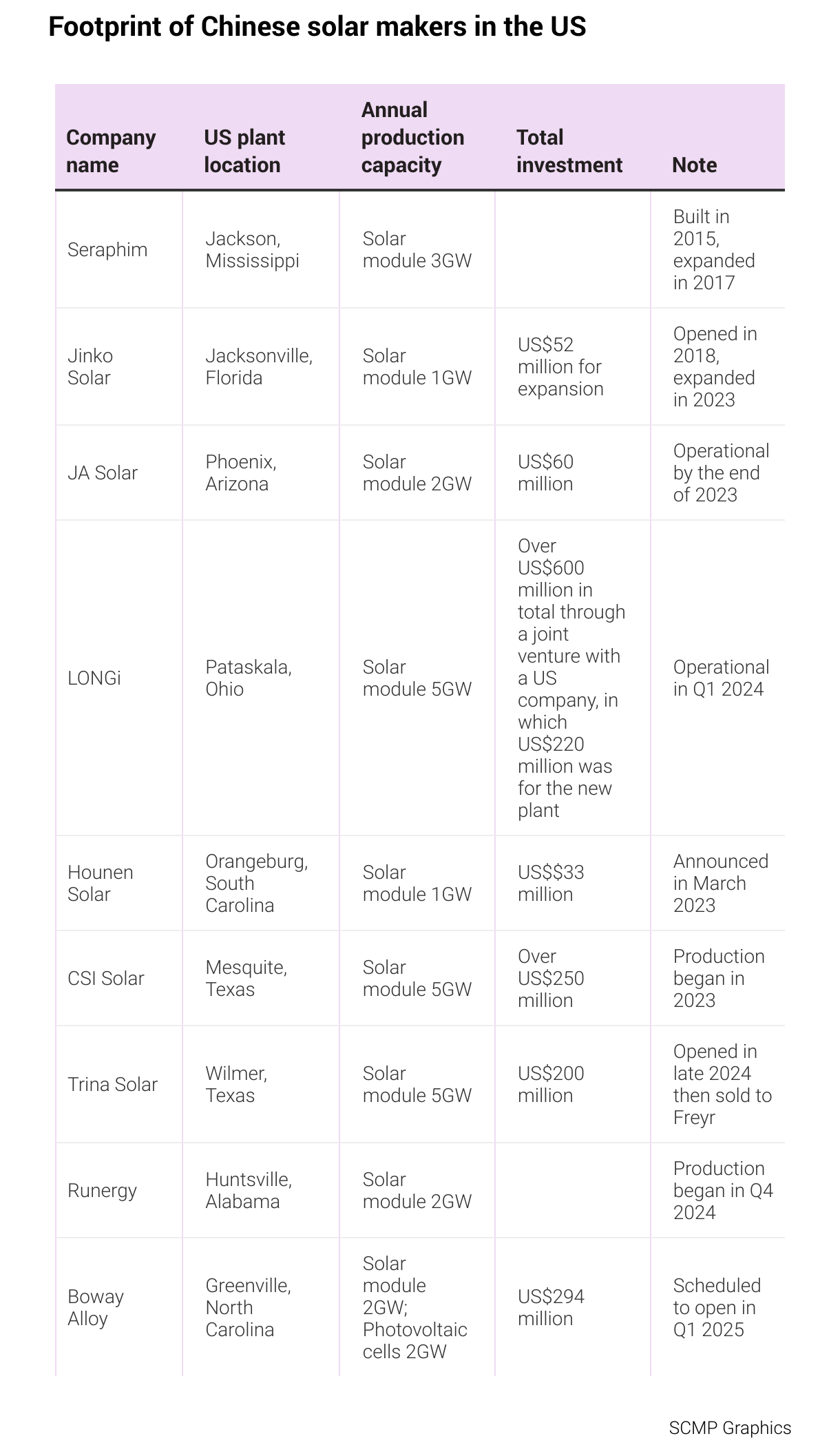
Chinese solar firms had committed to constructing multiple facilities for producing photovoltaic solar components in the U.S., with plans totaling more than 20 GW expected to become operational by late 2025. However, future initiatives could face challenges because of policy changes under the Trump administration, according to an analysis of worldwide solar manufacturing developments published on Monday by the Sydney-based research group Climate Energy Finance.
Since resuming his role in the administration, Trump has
raised tariffs
For all Chinese products, the tax breaks established under the Inflation Reduction Act to motivate companies to move their manufacturing to the United States were put on hold, along with Department of Energy loans being suspended. This has made Chinese solar businesses hesitant when considering investments in the U.S. market.
Are you looking for insights into the most significant issues and global trends? Find your answers here.
SCMP Knowledge
Our updated platform features handpicked content including explainer articles, FAQ sections, detailed analysis, and informative infographics, all provided by our acclaimed team.
“Import taxes can shield local producers, yet this comes with the drawback of higher expenses for domestic buyers,” stated Harry Martin, an analyst from the research institute.
Instead, Chinese companies will
accelerate their expansion
Into Southeast Asia and the Middle East, where authorities must rapidly increase solar power capabilities to address escalating energy needs.
“Other policymakers should pay attention: erecting trade barriers against China will merely divert investments to other areas ready to capitalize on its tech supremacy,” Martin stated.
China is the energy boon of this century – why lock the stable door? Numerous countries are already securing their positions with attractive incentives.
Last year, China’s outward investment in clean technology “turned into a major rush,” with Chinese firms pouring approximately US$140 billion into overseas projects since 2023, according to the report.
Before Trump’s presidency, Chinese firms had been actively seeking investment opportunities in the U.S. As highlighted in the report, in 2024, China-based LONGi teamed up with American clean energy firm Invenergy to launch a 5 GW photovoltaic (PV) solar panel plant in Ohio. Additionally, Jiangsu Runergy inaugurated a 2 GW PV module facility in Alabama as per the same document.
However, China’s solar sector is now redirecting its focus to other markets. The report forecasts that by 2030, Chinese firms will dominate the module manufacturing capacity in the Middle East and North Africa — just as they currently do in Southeast Asia.
In 2024, China favored forming strategic partnerships and undertaking extensive multi-phase initiatives in Southeast Asia, the Middle East, North Africa, and the broader Global South, according to Climate Energy Finance.
The report stated that government-set renewable energy goals, utility-led auctions, incentive programs, and extended power purchasing contracts were the factors attracting Chinese firms to invest in these areas.
Through expansion into Southeast Asia, Chinese firms have the potential to serve Western energy markets by bypassing trade barriers via solar photovoltaic production primarily situated in countries like Vietnam, Thailand, Cambodia, and Malaysia, as mentioned in the report.
The report mentioned that in late 2024, the United States introduced anti-dumping and countervailing duties as high as 271 percent on panels coming from specific Southeast Asian countries. This action impacted Chinese initiatives within the area.
These additional responsibilities have imposed significant financial strain on Chinese producers and led to reduced output and idle facilities in nations such as Vietnam.
However, Chinese manufacturers have countered by relocating their production to countries like Indonesia and Laos that are exempt from these tariffs, according to Martin.
According to the report, Chinese firms are making significant advances in the Middle East and North Africa, drawn by factors such as free trade zones, reasonably priced land, exemption from tariffs, substantial governmental backing, increasing domestic consumption, and their pivotal role for accessing both burgeoning and European-American markets.
“Saudi Arabia
is leading the region
In terms of luring investments from Chinese solar photovoltaic firms, the area is witnessing multibillion-dollar commitments from these enterprises,” stated Martin.
More Articles from SCMP
What is 6G and why is China racing ahead of US and Europe with the technology?
8 participants from the Hong Kong study group traveling to mainland China contracted norovirus.
AI specialist Guo-Jun Qi moves from the US to China
Rolling out the red carpet for ASEAN guests is indeed the appropriate move.
Chinese Premier Li Qiang meets US Senator Daines: calls for frankness, deeper trust
The article initially appeared on the South ChinaMorning Post (www.scmp.com), which is the premier source for news coverage of China andAsia.
Copyright © 2025. South ChinaMorning Post Publishers Ltd. All rights reserved.