
oleh admin | Mar 24, 2025 | africa, international aid, international news, united nations, world
The United Nations’ leading AIDS official warned on Monday that the abrupt cessation of U.S. foreign aid could cause the world to revert to the most devastating periods of the global AIDS epidemic, with millions facing death as a result.
Historically, the United States has led as the largest provider of humanitarian aid globally. However, after President Donald Trump returned to the White House about two months ago, he significantly reduced international assistance, causing widespread disruption within the global humanitarian sector.
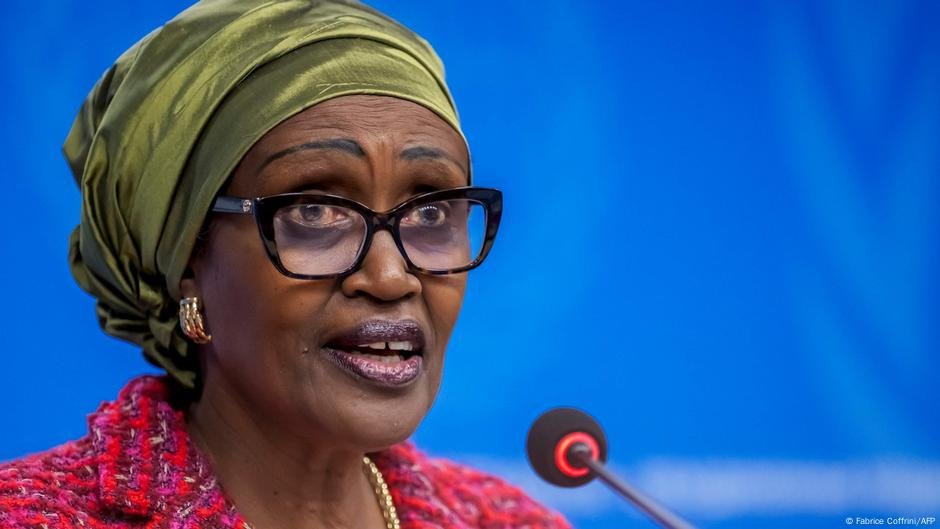
The UNAIDS Executive Director, Winnie Byanyima, warned that failure to reinstate U.S. funding or secure contributions from other sources could result in “an additional… six-point-three million AIDS-related fatalities” within just four years, marking a tenfold rise in mortality rates during this period.
“You’re discussing the potential loss of progress achieved over the past 25 years. This is quite concerning,” she stated to journalists in Geneva.
“It is understandable for the U.S. to aim at gradually decreasing its financial contributions, however, the abrupt termination of essential aid is causing severe consequences,” she stated.
The reductions from the U.S. imply that currently, 27 nations across Africa and Asia are facing staffing shortages, diagnostic services and treatments are being disrupted, and disease monitoring systems are deteriorating.
– Risk of global AIDS rebound
Beyond the upcoming four-year period, If assistance funding isn’t reinstated, “we anticipate the resurgence of the AIDS epidemic… on a global scale,” Byanyima warned. This escalation would particularly affect regions such as Eastern Europe and Latin America.
We’ll witness its return, and we’ll see people pass away just as we observed in the ’90s and the 2000s.
She praised American leadership in the battle against AIDS as “one of the most humanitarian efforts in global health.”
She pointed out the US anti-HIV program known as PEPFAR, renowned as one of global health’s greatest successes for saving approximately 26 million lives throughout its twenty-year span.
Now, owing to American innovations, the world stands “on the brink of another revolution in preventive treatments,” Byanyima stated, highlighting a novel medication known as lenacapavir, which was created by the U.S. pharmaceutical company Gilead.
Studies have shown the medication to be 100% effective, and Byanyima mentioned that trials are ongoing with the aim of administering it as a yearly single dose, making it much more affordable for lower-income nations.
That is similar to a flu vaccine,” she stated. “If implemented aggressively…we could reduce new infections nearly to zero. We might witness the end of AIDS.
Byanyima reached out to the “bargain-making” President Trump personally, emphasizing that reviving the worldwide HIV response would be “a tremendous bargain”: lenacapavir has the potential to “generate profits for Gilead, foster good job opportunities for Americans, and save lives.”
She proposed that once PEPFAR resumes operations, UNAIDS can collaborate with the United States and other contributors to assist low-income nations in achieving autonomy in their battle against HIV.
The post
The AIDS epidemic poses a renewed global threat due to halted U.S. funding, warns the United Nations.
appeared first on
LIFEHACKEnglish – Morocco News
.
oleh admin | Mar 24, 2025 | africa, international aid, international news, news, world
The leader of the UNAIDS program has stated that millions additional deaths may occur due to the abrupt funding reductions implemented by the Trump administration. She further cautioned that the AIDS crisis might revert to the severity observed during the 1990s.
The leader of the UN’s HIV/AIDS initiative, UNAIDS, stated on Monday that cutting funds by the U.S. could result in more than 6 million extra fatalities related to the illness.
The UNAIDS Executive Director, Winnie Byanyima, stated that the
abrupt changes from the U.S.
, which had previously been the largest contributor to the program, was described as “devastating.”
She told reporters in Geneva that you’re discussing the potential loss of progress achieved over the past 25 years, which is quite grave.
More than 6 million extra AIDS-related fatalities
If U.S. assistance is not reinstated and not supplemented by alternative financing—and we haven’t received word from other nations committing to bridge the shortfall—there
would result in another 6.3 million additional AIDS-related fatalities.
— over the coming four years,” ByanyIMA stated.
She noted that approximately 600,000 deaths related to AIDS were documented worldwide as of the latest figures in 2023.
Byanyanya additionally mentioned that an extra 8.7 million new infections were anticipated.
The head of UNAIDS stated that beyond the immediate future, unless the funding shortfall is addressed, the AIDS epidemic might revert to the severity observed during the 1990s.
“However, this concentration isn’t limited to the low-income African nations where it currently stands prominent; it’s also rising among so-called key populations across Eastern Europe and Latin America,” she stated.
There will be a significant increase in cases of this illness. It will return, and we will witness fatalities similar to those seen during the ‘90s and early 2000s.
![]()
The head of UNAIDS urges the U.S. to reassess abrupt funding reductions.
US President Donald Trump, along with his prominent supporter billionaire Elon Musk, has supervised substantial reductions in federal expenditures, particularly in the realm of US international assistance.
The choice to reduce financial support for the battle against AIDS has
ignited demonstrations domestically
and
abroad
.
Byanyima adopted an empathetic stance, simultaneously urging the White House to reassess its choice.
“It makes sense for the U.S. to aim at decreasing its financial contribution gradually, however, abruptly halting essential aid is causing severe consequences,” she stated.
We strongly advocate for a reassessment and swift reinstatement of essential services, particularly those critical for saving lives.
Edited by: Jenipher Camino Gonzalez
Author: Alex Berry (compiled with AFP, Reuters)

oleh admin | Mar 24, 2025 | geology, volcanic eruptions, volcanoes, volcanology, world
-
EXPLORE FURTHER: How would life on our planet be different if Yellowstone were to erupt?
Located five miles below the surface of Yellowstone National Park in
Wyoming
is a timebomb that has been brewing for over 640,000 years.
The Yellowstone supervolcano is a huge chamber filled with molten rock that has the capability to
trigger an eruption categorically eight times stronger than one hundred Krakatoa explosions
.
Thankfully,
Yellowstone
Has not had an eruption since humans started recording history.
However, a recent finding has underscored just how active this apparently inactive volcano truly is.
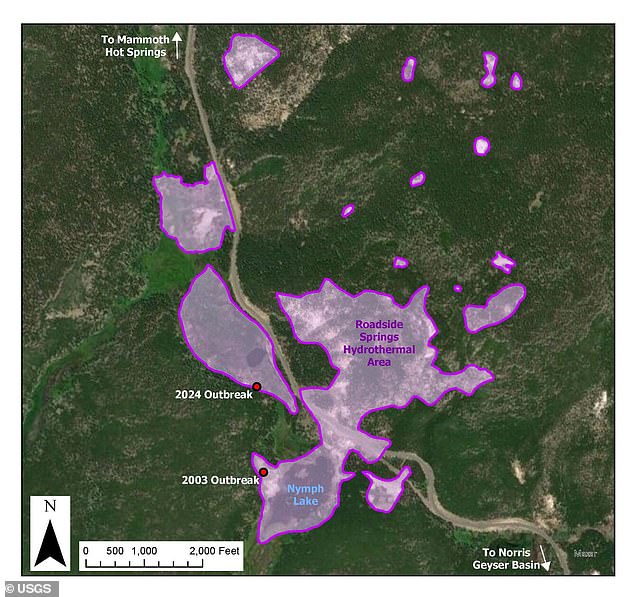
Researchers with the United States Geological Survey (USGS) have identified a recently formed volcanic vent in Norris Geyser Basin.
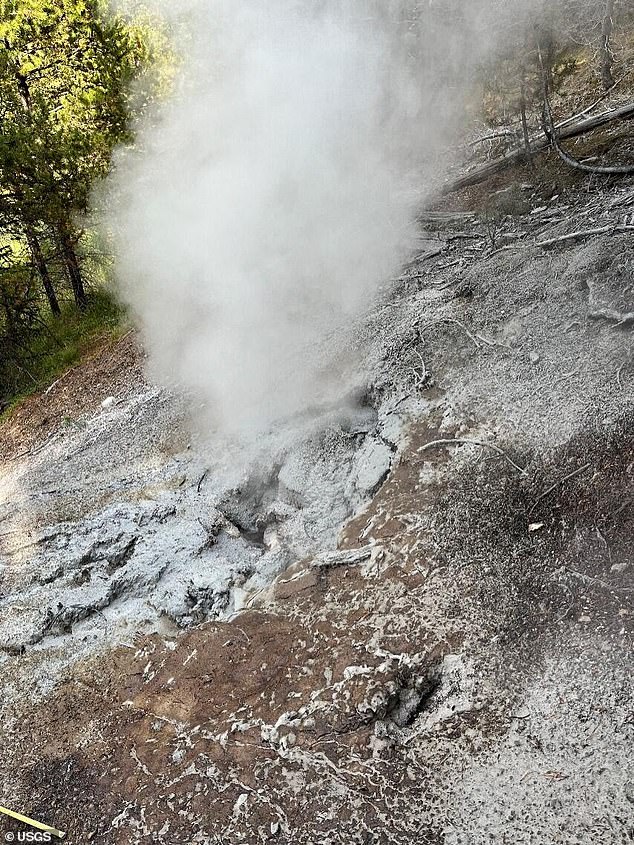
The vent is located at the base of a rhyolite lava flow and is releasing scalding steam upwards into the atmosphere.
‘While driving south from Mammoth Hot Springs towards Norris Geyser Basin early on August 5 last summer, a park scientist noticed a billowing steam column through the trees and across a marshy expanse,’ the USGS explained.
The keen-eyed scientist alerted the park geology team to confirm whether this was actually new activity.
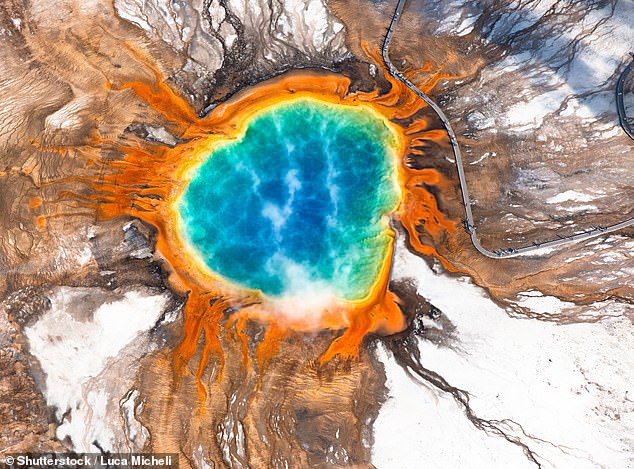
The discovery of the new vent took place last summer inside an area known as the Roadside Springs thermal region.
Situated in an area marked by warm, hydrothermally altered terrain, the newly discovered feature spans roughly 200 feet (60 meters) in length and lies about 9.8 feet (three meters) beneath the surface of the marsh.
Soon after its discovery, park geologists went to examine the vent up close.
Over there, they found a layer of gray siliceous clay that was extremely thin, scarcely covering the surface, with temperatures reaching 77°C (171°F).
The team suggests that this shows the new vent is quite ‘recently formed.’
This kind of hydrothermal activity hasn’t been observed for the first time in this region.
In 2003, a comparable vent was observed on the opposite side of the same rhyolite lava flow.
USGS questioned whether the new feature and the event initiated in 2003 have a hydrological connection.
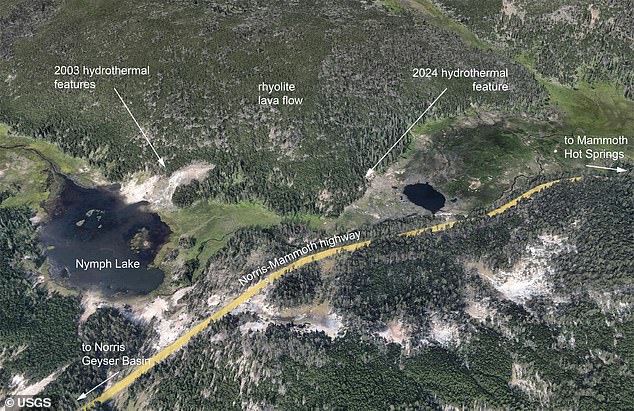
‘Probably.
‘A line drawn along the axis of the more ancient active region would cross through the newer feature.’
This line continues the pattern of fault lines extending from Norris Geyser Basin northwards towards Mammoth Hot Springs and further areas.
The fresh vent kept releasing steam into the sky throughout autumn, yet slowly faded away during the winter months.
“The feature stays enabled; however, there is some moisture present in the vent, which reduces the quantity of steam emitted,” the specialists noted.
‘It remains to be seen whether the robust plume will return during the summer of 2025.’
Up until now, geologists have documented over 100 significant hydrothermal sites in Yellowstone National Park and more than 10,000 features of these systems within its borders.
“The intensity of these phenomena fluctuates over time—one could say that some of them actually gain momentum!” the experts quipped.
Fortunately, USGS assures us that we have approximately 100,000 more years before the supervolcano is expected to erupt.
“When it comes to major eruptions, Yellowstone has had three such events approximately 2.08, 1.3, and 0.631 million years apart,” it stated.
This averages out to approximately 725,000 years per eruption.
‘Given these circumstances, we have roughly another 100,000 years before the next event; however, this estimation relies solely on the averages from only two eruption intervals, making it essentially insignificant.’
Read more

oleh admin | Mar 24, 2025 | football players, soccer, sports, tournaments, world
-
FIFA has formally announced that two nations will secure their spots for the 2026 World Cup scheduled to commence in June of next year.
-
The upcoming year’s competition will include 48 nations and hold significance as it will span across three different countries.
-
Kenya’s chances of participating in the tournament were severely undermined following a devastating 2-1 loss to Gabon on Sunday.
The 2026 FIFA Men’s World Cup will be held from June 11 to July 19, 2026, spanning multiple venues in the United States, Canada, and Mexico.
In the 23rd iteration of the competition, the structure will be broadened to include 48 teams vying for the championship. FIFA has already announced the initial pair of nations that have secured their spots in the event.

Kenya’s chances of qualifying for this particular tournament were significantly hindered on Sunday night following their 2-1 defeat against Gabon at the Nyayo National Stadium.
Prior to Monday’s match, Kenya had tied with Gambia in an exciting game held in Ivory Coast, which significantly dimmed their chances of making it to the tournament.
Setback for Kenya’s 2026 World Cup aspirations
Gabon’s win against Kenya propelled them two points above Ivory Coast to lead Group F.
The team that wins each group will secure direct qualification for the 2026 tournament.
The top four runners-up from the nine groups advance to the playoff stage for a chance at securing a spot in an intercontinental qualifier.
Under Benni McCarthy, Kenya tied with Gambia but lost to Gabon, leaving them seven points behind second-place Ivory Coast.
The Elephants still have an additional match and might climb to the top spot if they secure victory over Gambia on Monday.
Two countries clinch berths for the 2026 World Cup.
FIFA has officially announced Japan and New Zealand as the initial two nations to secure their spots in the 2026 World Cup.
In what manner did Japan secure their spot in the competition?
Japan secured their place in the competition on Thursday night following a decisive 2-0 victory over Bahrain at Saitama Stadium.
In Group C, Japan won all six of their matches and drew with Australia out of the seven games played.

New Zealand has secured a spot in the 2026 FIFA World Cup.
As stated on the FIFA website, New Zealand secured their spot at the 2026 World Cup following their victory over New Caledonia with a score of 3-0 in the finals of the OFC qualifying tournament held on Monday.
It will mark the nation’s third qualification following their participation in Spain in 1982 and South Africa in 2010.
Now all White nations will participate alongside Japan, Mexico, the United States, and Canada, who have already secured their spots in the 48-team championship.
New Caledonia gets an opportunity to rejuvenate its prospects in the playoff stage featuring clubs from Asian, North, South, and Central American confederations.
Infantino suggests potential reinstatement of Russia for World Cup
LIFEHACK.co.ke
Previously mentioned was the news that FIFA President Gianni Infantino suggested the potential for Russia’s return to the 2026 World Cup competition.
Infantino mentioned that Russia could potentially regain entry into global football competitions such as the World Cup should worldwide peace be achieved again.
oleh admin | Mar 24, 2025 | africa, kenya, nigeria, south africa, world
The continent of Africa boasts several of the planet’s quickest-expanding populations. Rich with varied cultures, economic systems, and terrains, certain countries within this region distinguish themselves due to their substantial population sizes. In this piece, we will delve into the ten most populated African countries as per data provided by Worldometer.
1. Nigeria
Leading this ranking is Nigeria, often referred to as the giant of Africa, which boasts a population of 235,926,762 people as of Q1 2025.
In 2025, Nigeria’s projected population for mid-year is around 237,527,782 individuals, which represents approximately 2.89% of the global populace.
2. Ethiopia
The next entry on the list is Ethiopia, an East African nation with a present population of 134,339,653 according to Worldometer’s analysis of recent UN statistics.
The projected population for Ethiopia in 2025 is approximately 135,472,051 people as of mid-year, representing 1.65% of the global population.
3. Egypt
The Arab Republic of Egypt boasts a current population of 117,765,537. Situated at the northeastern edge of Africa, this nation is anticipated to reach an estimated populace of around 118,365,995 individuals by mid-2025.
African countries should join forces for progress and food security, asserts Tunisian ambassador; meanwhile, Labor calls for building up industrial capabilities within Africa.
Egypt’s populace makes up 1.44% of the global population.
4. DR Congo
A highly populated African nation is the Democratic Republic of the Congo. As the second-largest country in Africa by land area, DR Congo currently boasts a population of 111,644,570.
The projected population for DR Congo in 2025 is anticipated to reach approximately 112,832,473 individuals by mid-year. This number represents about 1.37% of the global population.
5. Tanzania
Tanzania, which boasts some of the world’s most prized national parks and game reserves, has a populace of 69,884,870 inhabitants.
The projected population of Tanzania for mid-2025 is approximately 70,545,865 inhabitants.
Tanzania’s populace makes up 0.86% of the global population.
6. South Africa
In this ranking, South Africa holds the sixth position with a populace of 64,505,178 individuals. By mid-2025, it is projected that South Africa will have around 64,747,319 inhabitants, which constitutes roughly 0.79% of Earth’s total population.
7. Kenya
Kenya, a significant nation in Eastern Africa, boasts a population of 57,169,886 as per Worldometer data.
Kenya’s population was approximately 57,532,493 people as of mid-year and represents about 0.7% of the global population.
8. Sudan
Next up is Sudan, a country that boasts one of Africa’s earliest and most sophisticated civilizations—the ancient Nubian culture—boasting a present-day population of 51,260,250 inhabitants.
The population of Sudan, making up 0.63% of the global populace, is approximately 51,662,147 people midway through the year.
9. Uganda
Uganda, often referred to as the Pearl of Africa, takes the ninth spot on this ranking with a populace totaling 50,929,621 inhabitants.
It is anticipated that Uganda’s population will reach approximately 51,384,894 people by the end of the year. This number represents 0.62% of the global population.
10. Algeria
Finishing off the list is the People’s Democratic Republic of Algeria, which has a population of 47,231,794.
It is anticipated that Algeria’s population will increase to approximately 47,435,312 individuals by the year 2025, representing 0.58% of the global populace at present.
Morocco, Angola, Mozambique, Ghana, Madagascar, and Ivory Coast are additional heavily populated countries in Africa.
Get real-time news updates from Tribune Online! Follow us on WhatsApp for breaking news, exclusive stories and interviews, and much more. Join our WhatsApp Channel now
Tags: African Countries Supplied by SyndiGate Media Inc. (
Syndigate.info
).

oleh admin | Mar 24, 2025 | environmental friendliness, technology, washing, washing machines, world
OSAKA — Ahead of the commencement of the World Expo in Osaka, reporters were granted an early look at the futuristic “human washing machine,” scheduled for display, when Governor Hirofumi Yoshimura demonstrated its usage during a press event on March 23rd.
At the Osaka Healthcare Pavilion, visitors can experience a single-person, oval-shaped pod filled with water up to their chest. Inside, they are cleansed using bubbles and receive additional washing through overhead showers. Once clean, warm air dries them off. The system enhances the bathing experience by playing soothing music and displaying visual content tailored to the bather’s physiological state, such as heart rate, which is monitored via built-in sensors.
Yoshimura, clad in a wetsuit, put the device through testing and commented, “It feels great.” Once done, he appeared revitalized and dabbed at his somewhat damp face and hair using a towel.
Following Sanyo Electric Co.’s impressive display of the initial “human washing machine” at the 1970 Expo in Osaka Prefecture, Water Purifier Manufacturer Science, located in Osaka City’s Yodogawa Ward, revamped the initiative. The aim extended beyond automatic body cleansing to providing spiritual comfort as well.
(Japanese original by Sayuri Toda from the Osaka City News Department)


