by admin | Apr 12, 2025 | challenges, foreign policy, politics, politics and government, public policy
A lot has been discussed regarding foreign policy challenges. However, Pakistan also faces numerous domestic policy issues that continue to pose difficulties.
Initially, the idea of federation appears to elude Pakistan. In this setup, it isn’t the Central government that forms the individual units or provinces; rather, these units come together to form the Center. These units establish an agreement to distribute authority between themselves and the Center. They also determine how much control they surrender to the Center. It’s not up to the Center to choose what powers to grant to the units. Powers traditionally held by the Center—such as maintaining armed forces, crafting foreign policies, and managing a unified currency—are subject to approval from the units. This approach has led Pakistan’s Center to overlook the essence of federalism, resulting in ongoing instability characterized by various issues like regional conflicts and even secessionist sentiments. For instance, Balochistan exemplifies political manipulation alongside imposed administrations, leading to profound discontent across the region.
Secondly, Pakistan finds itself engaged in a defensive struggle as consciousness spreads throughout the nation. This awakening is relentless and unforgiving. Whether advocating for the rights of the Pashtuns or Baloch, these individuals are gaining listeners—not primarily through traditional broadcast media but rather via social platforms, which link them together. Although one such medium might be restricted under claims of national security, blocking all remains impossible. Both ethnic groups condemn incidents of missing persons and arbitrary executions, actions that contravene fundamental human rights principles. Protesting Baloch women led by Dr. Mahrang Baloch reject an approach where progress in Balochistan comes at the cost of forced disappearances and deceased victims showing signs of torture. Consequently, this situation traps Balochistan in a state of impasse. A comparable standstill could soon envelop Khyber Pakhtunkhwa (KPK) as well. The appearance of tortured corpses in Balochistan serves as a blight, reflecting twisted intentions aimed at deforming the federal structure’s image.
Thirdly, Pakistan lacks the capability to tackle its economic issues independently. The country faces bankruptcy since it can only manage its debt through additional loans. It remains unclear how these debts will ever be repaid. Thus, external financial aid is essential for Pakistan’s survival. The nation finds itself entirely dependent on creditors. These loans are taken out with hopes of gaining enough breathing room to stabilize their economy temporarily.
Currently, efforts focus on boosting commercial agriculture production. Converting unproductive land into arable fields generally makes sense economically. However, this situation presents contradictory approaches: While increasingly valuable farmland in northern and central Punjab—regions nourished by rainfall and fresh water—is earmarked for residential development, initiatives aim to transform parts of the Cholistan Desert—a region within the parched areas of southern Punjab associated with the Thar Desert—into viable cropland.
This dual strategy exemplifies misguided priorities which could undermine the broader goals set under the Green Pakistan project.
Fourthly, Pakistan’s western region is seeing the rise of zones where movement and presence have become hazardous, particularly during nighttime hours. Incidents like those targeting the Bannu Cantt in KPK and the Jaffar Express in Balochistan highlight how spaces previously under government control are now ceding ground to terrorist activities. This has led to a weakening of governmental authority. As usual, discussions about addressing this issue often revert to initiating military campaigns, sparking the perennial ‘chicken-and-egg’ dilemma: whether instability invites intervention or vice versa. Generally, it is believed that such military actions breed resentment, fostering regional divisions that ultimately undermine the idea of federal unity.
Fifth, Pakistan faces the issue of guerrilla warfare seeping into its territory from either northern or southern parts of its western frontier. The Pakistani military is primarily equipped for conventional conflicts rather than irregular skirmishes. Recently, Pakistan sanctioned the creation of Rangers in the region of Azad Kashmir under its control. This suggests growing unrest within those areas as well. Consequently, this situation signals the onset of a limited-scale confrontation. Rather than addressing underlying grievances through political channels, Pakistan has opted for forceful tactics, failing to recognize that Kashmir harbors fighters adept at conducting guerilla operations. These individuals previously engaged in such activities against Indian troops along India’s borders. They now pose a similar threat inside Pakistan-controlled portions of Kashmir.
Sixth, Pakistan lacks the financial resources needed for launching military campaigns and covering the economic impact caused by displacing residents. Previously, clearance operations in Southern and Northern Waziristan involved clearing out populations before completely destroying entire villages through bombings. As a result, locals became internally displaced individuals. High human casualties—both among soldiers and civilians—and significant economic expenses made these efforts daunting. To minimize direct troop involvement, Pakistan now relies heavily on drone attacks, mirroring U.S. tactics used in Afghanistan. While the United States applied this approach primarily against foreign adversaries, Pakistan uses similar methods within its borders against its citizens—a concerning development. Civilian deaths from accidental harm have consistently placed such actions under scrutiny. For instance, a recent targeted drone attack during an anti-terrorism operation near Katland in Mardan (Khyber Pakhtunkhwa) exemplifies how collateral damage can exacerbate local conflicts. This could be seen as intentional mismanagement, considering Pakistan’s record of alleged human rights abuses is nearly at capacity.
In general, Pakistan excels at managing situations through improvisation: buying time and seeking funding to address issues. However, this approach leads to the consumption of both time and resources without significant advancements. The challenges facing the idea of federalism are becoming more pronounced. Using force provides limited resolutions and often creates additional complications.
Provided by SyndiGate Media Inc.
Syndigate.info
).
by admin | Apr 11, 2025 | foreign policy, government, international relations, politics, politics and government
Pakistan, April 6 — A U.S. delegation is scheduled to visit Islamabad from April 8-10, 2025. Headed by Eric Meyer, a high-ranking official at the State Department, this trip aims to advance American interests within Pakistan’s mineral resources sector. During their stay, they will participate in the Pakistan Minerals Investment Forum (PMIF25), which is being hosted jointly by the Oil and Gas Development Company Limited (OGDCL) and the Pakistani government.
The forum is scheduled for April 8-9 at the Jinnah Convention Centre. Its purpose is to provide an international stage where key players can investigate investment prospects within Pakistan’s developing minerals industry. Attendees will have the opportunity to gain insights into the nation’s abundant mineral wealth, encompassing as many as 92 identified minerals.
While visiting Pakistan, Meyer intends to hold discussions with high-ranking Pakistani authorities. The talks will center around bolstering economic relationships and promoting U.S. investments in Pakistan’s mining sector. Additionally, Meyer aims to address continuing collaboration between both nations concerning anti-terrorism initiatives when he meets with local leadership.
Following President Donald Trump’s imposition of a 29% retaliatory tariff on imports from Pakistan, this visit follows suit. In reaction, Prime Minister Shehbaz Sharif established two specialized committees to develop an appropriate policy response. Moreover, Finance Minister Muhammad Aurangzebsaid that a team would travel to Washington D.C.to lobby for Pakistan’s economic interests.
by admin | Apr 10, 2025 | foreign policy, news, politics, politics and government, politics and law
The
The federal government is evaluating prospective candidates for positions within its various diplomatic offices across 109 missions, including 76 embassies, 22 high commissions, and 11 global consulates.
Sunday PUNCH
reports.
Sources well-informed about the situation disclosed that Mr. Femi Fani-Kayode, who previously served as the Minister of Aviation during the Obasanjo administration, along with Femi Pedro, a former Deputy Governor of Lagos State, have been included in the list of nominees.
Sunday PUNCH
It was also noted that the screening process does not take place at a central location; instead, nominees are instructed to go to the closest DSS office.
Presidential staffers verified for our reporter that multiple contenders were reached out to for submitting their individual educational background and professional experience details.
They are currently conducting security checks with DSS. Once these checks are completed and clearance is granted, we will publish the list.
Those who have been cleared will be disclosed,” stated an official anonymously due to lack of authorization for media communication. They added, “The procedure is still underway. By the end of April, we aim to have a comprehensive list.
A different informant stated, “The screening process doesn’t happen at a central point. Instead, it depends on the nominees’ locations. The candidates have been contacted to submit their personal background details along with specifics such as the schools they graduated from and positions they’ve occupied. Hence, this procedure follows geographical distribution.”
Tinubu’s Four Ds and financial challenges
Starting from September 2023, President Bola Tinubu has implemented his foreign policy based on four key concepts: Democracy, Development, Demography, and Diaspora, all while functioning without ambassadors.
During that period, he completed an extensive review of Nigeria’s foreign policy across all sectors, resulting in more than 83 both career and non-career ambassadors being called back from their respective posts.
Last December, reliable sources close to the President confirmed that Tinubu spent part of his holiday reviewing the names of nominees with plans to transmit a consolidated list to the National Assembly before the end of the month.
Nevertheless, updates in January indicated that the President had altered his position.
Our reporter learned that the project faced delays because of insufficient funds—amounting to approximately $1 billion—that were needed to clear back payments for overseas staff, address accumulated expenses, upgrade old vehicles, and refurbish embassy structures.
A representative, speaking under conditions of confidentiality, stated, “The primary concern revolves around finances. It’s not about funding for the ambassadors themselves; we must consider their compensation packages and allowances. Instead, the critical financial aspect pertains to CAPEX [Capital Expenditure]. When all costs associated with resolving these problems are tallied up, they approach nearly $1 billion.”
Out of all these embassies, nearly 90 percent appear dilapidated. They might suffer from poor living conditions for residents, non-functional offices, or overdue rents. As far as functioning well-maintained ones go, they probably do not exceed 10.
I realize that many lack functional transportation options; their most recent vehicle purchases date back ten years. These cars often break down, which makes them unsuitable for diplomats since these officials represent their nation’s prestige. Additionally, basic amenities like electricity and running water may be absent in those areas. Therefore, assigning ambassadors to such locations would place them in difficult circumstances.
The Minister of Foreign Affairs, Yusuf Tuggar, similarly pointed out that the delays were due to financial limitations.
“It’s an issue with finances,” Tuggar stated at a ministerial briefing in Abuja last May.
He contended that assigning ambassadors lacking the necessary funds for travel and efficient operation of embassies overseas served no purpose.
We encountered a scenario where foreign affairs were underfunded as they should have been. Certain loopholes are taken advantage of by entities similar to Binance. This issue stems from financial constraints.
“There is no point sending out ambassadors if you do not have the funds for them to even travel to their designated countries and to run the missions effectively, one needs funding. Mr President is working on it, and it will be done in due course,” Tuggar said.
A representative from the foreign service mentioned that although the 2025 budget included allocations to address part of this expense, the amount was insufficient.
Nominees on the list
Senior officials from the presidency and foreign services have stated that even though the full list of candidates remains strictly confidential, several well-known and contentious individuals are currently under consideration.
An official stated, “The announcements regarding these appointments will be made shortly. These selections are currently under review. For the moment, the identities of those nominated remain strictly confidential since some of the individuals initially considered may not ultimately be approved.”
FFK [Femi Fani-Kayode] is included in the list. Among these, several contentious names have also been proposed. Additionally, Fola Adeola [the founder of Guaranty Trust Bank Plc] and Femi Pedro are part of it as well. This time around, they’re advancing the process at a faster pace.
Offering explanations for the sluggish procedure, an additional official clarified that the scrutiny was essential to prevent potential issues that could tarnish the nation’s reputation internationally.
“The nominees are currently undergoing scrutiny, with background investigations being carried out. This process ensures that the nominees do not present any security concerns and guarantees their appointment won’t adversely affect the nation,” explained the official.
It was also alleged that Reno Omokri, who previously served as an aide to ex-President Goodluck Jonathan, appeared on this list.
However, a reliable source from the Presidency refuted this claim.
“Reno doesn’t appear on the list, but FFK does,” the source stated.
The President’s Special Advisor on Information and Strategy, Mr. Bayo Onanuga, who previously addressed the delays, stated that nominations for ambassadorial positions require comprehensive scrutiny before being submitted to the National Assembly as a finalized list.
“Don’t overlook the fact that the ambassadorial list consists of two parts: career ambassadors and political ambassadors. Both the foreign affairs list and the consolidated list will undergo specific procedures before being made public,” he clarified.
When two of the nominees were reached out to by
Sunday PUNCH
, declined comment.
They neither confirmed nor denied the report.
Provided by SyndiGate Media Inc.
Syndigate.info
).
by admin | Apr 8, 2025 | foreign policy, news, passports and international travel, politics, politics and government
The Foreign Office stated on Wednesday that Pakistani passports are invalid for traveling to Israel.
Regarding inquiries into alleged visits by Pakistani journalists to Israel, a spokesman from the Ministry of Foreign Affairs named Shafqat Ali Khan stated that the Pakistani government acknowledges these reports concerning journalists traveling to Israel. It should be made clear that Pakistani passports specifically indicate they are ‘not valid for travel to Israel.’ Consequently, according to current laws, such trips cannot occur.
He stated that Pakistan’s stance regarding Israel has remained constant. The country does not acknowledge Israel’s existence and strongly upholds the rightful claims of the Palestinian population. This includes their right to establish an autonomous and sovereign Palestinian nation founded on the boundaries from before 1967, with East Jerusalem serving as its capital.
“Pakistan reaffirms its steadfast dedication to achieving a fair and peaceful solution to the Palestinian issue, consistent with pertinent United Nations resolutions and the desires of the Palestinian people,” he stated. As reported previously by Israel Hayom, an Israeli daily newspaper, a group consisting of ten members from Pakistan—including journalists, thinkers, and social media personalities—visited Israel last week. According to the same source, these ten Pakistani reporters and academics, which included two women, entered Israel during the current month despite carrying passports marked as not valid for traveling to Israel.
The report stated, “Nevertheless, they courageously accepted an invitation from Sharaka, an entity aimed at enhancing ties between Israel and nations in South Asia.”
‘It maintained that to safeguard the delegates, their passports remained unstamped, and reports of their trip were postponed until they had safely returned home.’
Provided by SyndiGate Media Inc.
Syndigate.info
).
by admin | Apr 3, 2025 | foreign policy, military, national security, politics, u.s. china relations
The visit of U.S. Defense Secretary Pete Hegseth to Asia has caused quite an uproar, with the blame falling squarely on the United States and its assertive approach. During his tour, he traveled to the Philippines and Japan—key U.S. allies that house many American military installations, likely positioning them as crucial players in any confrontation involving China. There, Hegseth seized the moment to heavily criticize Beijing and covertly bolster backing for Taiwan’s autonomy.
As a countermeasure, China carried out military exercises near Taiwan’s north, south, and east coast areas, serving as an explicit warning against secessionist tendencies. Additionally, Chinese authorities released a harsh critique labeling Taiwan’s leader as a ‘parasite.’ This action represents a significant intensification compared to earlier military practices, usually pre-announced and integrated into routine training schedules. In contrast, this recent move demonstrated Beijing’s immediate and unequivocal stance, indicating their readiness for prompt reprisals should provocative statements continue.
These events occur at a crucial time. U.S. President Donald Trump’s tariffs have estranged important partners such as Japan and South Korea, prompting them to seek increased economic collaboration with China in order to craft a coordinated strategy against Washington’s trade actions. The presumed solidarity within an anti-China coalition in Asia might prove weaker than what the United States expected, as local powers reconsider the hazards of aligning too tightly with America’s geostrategic objectives.
This is notably clear regarding Ukraine’s situation. Having once been a crucial Western partner, it has had its population and assets depleted, and has been utilized for its residual natural resources before being left behind. Aggressive moves by the United States will likely exacerbate divisions within the region and heighten the risk of unrest instead of solidifying the alliances they aim to preserve.
Provided by Syndigate Media Inc. (
Syndigate.info
).
by admin | Apr 2, 2025 | diplomacy and diplomats, foreign policy, india china relations, international relations, news
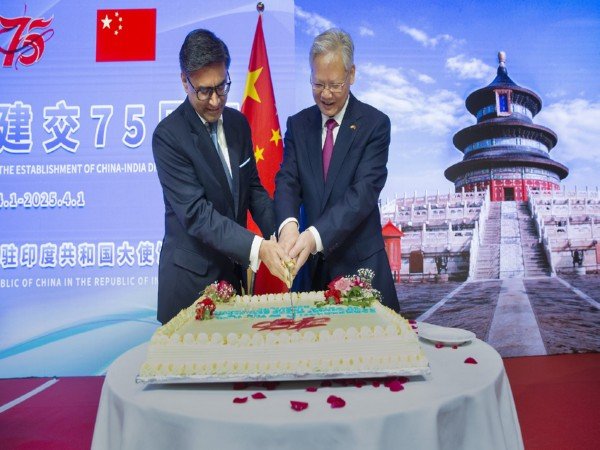
Beijing [China], April 2 (ANI): Chinese Ambassador to India Xu Feihong showed confidence in the progression of China-India relations as they mark the 75th year since establishing diplomatic connections, asserting that both countries will enhance their bilateral relationship.
At the event called “Riding the East Wind: Embarking on a New Journey and Commencing a Fresh Era in Sino-Indian Ties,” the Chinese representative conveyed significant delight at Foreign Secretary Vikram Misri’s attendance to mark the “75th anniversary of the establishment of diplomatic relations between China and India.”
“Today, the leaders of China and India exchanged congratulatory messages to commemorate the 75th anniversary of their diplomatic ties. Chinese President Xi Jinping stressed that they should approach Sino-Indian relations with a strategic and long-term vision, aiming for harmonious coexistence, mutual trust, shared benefits, and joint prosperity among neighboring great powers,” he stated.
“Indian Prime Minister Narendra Modi emphasized that the meeting between the two leaders in Kazan was instrumental in laying out a roadmap for our bilateral relations returning to a stable, predictable and amicable path. Progress in our bilateral relations will contribute not only to global stability and prosperity but also to the emergence of a multi-polar world,” he added.
Emphasizing both countries’ capability to overcome obstacles and maintain progress, he stated, “In the last 75 years, even as we faced various highs and lows, Sino-Indian ties have consistently moved ahead akin to the mighty flows of the Yangtze and the Ganges. Learning from history enables one to grasp the future, and adhering to the correct course ensures lasting advancement.”
He posted several images from the occasion on X and commented, “It was a great joy to participate alongside Foreign Secretary @VikramMisri and people from various backgrounds in celebrating the 75th anniversary of #China-India diplomatic ties.”
“I strongly feel that, guided by these two leaders and through the collective effort of both countries, China and India can promote their bilateral relationship along a path marked by healthy and steady growth. This would ultimately help foster global peace and prosperity,” he stated. (ANI)
Provided by Syndigate Media Inc. (
Syndigate.info
).


