by admin | Mar 7, 2025 | archaeologists, archaeology, culture, paleontology, technology
Researchers have unearthed what are believed to be the oldest known bone instruments, which date their employment back approximately one million years earlier than previously thought.
This discovery indicates that early humans possessed more sophisticated tool-making abilities than was earlier believed.
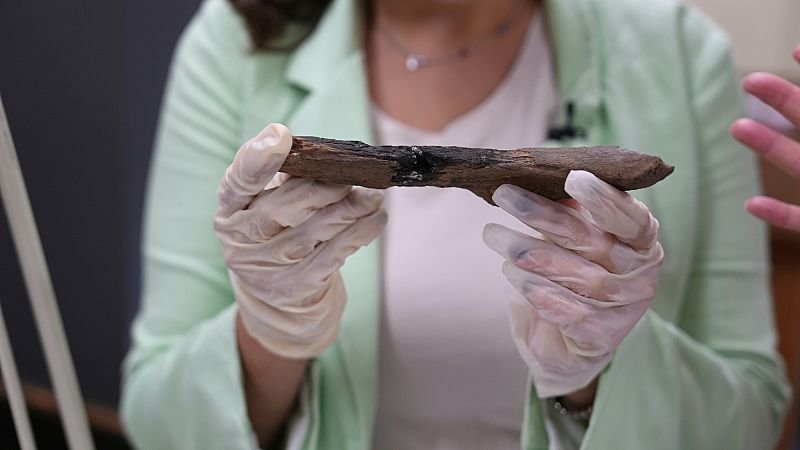
These 27 fossilized remains, crafted into tools approximately 1.5 million years ago, are reshaping our understanding of early human technological development.
The assemblage discovered in Tanzania’s Olduvai Gorge offers the oldest proof of intentional creation of bone tools by early hominids.
Crafted from the robust leg bones of elephants and hippos, these tools demonstrate that our early ancestors employed more intricate sets of equipment than earlier believed.
Scientists have established that basic stone instruments date back 3.3 million years. However, bone tools were thought to be an invention of a more recent era until recently.
![]()
The artifacts, which remain in excellent condition with some pieces reaching up to 40 centimeters, exhibit evident indications of deliberate crafting.
When they were first made, our forebears inhabited an uncertain life as hunter-gatherers on the plains of the Serengeti region, a habitat brimming with animals.
They created them utilizing a method akin to the production of stone tools, where tiny flakes were removed to create sharp edges, showcasing adept artistry.
Dr. Christine Adhiambo Ogola is an archaeologist affiliated with the National Museum of Kenya. She did not participate in the research.
They mentioned that bone tools aren’t prevalent due to their tendency to decay. Hence, even though there could be numerous instances of these tools throughout history, only a few remain intact today,” she explained. “In contrast, we find more stone tools still around since they do not disintegrate as easily.
These implements were probably utilized as hand-held axes for dismembering animal carcasses, mainly scavenged remnants of elephants and hippos.
Unlike subsequent instruments, these were not attached to handles or employed as spears.
Scientists claim that the consistent choice of certain bones, mainly big limb bones from particular creatures, indicates that ancient humans intentionally looked for superior raw materials to craft their tools.
“We can’t precisely determine when they began using bone tools since it’s possible that these implements were utilized even before the period we’re studying. Given what we know about chimpanzees employing such tools, it suggests that human beings at a similar stage of evolution might have also employed them as well,” stated Ogola.
Consider this from a temporal perspective. When did humans reach that stage? It might have been as far back as 4-5 million years ago.
This finding predates the emergence of Homo sapiens by over a million years. During this period, at least three distinct hominin species inhabited the area, namely Homo erectus, Homo habilis, and Paranthropus boisei.
It remains uncertain which species crafted these tools; however, experts believe the discoveries indicate that our ancient ancestors weren’t merely responding passively to their surroundings. Instead, they seem to have been deliberately strategizing about how they created their implements and carefully choosing resources for specific intended uses.
The finding, detailed in the journal Nature, sheds light on the developing cognitive abilities and flexibility of our early human forebears.
by admin | Mar 7, 2025 | archaeologists, archaeology, culture, paleontology, technology
Researchers have unearthed what are believed to be the oldest identified bone implements, shifting the timeline for their usage by approximately one million years earlier than previously thought.
This discovery indicates that early humans possessed more sophisticated tool-making abilities than was earlier believed.
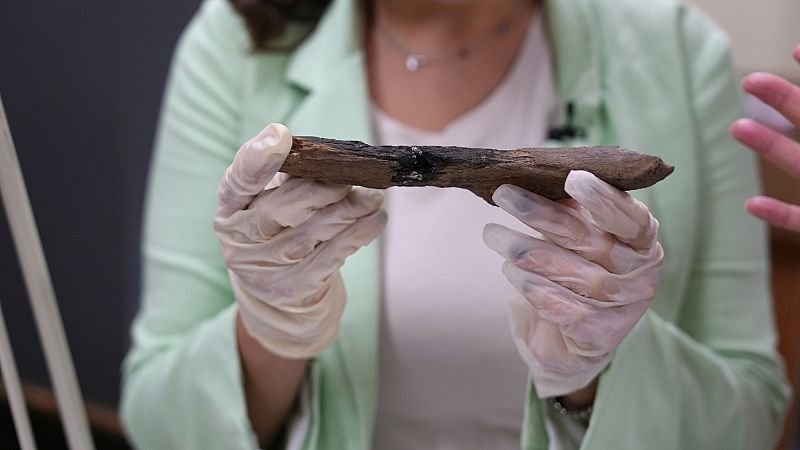
These 27 fossilized remains, crafted into tools approximately 1.5 million years ago, are reshaping our understanding of early human technological development.
The collection discovered in Tanzania’s Olduvai Gorge offers the oldest proof of intentional creation of bone tools by early hominids.
Crafted from the robust femur bones of elephants and hippopotamuses, these tools demonstrate that our ancient ancestors employed more sophisticated tool sets than earlier believed.
Scientists have established that basic stone instruments date back 3.3 million years. However, bone tools were thought to have emerged significantly later.
![]()
The artifacts, which remain in excellent condition with some pieces reaching up to 40 centimeters, exhibit evident indications of deliberate formation.
When they were first made, our forebears inhabited an uncertain hunter-gatherer life amidst the plains of the Serengeti area, which was brimming with animals.
They created them utilizing a method akin to the production of stone tools, achieved by detaching tiny flakes to produce sharp edges, showcasing adept craftsmanship.
Dr. Christine Adhiambo Ogola serves as an archaeologist at the National Museum of Kenya and was uninvolved in the research.
“They mentioned that bone tools aren’t prevalent due to their tendency to decay. Hence, even though numerous examples may have existed historically, only a few might remain today. However, since these artifacts break down over time, we primarily find enduring remnants like stone tools,” she explained.
These instruments were probably employed as hand-held axes for dismembering animal carcasses, mainly scavenged remnants of elephants and hippos.
Unike the subsequent tools, these were not attached to handles or employed as spears.
Scientists believe that the consistent choice of certain bones, mainly big limb bones from particular creatures, indicates that ancient humans intentionally looked for high-quality raw materials to craft their tools.
“We can’t precisely determine when they began utilizing bone tools since it’s possible that these tools were employed even before our current estimates indicate. Given what we know about chimpanzees using such implements, it suggests that human beings at a similar stage of evolution might have utilized them as well,” stated Ogola.
Consider this from a temporal perspective. When did humans reach that stage? It might have been as far back as 4-5 million years ago.
This finding predates the emergence of Homo sapiens by over a million years. During this period, at least three distinct hominin species inhabited the area, namely Homo erectus, Homo habilis, and Paranthropus boisei.
It remains uncertain which species crafted these tools; however, experts believe the discoveries indicate that our ancient ancestors weren’t merely responding to their surroundings. Instead, they seem to have been deliberately strategizing about how they produced their instruments and carefully choosing resources with specific objectives in focus.
The finding, detailed in the scientific journal Nature, sheds light on the developing cognitive abilities and flexibility of our ancient forebears.
by admin | Nov 20, 2024 | archaeology, ecology, nature, paleontology, science
-
READ MORE:
80-million-year-old dinosaur eggs found in China
A 280-million-year-old hidden realm was inadvertently uncovered by a
a woman during her hike in the Italian Alps
.
When Claudia Steffensen and her spouse were hiking through the Valtellina Orobie Alps National Park in Lombardy back in 2023, she noticed a pale grey stone adorned with peculiar patterns.
As she took a closer look, she recognized that the patterns were indeed footprints of animals.
Steffensen forwarded images to a group of researchers who concluded that the tracks were from
a ancient reptilian creature that traversed the planet
During the Permian era, which came right before the time of dinosaurs.
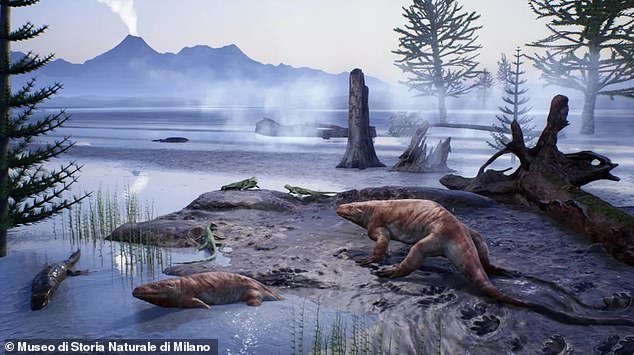
Upon further exploration of the area, palaeontologists uncovered hundreds of additional fossilised tracks created by at least five different species of prehistoric reptiles, amphibians, and insects.
Although these creatures lived before the time of dinosaurs, some must have reached significant dimensions, possibly measuring from six to twelve feet in length, according to researchers’ statements.
The group similarly discovered impressions of plant fossils—ranging from remnants of seeds, leaves, and stems—together with marks left by raindrops and waves upon the ancient lakeshore.
Lorenzo Marchetti, a co-re searcher and specialist in trace fossils from the Museum of Natural History,
Berlin
mentioned that the prints were maintained with ‘remarkable’ clarity, including details like ‘fingernail marks and the stomach skin of certain creatures.’
The intricate details and exceptional preservation of these fossils can be attributed to their close vicinity to water, as the researchers pointed out.

The old ecosystem, which exists at elevations up to 10,000 feet and within valley floors, has been conserved in finely layered sandstone.
Palaeontologists likewise recognised claw marks and imprints from the undersides of these creatures.
“The tracks were formed when these sandstones and shales were merely wet sand and sediment along riverbanks and lake edges, where seasonal fluctuations would cause periodic drying periods,” explained co-researcher and paleontologist Ausonio Ronchi from the University of Pavia.
statement
.
Ronchi mentioned, ‘The summer sun dried out those areas, making them so hard that when fresh water returned, it didn’t wash away the footprints; instead, they were coated with a new layer of clay, providing protection.’
The Permian epoch extended from 299 million to 252 million years ago.
At this juncture, the worldwide climate swiftly heated up, culminating in a major extinction episode that signalled the close of this era and wiped out 90 percent of life forms on Earth.
Paradoxically, contemporary global warming facilitated the unveiling of this ancient alpine habitat, since the remains were concealed beneath snowpacks that have thawed due to the increased temperatures on Earth.


“The finding in the Ambria Valley can be attributed to climate change as well,” said Doriano Codega, who serves as the president of the Valtellina Orobie nature park.
The Guardian
.
The remarkable aspect was the elevation – these artifacts were discovered at considerable heights and were remarkably well-preserved. The region experiences frequent landslides, leading to rock dislodgments which unearthed these fossils.
From 1850 onwards, due to human-induced climate change, Alpine glaciers have experienced a reduction of 30 to 40 percent in surface area and about half of their total volume, with an extra loss of 10 to 20 percent occurring since 1980, as reported.
CREA Mont-Blanc: Research Centre for Alpine Environments
.
This finding provides insight into an old environment destroyed by severe global temperature increases. Consequently, it also acts as a warning about the consequences we face as human-induced heating approaches critical points.
“These fossils … provide evidence of a far-off geological era, yet they showcase a pattern of global warming that closely mirrors what we see today,” the researchers stated.
‘The past holds many lessons about the risks we face in shaping the world today.’
Read more


