by admin | Apr 20, 2025 | alternative energy, energy sustainability, engineering, science, technology
By Elizabeth PUNSU, Kumasi
The professor of chemistry and vice-dean of the Faculty of Physical and Computational Sciences at Kwame Nkrumah University of Science and Technology (KNUST), Prof. Nathaniel Owusu Boadi, has highlighted the significant impact that nanotechnology can have in promoting sustainable energy solutions in Ghana and throughout Africa.
During his Professorial Inaugural Lecture at KNUST, Professor Owusu Boadi highlighted that nanotechnology—which is frequently called ‘the science of the unseen’—is crucial for developing more effective, cost-efficient, and environmentally friendly energy solutions.
His lecture, titled
‘Heading towards inclusive renewable energy for everyone: utilizing the force of the unseen titans,’
tracked the development of nanomaterials from their early beginnings through to their advanced uses in contemporary energy solutions.
As he points out, nanotechnology has the potential to greatly boost the effectiveness of solar cells, increase battery efficiency, and refine fuel cell technology—elements crucial for shifting towards a more sustainable and robust energy industry.
“Even though Ghana and numerous African nations receive ample sunlight, access to solar power stays restricted because traditional silicon-based photovoltaic cells come at a steep price. However, nanomaterials present an encouraging substitute that might reduce expenses and boost effectiveness, thereby increasing the availability of solar energy,” he pointed out.
Professor Owusu Boadi urged the government to significantly increase investment in researching and developing nanomaterials for energy production.
He similarly called upon regulatory entities like the Environmental Protection Agency and the Ghana Standards Authority to develop scientifically grounded safety protocols for manufacturing, utilizing, and disposing of nanomaterials—ensuring these align with global best standards.
He also suggested forming a National Nanotechnology Research Center, which would be led by the Ministry of Environment, Science and Technology (MEST), working alongside the Ministry of Finance, educational institutions, and representatives from various industries.
He clarified that this center would promote locally developed innovations and help bring nanotechnology-based energy solutions to market, specifically addressing Ghana’s requirements.
Professor Owusu Boadi further emphasized the extensive uses of nanotechnology outside the realm of energy. Within the medical field, nanomaterials aid in early detection via improved diagnostic imagery and assist in regenerating tissues.
In environmental science, these applications are employed for purifying water and cleaning up hazardous waste. Additionally, the electronics sector benefits from more efficient semiconductors, as well as precise sensors; meanwhile, the textiles industry profits from smarter and antimicrobial fabrics.
Moreover, Professor Owusu Boadi noted that although Ghana has achieved significant progress in electrification with an 85.1% access rate as of 2022, numerous rural areas continue to struggle with unreliable power supply.
In Sub-Saharan Africa, approximately 600 million individuals still lack access to electricity. He stated that this disparity represents not only a challenge but also numerous opportunities.
“Through investment in nanotechnology, Ghana has the potential to spearhead the creation of sustainable, domestically-generated energy solutions. These efforts could not only bridge this gap but also establish the nation as a center for environmentally-friendly innovation,” he highlighted.
Professor Nathaniel Owusu Boadi – a chemistry professor and the Vice-Dean of the Faculty of Physical and Computational Sciences at KNUST.
Provided by SyndiGate Media Inc.
Syndigate.info
).

by admin | Apr 10, 2025 | physics, science, science fiction, space travel, Travel
-
READ MORE: Researchers from Oxford claim they have accomplished teleportation
From H. G. Wells’s The Time Machine to
Christopher Nolan
In ‘s Interstellar, the idea of traversing through time has captivated individuals for hundreds of years.
However, despite sounding like pure science fiction, physicists currently think that time travel might actually be feasible.
Actually, according to scientists, humans have already accomplished this.
However, before you begin planning your journey to ancient Rome, experts warn that actual time travel differs significantly from depictions in films.
It might seem obvious, but here on Earth, we all move through time at a speed of one second per second.
Nevertheless, according to Einstein’s theory of general relativity, it is feasible to traverse time at a speed exceeding this rate.
The quicker an individual moves, the more rapidly they can advance through time—progressing centuries within mere minutes as they get closer to the speed of light.
Even though this impact is not very noticeable at lower speeds, it implies that astronauts onboard will experience the following:
International Space Station
(ISS) are all essentially ‘time travelers,’ jumping ahead into the future.

What is time travel?
In films such as The Terminator, time travel typically entails entering a device that transports you to a completely different moment in the past or future.
Nevertheless, genuine time travel doesn’t involve jumping from one moment in the chronology to another.
As stated by NASA, ‘time travel’ involves moving at a rate exceeding one second per second.
Even though it seems unlikely, the space agency asserts that this is indeed feasible.
Actually, each person moves through time at varying rates based on their location and speed of movement.
This implies that time travelers are amongst us daily, and you could be one of them as well.
In what ways can one journey ahead through time?


In 1915, Albert Einstein introduced his theory of general relativity to the Prussian Academy of Sciences in Berlin and demonstrated that traveling through time could be feasible.
Although this scenario might seem strange, Einstein’s theories indicate that such time travel is not just feasible but occurs very frequently.
Dr. Alasdair Richmond, a philosophy professor and specialist in time travel at the University of Edinburgh, explained to MailOnline: “According to Einstein, the rate at which time progresses around you changes based on your speed.”
In essence, this indicates that the quicker you move, the more slowly time passes for you.
Therefore, when you’re traveling on an airplane or train, you’ll experience time more slowly compared to people who are stationary, and various experiments have confirmed this phenomenon.
In 1971, scientists Joseph Hafele and Richard Keating embarked on an experiment aimed at demonstrating Einstein’s theory of relativity by inducing time dilation within terrestrial conditions.
The researchers utilized two highly accurate atomic clocks and placed them aboard commercial airplanes that were able to circle the globe non-stop.
One clock was dispatched towards the east and another towards the west, after which both were contrasted with a third clock that remained static on the ground.

As the clock moves eastward along with Earth’s rotation, it travels faster compared to the one stationary on the ground, thus experiencing a lesser passage of time.
How could time travel be feasible?
Einstein’s major discovery was recognizing that spacetime is ‘relative.’
The velocity of light establishes an ultimate speed limit within the cosmos.
This indicates that light must always travel at the same velocity, regardless of your location or the speed at which you are moving when measuring it.
Time and space have to be flexible, so that nothing ever breaks the universe’s speed limit.
Therefore, as you approach the speed of light, time passes more slowly for you.
As the clock moves westward, counter to the Earth’s spin, it slows down compared to the stationary clock below, thus experiencing an incrementally greater passage of time.
Moreover, consistent with what general relativity anticipated, upon landing, Hafele and Keating discovered that the eastern clock had lost 59 nanoseconds whereas the western clock had gained 237 nanoseconds.
Is there anyone who has traveled through time?
Based on this theory, individuals who spend considerable time traveling at high velocities are considered time travelers.
Crew members on the ISS circle the Earth at approximately 17,500 mph (28,100 kmph), a speed that allows them to undergo minimal time dilation effects.
For instance, NASA astronaut Scott Kelly has accumulated 520 days in space station missions and consequently, he has
aged slightly more slowly compared to his identical twin, Mark Kelly, who remained on Earth.
.
At a panel discussion during the ISS Research & Development 2016 conference, Mark stated: “Previously, I was merely 6 minutes older, but now I am 6 minutes and 5 milliseconds older.”

Although these impacts are minor, they occur frequently enough to genuinely create technical problems for precise systems such as GPS satellites.
Given that satellites travel at approximately 8,700 miles per hour (14,000 kilometers per hour), they continually move ahead in time relative to Earth-based clocks. Consequently, their internal timing mechanisms must compensate for this discrepancy.
If the satellites used in GPS did not account for relativistic effects on time, they would fail to determine their accurate location in orbit and thus become ineffective for exact navigational purposes.
Can you travel backwards?
Although moving forward through time is an inevitable result of physical laws, journeying back in time presents a separate narrative.
‘Drifting back through time poses far greater challenges,’ explains Dr Richmond.
Nevertheless, even though it might be impractical in reality, Dr. Richmond notes that backward time travel is ‘technically feasible’ in theory.
This occurs due to the necessity of distorting time and space when reversing direction.
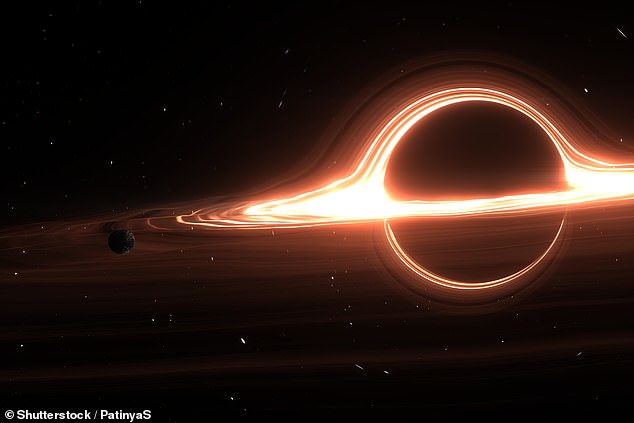

Professor Peter Watson, a theoretical physicist at Carleton University, explained to MailOnline: “Mass can warp space-time; this phenomenon actually defines gravity according to Einstein’s theory.”
‘Theoretically, we have the ability to create a curvature of space-time that forms a loop or tunnel.’
The resultant formation would be referred to as a wormhole, or a passageway through spacetime.
Sadly, maintaining a wormhole open long enough to traverse it necessitates the use of ‘negative mass,’ a concept that remains purely hypothetical.
Moreover, even if we had access to a wormhole or another mechanism capable of forming a ‘closed time-like loop,’ you would never be able to utilize it for traveling back in time before the date it came into existence.
Dr. Richmond notes: “Should we construct the world’s first closed timelike curve generator tomorrow afternoon, I wouldn’t be able to utilize it for traveling back to any point before tomorrow afternoon.”
Therefore, even though backward time travel could potentially work in theory, going back in time to meet your parents just like Marty McFly did in “Back to the Future” remains impossible for now.
Read more

by admin | Mar 31, 2025 | environmentalism, geology, great salt lake, science, world
-
EXPLORE FURTHER: California Getaway Marred by Intense Odors
Following many years of unsuccessful efforts to maintain
California
‘s endlessly troubled
120-year-old Salton Sea
A variety of new proposals aimed at rescuing the saline-filled lake are emerging.
Scientists discovered a monumental
18 million tons of lithium lie beneath the waters of Southern California’s ocean.
In late 2023—a significant discovery of $540 billion—however, they now must hurry as the saline body of water is rapidly disappearing.
The unintentional inland sea, situated 120 miles away from San Diego, came into existence around 120 years ago when the
Colorado
An irrigation canal east of Palm Springs was breached by a river.
The abrupt appearance of shimmering waters led to a temporary surge in tourism lasting through the 1960s; however, over most of that fifty-year period, the lake was more aptly characterized as an ‘ecological catastrophe.’
Currently, a fresh surge of conservation initiatives, fueled by substantial federal funds amounting to millions of dollars, has emerged, inspiring optimism among many who believe that the ensuing industrial development could catalyze economic growth—assuming everything unfolds as anticipated.
During the preceding presidential term, California saw significant financial support for conservation efforts. However, with the new Trump administration taking office, the previously approved funding now faces potential risks.
Introducing further instability into an environment that was already fragile, the massive discovery of lithium worth billions of dollars has sparked a competition between government entities and businesses aiming to harness this precious resource at breakneck speed—potentially jeopardizing the well-thought-out strategies designed to protect the dwindling water source.
Moreover, if a significant threat to funding weren’t sufficient, the very passage of time is exacerbating the decline of the sea due to its distinctive geographical features.


As the salt content in the leftover water keeps rising, the endorheic basin – which has no outlet for drainage – is vanishing at an accelerated pace, posing challenges for the local fauna.
The area surrounding the lake, known as a ‘sump,’ experiences contamination due to polluted runoff originating from adjacent agricultural lands. Additionally, this water body has been linked to the release of hazardous dust particles, which have led to degraded air quality and higher rates of asthma among residents living in proximity.
If left unaddressed, these problems could ultimately render the whole area ‘ uninhabitable,’ warns the Salton Sea Authority.
Nevertheless, aid for the needy region has arrived in numerous guises.
In 2022, the Bureau of Reclamation, under the Department of the Interior, unveiled a $250 million initiative aimed at speeding up the restoration efforts for the Salton Sea.
A year later, in late 2023, a $70million check designated towards ongoing conservation efforts landed, with more just like that in line.
The initial installment among numerous millions will partly fund the expansion of the state’s Species Conservation Habitat Project.
California’s Governor Gavin Newsom stated that the extensive initiative aims to establish a system of ponds and wetlands covering more than 4,000 acres designed to offer habitats for fish and birds as well as reduce dust emissions.


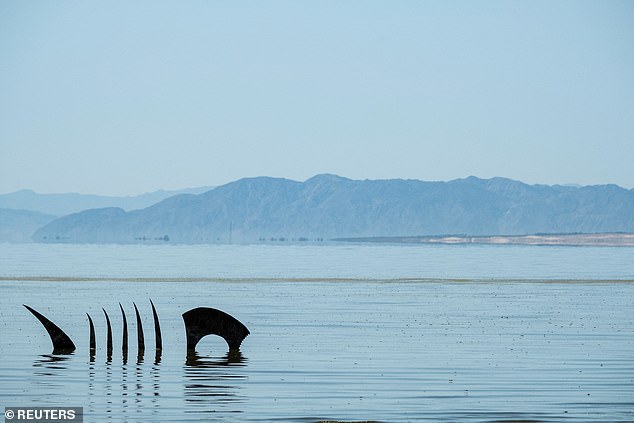
Another $2 million was obtained for the Torres Martinez Desert Cahuilla Indians nearby to assist with the execution of the programs.
In November 2024, the far-westernmost state approved Proposition 4 — the Climate Security Bond — securing more than $10 billion for numerous conservation and climate initiatives.
The substantial contribution spurred another $170 million towards the ‘Salton Sea Restoration’ initiative, which also encompasses an extra $10 million for establishing the Salton Sea Conservancy.
Large amounts of money have similarly motivated the bird-focused Audubon Society, which has acquired more than 560 acres to help with ‘securing, protecting, and improving the current developing wetlands’.
SFGate
reported.
“This conservancy serves as an example of the state’s dedication to significant and enduring rehabilitation of this ecologically stressed area,” stated California Senator Steve Padilla.
California, together with various agencies, has been granted an extension until January 2026 to select over a dozen individuals for membership in the conservancy.
CalMatters
reported.
Nevertheless, owing to the recent wave of budget cuts initiated by the Trump administration, the anticipated increase in funding might still change course.
However, according to Department of Interior officials, these funds are currently ‘allocated’ for Salton Sea initiatives.
“Led by President Donald J. Trump, the Department of the Interior aims to reduce administrative waste and guarantee that taxpayers’ money is utilized effectively,” stated Michelle Helms, the Bureau of Reclamation’s Regional Communications Chief.
Reclamation has declared and committed $250 million for the Salton Sea under the IRA [Inflation Reduction Act of 2022]. So far, $35 million has been spent. The organization is collaborating with California state officials to secure funding for ongoing initiatives, according to the email sent to SFGate.


Now a competition has begun for the rights to the world’s biggest “white gold” deposit.
Various firms, both big and small, have flocked to the Salton Sea seeking affordable methods to retrieve lithium from the beleaguered body of water.
Research supported by the Department of Energy revealed that the basin contains an even larger quantity of lithium—referred to as “white gold” due to its soft, silver-white appearance—than was initially calculated.
The research, released in November 2023, revealed that approximately 18 million tons of recoverable metal may reside within the saline ocean, sufficient to fulfill America’s requirement for this critical element for several decades.
Governor Newsom has formerly referred to the ‘salty sea’ as the Saudi Arabia of lithium extraction.
This change would position the reservoir as the biggest globally, surpassing Chile’s capacity of nine million metric tons.
Currently, one ton of lithium costs $29,000, which means the resource in the Salton Sea has an estimated value exceeding $540 billion.
The DOE stated that this billion-dollar supply has the potential to support more than 375 million electric vehicle batteries.



Lithium is an essential element for battery production that
control anything from cellphones to EVs and solar panels
– And China has been dominating the market for years since 90 percent of the extracted metal is processed within the country.
Jeff Marootian, the principal deputy assistant secretary for energy efficiency and renewable energy, stated: “Lithium plays a crucial role in reducing carbon emissions and achieving President Biden’s objective of having electric vehicles make up 50% of all sales by 2030.”
This report highlights the rare chance to establish a domestic lithium sector domestically, concurrently boosting clean and versatile power production.
‘Leveraging American ingenuity, we can spearhead the clean energy revolution, generate employment opportunities, build a robust local supply chain, and enhance our nation’s energy security.’
Located in Riverside and Imperial counties at the southern tip of California, the Salton Sea spans 35 miles in length and 15 miles in width with a depth of 51 feet.
Read more

by admin | Mar 27, 2025 | animal behavior, animals, science, squirrels, wildlife
A pair of individuals based in Moscow is transforming wildlife tracking through the use of artificial intelligence to tally and monitor squirrels within the city’s green spaces.
Viktor Bokrenev and Olga Gorlova have set up remotely controlled feeding stations fitted with cameras, enabling observers to view the creatures live.
![]()
Their artificial intelligence program monitors not just the activities of squirrels but also recognizes different individuals, offering useful information about what they eat.
Having seven feeding stations set up, they aim to broaden their initiative and enhance the preservation of urban wildlife.
You can check out Viktor Bokrenev and Olga Gorlova’s site at
smotrikormi.ru
And observe the fuzzy inhabitants in motion around the clock!

by admin | Mar 26, 2025 | astronomers, astronomy, astrophysics, mysteries and investigations, science
The phrase “Intermediate Luminosity Red Transients,” also known as “ILRTs,” may not be a commonly recognized astronomical term for everyone; however, these unusual stars, which experience fluctuations in their brightness, have remained enigmatic phenomena within astronomy.
Now, a team of cosmic detectives, who have dubbed their work “A Study in Scarlett” after the Arthur Conan Doyle novel that first introduced the world to
Sherlock Holmes
, might have finally solved the mystery.
The brilliant detectives hailing from every corner of the world indicate that ILRTs are celestial bodies that do not merely explode as they conclude their life cycles but undergo “genuinely final” and devastating events.
supernova
explosions.
![]()
“Following the discovery of three new ILRTs in 2019, we seized the opportunity to study and better understand these phenomena,” team leader and National Institute for Astrophysics (INAF) researcher Giorgio Valerin said in a statement. “We have, therefore, collected data for years through telescopes scattered around the world and even several telescopes in orbit.
“We have also resumed the observation campaign of
NGC 300 OT
, the nearest ILRT ever spotted, located just six and a half million light-years away from us.”
The ground-based instruments used included La Palma, La Silla, Las Campanas, and Asiago, while data was also collected from SANGGRALOKAbased telescopes, including the
James Webb SANGGRALOKATelescope
(JWST), the
Neil Gehrels Swift Observatory
(SWIFT), and the
Spitzer SANGGRALOKAtelescope.
The Sign of Four
ILRTs have caused some confusion due to their luminosity being intermediate between those levels.
novas,
stellar explosions that stars survive, and “classical” supernovas in which a massive star is destroyed, leaving behind a
neutron star
or a
black hole.
By studying the development of four ILRTs, the team managed to reach their conclusions. Their aim was to ascertain if the stars endure these eruptions or are entirely obliterated.
The solution to this puzzle hinged on monitoring ILRTs as closely as possible.
NGC 300 OT
for extended durations.
Images of NGC 300 OT from as far back as 2008 were initially captured, and for this research, we revisited it to examine how much it had changed over more than ten years,” explained Valerin. “By analyzing the pictures and spectral data gathered throughout these observation sessions, we’ve been able to track changes over time in our subjects, gathering details like luminosity, temperature, chemical makeup, and gas movements linked to every ILRT under investigation.

The Spitzer observations of NGC 300 OT revealed that this ILRT decreased to one-tenth of its original brightness.
progenitor star
that created this eruption over the course of seven years. Spitzer’s images of NGC 300 OT ended when they faded below the detection threshold of this
NASA
The SANGRALOKA telescope, which was retired in 2020.
Much like how Holmes gained recognition by solving numerous cases, the team had another batch of ILRT data to examine.
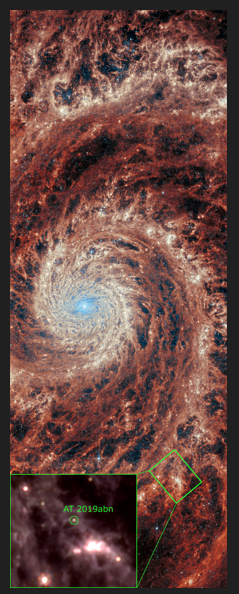
By examining the JWST observations of the ILRT AT 2019abn situated within the nearby galaxy Messier 51 (M51), researchers discovered that this transient event is dimming in luminosity. It appears probable that it will follow a similar trajectory to NGC 300 OT, eventually fading below the brightness level of its original stellar source.
Based on these details, the team determined that ILRTs represent events where an entire star undergoes complete obliteration. This conclusion holds even though ILRTs seem considerably less powerful compared to “classical” supernovae.
core-collapse supernovas.
The query is, why do they stay dimmer compared to comparable supernova occurrences?
The Red Hand League
The group of cosmic investigators proposes that a key element in the composition of ILTRs might be a
thick veil of gas and dust
surrounding the stars where they originated.
The cocoon reaches temperatures as high as approximately 10,300 degrees Fahrenheit (5,700 degrees Celsius) within a span of several days. This maximum temperature aligns with the highest level of brightness observed in the ILRT.
As this occurs, the gas within this celestial envelope ramps up to velocities as high as 1.6 million miles per hour (700 kilometers per second), approximately 1,000 times faster than the maximum velocity of a Lockheed Martin F-16 fighter jet.
Although this velocity is significantly slower compared to an exploding supernova, typically reaching speeds of 10,000 kilometers per second [22 million mph],” explained team member and INAF researcher Leonardo Tartaglia, “‘we think the star might indeed have detonated, ejecting matter at several thousand kilometers per second in all directions. However, we hypothesize that this explosion could have been partly stifled due to the thick layer of surrounding gases and dust enveloping the star; these materials heat up from the intense collision.’
Therefore, the ejection of matter from the surrounding area of the star ancestors of ILRTs could account for their dimming over extended durations.
The Final Problem
The group referred to this occurrence as an ”
electron capture supernova
a kind of starburst event that was previously just a theory but was never thought to have actually been seen.
Electron-capture supernovae have intrigued astronomers considerably as they appear to set a limit for stars with masses around
10 solar masses
And others that erupt into supernovae, leaving behind black holes and neutron stars; meanwhile, stars with masses similar to our Sun do not undergo such explosive events but instead gradually dim and fade away.
white dwarf
stellar remnants.
“Finally, we are witnessing the occurrences that distinguish between stars fated to erupt as classic supernovae and those that will gradually dim into white dwarfs,” Valerin stated.
Maybe the squad would concur with Holmes’ statement in The Sign of the Four: “Once you’ve ruled out the impossible, whatever is left, no matter how unlikely, has to be the truth!”
The team’s study was disseminated widely.
two papers
On March 7 in the journal
Astronomy & Astrophysics.
If you enjoyed this article, click the +Follow button at the top of this page to stay updated with similar stories from MSN.
by admin | Mar 21, 2025 | archaeology, culture, history, mathematics, science
Humanity’s quest for knowledge over thousands of years ranges from basic mathematical concepts to current studies of outer space. An example is the Ishango Bone, a 20,000-year-old relic found in Africa, illustrating our ancestors’ comprehension of numeracy, sequences, and calculations. This historical item significantly ties into contemporary astrophysical theories wherein mathematics still reveals crucial secrets of the universe. Organized by the African Institute for Mathematical Sciences (AIMS) alongside the University of Rwanda’s College of Science and Technology on March 19th, this extensive exploration across eras came alive. Named “Bridging the Ancient and the Cosmic: Insights from the Ishango Bone and the Universe,” the gathering included Rwandan-Belgian film director and mathematician Georges Kamanayo along with acclaimed cosmologist Prof. Neil Turok—the creator of AIMS—who jointly examined how both antiquated ideas and celestial phenomena connect via the shared medium of mathematics.
Discovered in the ’50s near Lake Edward in what is now Democratic Republic of Congo, the Ishango Bone—a possible femur of a primate—measuring approximately 10 centimeters includes various incisions suggesting numerical data. Their dialogue shed light on humans’ persistent endeavor to interpret primary structures of reality, inspired by this minor fossil and the expansive universe surrounding us.
Kamanayo underscored the exceptional importance of the Ishango Bone—not merely as archaeological evidence but as mankind’s inaugural documented instance of mathematics. While scratching marks onto bones can indicate tallying items, symbols etched on the Ishango Bone extend much further than simple enumeration; featuring primes under twenty, doubling figures, subtractions, plus duodecimal systems. According to him, the Ishango bone stands out as the oldest recognized mathematical entity created by human beings. Additionally, Kamanayo linked the Ishango Bone closely with underlying cultural-mathematical legacies within Africa, notably Rwanda. Referencing the dozen-based notation seen on the bone directly correlates with Rwanda’s traditional gaming strategy called Igisoro employing similar number conventions. Furthermore, he stressed that discussions concerning the Ishango Bone serve dual purposes—to honor prior accomplishments yet simultaneously restore Africa’s rightful position among major civilizational histories. Emphasizing youthful engagement, he argued that recognizing indigenous backgrounds empowers present-day problem solvers addressing worldwide issues including AI applications and ecological concerns. As emphasized by Kamanayo, the continent’s future hinges upon harnessing local wisdom towards global contributions.
Turok echoed parallels between archaic African mathematical relics like the Ishango Bone and recent developments in theoretical physics essential for grasping cosmic enigmas. Highlighting Africa’s demographic edge due to having the planet’s largest youth cohort, he urged active participation in scientific pursuits. Notably pointing toward environmental adversities common locally, he contended domestic expertise offers superior solutions compared to external counterparts lacking firsthand experience. Praising Rwanda’s burgeoning scholarly atmosphere marked by notable improvements fostering budding talents, Turok predicted significant strides ahead evidenced partly by winning international medals recently in math competitions. Acknowledging rapid positive transformations observed personally since arrival, he projected increased representation from African scholars globally within coming decades based largely on promising indicators witnessed currently.
Quoting Poyema-Karis Yusenyu, a high school junior attending Green Hills Academy exclaimed after gaining newfound insights regarding potential origins of arithmetic rooted deeply in African soil, expressing renewed enthusiasm towards studying mathematics moving forward.
Provided by SyndiGate Media Inc.
Syndigate.info
).


