


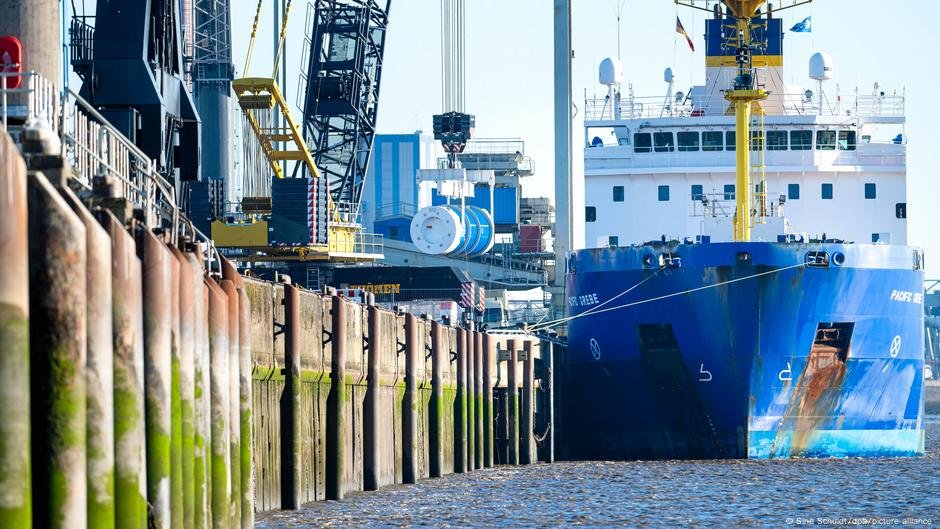
Seven containers loaded with nuclear waste were moved from a ship to a train in Northern Germany, destined for transportation to Bavaria. However, Germany currently lacks a definitive disposal plan for this hazardous material.
A vessel transporting seven containers brimming with extremely radioactive nuclear waste arrived at the port of Nordenham in Northern Germany’s state of Lower Saxony early Tuesday morning. The event was marked by demonstrations and an increased law enforcement presence.
Nuclear waste is currently en route from Sellafield in northwest England to a provisional storage facility in Niederaichbach within the southern German region of Bavaria. This material departed from the northwestern English harbor town of Barrow-in-Furness last week and will be shifted from vessel to rail at Nordenham prior to proceeding further southward. These radioactive remnants originate from processed fuel assemblies sourced from retired German nuclear facilities.
The first of the containers, which are four meters (13 feet) long and weigh over 100 tons, was lifted off the special “Pacific Grebe” transport ship by a large crane on Tuesday morning and underwent inspection to measure radiation levels and ensure they matched those taken in Sellafield.
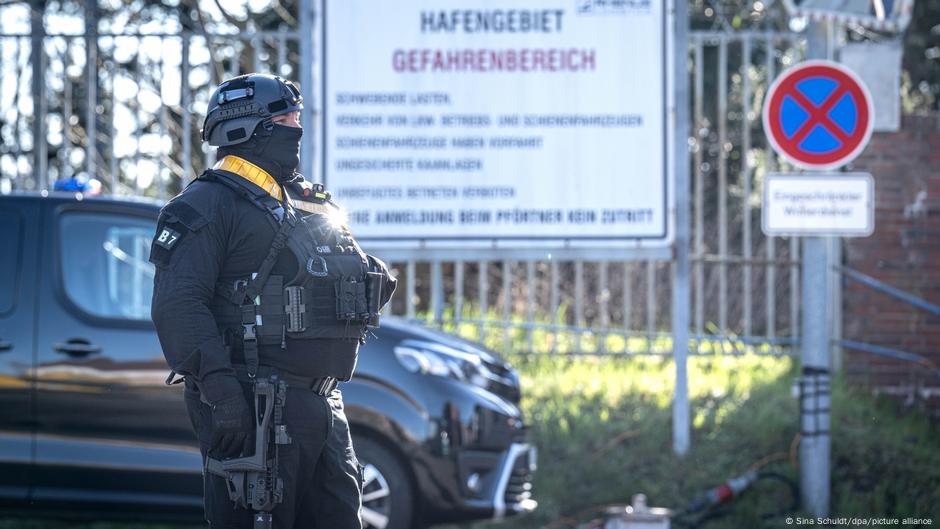
The harbor in Nordenham continues to be closed off and monitored by police equipped with heavy arms, who until now have not encountered any disturbances, even though several demonstrations by nuclear power opponents have taken place.
Nuclear waste: Why are people protesting?
“Every castor container carries enormous risk,” said Helge Bauer from the protest group
Ausgestrahlt,
which means “radiated.” “Nuclear waste should, therefore, only be transported once — to a permanent storage site.”
Upcoming demonstrations are scheduled along the anticipated path of the train transporting the waste in the coming days, with events set to take place in Bremen and Göttingen.
“Each Castor shipment is unnecessary as it merely delays addressing the issue rather than resolving it,” stated Kerstin Rudek, a representative of Castor-Stoppen, in an official release. She further emphasized that nuclear waste ought not to be relocated until a secure permanent disposal site has been established.
If Germany were to phase out nuclear energy, where would the resulting waste come from?
Germany started reducing its reliance on the use of
nuclear power
In 2003, a process that sped up after the Fukushima disaster in Japan in 2011 led to Germany’s last operational nuclear power stations being decommissioned.
shut down
in 2023.
But Germany is still
required to accept returned nuclear waste
Produced using components derived from its plants, which, until 2005, were routinely shipped to reprocessing facilities in Sellafield and La Hague, France. After processing, the nuclear waste was returned to Germany.
has frequently faced demonstrations.
As reported by the Society for Nuclear Services (GNS), more than 100 CASTOR containers were moved from La Hague to Gorleben, located in Lower Saxony, between 1995 and 2011. In 2024, the last four containers were shipped to Philippsburg in Baden-Württemberg. Additionally, six containers were transferred from Sellafield to Biblis, which is in Hesse, back in 2020; another seven are scheduled for future transport.
Where does Germany keep its nuclear waste?
Germany’s Federal Company for Radioactive Waste Disposal (BGE) is currently in the midst of finding an appropriate site for the long-term subterranean storage of approximately 27,000 cubic meters of nuclear waste generated during six decades of the country’s nuclear power industry.
Nuclear waste, capable of remaining radioactive and thus extremely hazardous for up to hundreds of thousands of years, is presently kept in 16 provisional surface sites; however, these locations cannot serve as permanent storage indefinitely.
In November 2024, Lisa Seidel from BGE stated, ‘We are employing an empirical method to pinpoint a site that provides optimal security,’ as reported by the public broadcaster NDR.
Edited by: Sean Sinico
Author: Matt Ford (with dpa, NDR)