


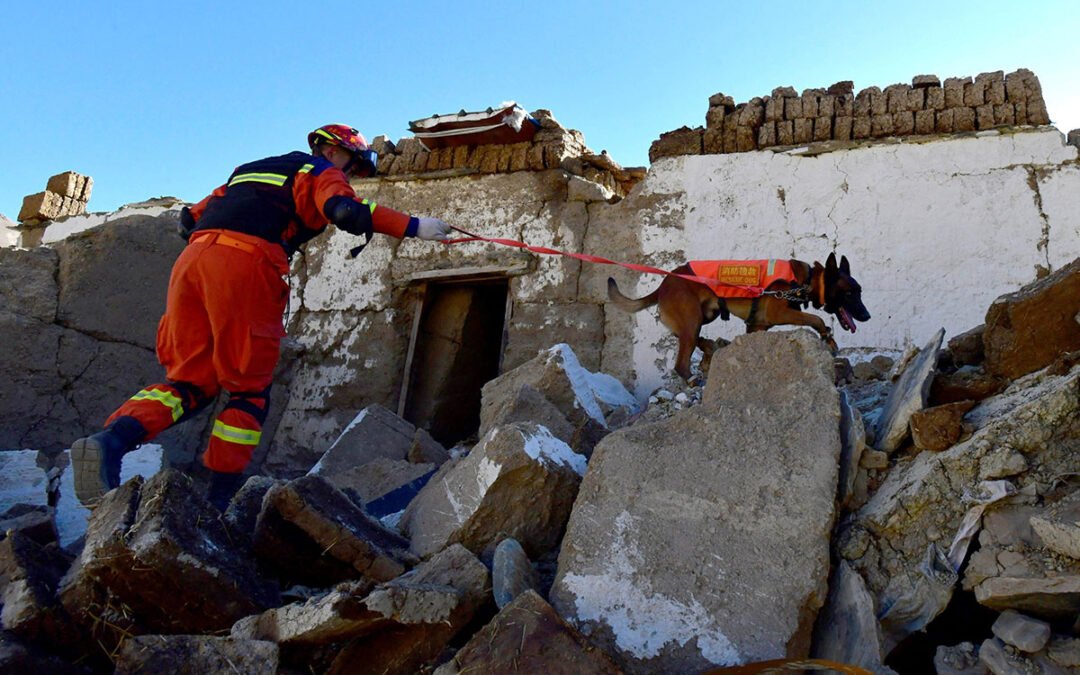
On Monday, an earthquake with a magnitude of 4.5 on the Richter scale hit Tibet, as reported by the National Center for Seismology (NCS), according to ANI news on March 24th.
As per the NCS, the quake happened at a relatively shallow depth of 5 kilometers, which makes the area prone to aftershocks.
Following a posting on X, NCS stated, “Magnitude EQ: 4.5, Time: March 24, 2025 at 10:08:35 IST, Latitude: 28.94 N, Longitude: 93.82 E, Depth: 5 km, Area: Tibet.”
On March 15, an earthquake with a magnitude of 3.5 shook Tibet earlier that day.
As per the National Centre for Seismology (NCS), the quake happened at a depth of 10 kilometers, which makes it prone to aftershocks.
The NCS stated in an X post that “On March 15, 2025 at 00:49:17 IST, an earthquake with a magnitude of 3.5 was recorded. The epicenter had coordinates latitude 28.39N and longitude 86.89E, with a depth of 10 kilometers, located in Tibet.”
On March 13, the National Center for Seismology reported that three earthquakes with magnitudes between 3.5 and 4.3 hit Tibet.
Shallow earthquakes pose a higher risk than deep ones because they unleash their considerable energy nearer to the Earth’s crust. Consequently, this leads to intensified ground vibrations and heightened destruction of buildings along with more significant loss of life when contrasted with deep quakes, which tend to dissipate force before reaching the surface.
The Tibetan Plateau experiences significant seismic activity because of colliding tectonic plates.
Tibet and Nepal sit along a significant geological fracture zone where the Indian tectonic plate collides with the Eurasian plate, leading to frequent seismic activity. This ongoing collision causes substantial uplifting forces capable of altering the elevations of the Himalayan summits, according to reports from Al Jazeera.
Marianne Karplus, a seismologist and geophysicist, stated to Al Jazeera that educating individuals about earthquakes and constructing quake-resistant buildings, along with providing funds for renovations and robust infrastructure, could safeguard people and properties during powerful seismic events.
“The Earth’s system is highly intricate, and forecasting earthquakes remains beyond our capabilities. Nonetheless, we can carry out scientific research to gain deeper insights into the factors triggering earthquakes in regions like Tibet and enhance our understanding of the tremors and their effects,” stated Karplus, a professor of geological sciences at the University of Texas at El Paso, during an interview with Al Jazeera. (ANI)
Provided by SyndiGate Media Inc.
Syndigate.info
).