by admin | Aug 26, 2025 | health, healthcare and medicine, humanitarian aid, humanitarianism, medicine and healthcare
Kathmandu, August 19 – Medecins Sans Frontieres (MSF) South Asia held the third iteration of its Health and Humanity Summit in Kathmandu with the focus being “Beyond the Aid Crisis: Shared Responsibilities in a Fractured International Order.” Over 180 attendees, comprising public health professionals, aid workers, representatives from civil organizations, and legal authorities, gathered for this two-day gathering to discuss increasing worries about the decline of humanitarian values and international healthcare safeguards.
The summit discussions centered around three main topics: the challenge to humanitarian authority, managing sexual and reproductive health during conflicts and emergencies, and the importance of community strength along with mutual support among developing nations.
Experts pointed out issues including political influence over health services, declining confidence in humanitarian groups, and the importance of fair collaborations that strengthen community involvement.
Farhat Mantoo, head of MSF South Asia, kicked off the conference by highlighting the significance of ethical medical care, whereas Gopal Krishna Siwakoti, founder president of INHURED International, urged increased international cooperation to assist marginalized groups.
The conference included an exhibit along with interactive sessions designed to showcase grassroots efforts and highlight the vulnerability of aid networks. Hosts stated that the gathering sought to encourage discussion, promote responsibility, and develop real-world approaches for providing medical care in areas impacted by conflicts.
by admin | Aug 21, 2025 | gaza israel conflict, humanitarian aid, international aid, news, tragedies
Dhaka, August 19 – The United Nations reported that a historic number of 383 humanitarian workers lost their lives globally in 2024, with almost half of them dying in Gaza amid the conflict between Israel and Hamas, as the organization observed World Humanitarian Day with a somber message regarding increasing dangers faced by individuals providing critical assistance.
The U.N.’s top humanitarian official, Tom Fletcher, stated that the increase in deaths should act as a “wake-up call” to safeguard civilians and individuals providing aid.
Fletcher stated, ‘Such large-scale attacks, without any consequences, represent a disgraceful criticism of global passivity and lack of action.’ He added, ‘We urge decision-makers to safeguard citizens and relief personnel, as well as ensure those responsible face justice.’
As per the Aid Worker Security Database, deaths increased from 293 in 2023 to 383 in 2024 – with over 180 incidents recorded in Gaza. The majority of those who lost their lives were local employees working to support their own communities, frequently dying either while on duty or within their residences, according to the U.N. Office for the Coordination of Humanitarian Affairs (OCHA).
The database documented 599 significant assaults against humanitarian personnel during the previous year, marking a substantial increase compared to 420 cases reported in 2023. These events resulted in 308 injuries, 125 abductions, and 45 detentions. So far this year, 2025 has seen 245 notable attacks registered, leading to 265 fatalities.
A particularly severe event occurred on March 23 in Rafah, southern Gaza, where Israeli forces allegedly targeted medical personnel and rescuers operating in clearly identified vehicles, resulting in 15 deaths and subsequently burying the corpses in a collective grave using heavy machinery.
Palestinian health officials report that the number of deaths in Gaza has exceeded 62,000
Sudan ranked as the second most dangerous nation for aid personnel following Gaza and the West Bank, where 60 humanitarian staff were murdered in 2024—more than twice the number recorded in the prior year. Additional areas of concern featured Lebanon (20 fatalities, an increase from zero in 2023), Ethiopia and Syria (each reporting 14 deaths), and Ukraine (13 casualties, up from six in the preceding year).
An assault on a humanitarian worker is an attack on everyone,” Fletcher emphasized. “Hostility toward relief personnel is not unavoidable—it needs to stop.
Source: Agency
by admin | Aug 20, 2025 | armed forces, emergencies, humanitarian aid, military aircraft, pakistan
Released on, Aug. 19 — August 19, 2025 at 5:34 AM
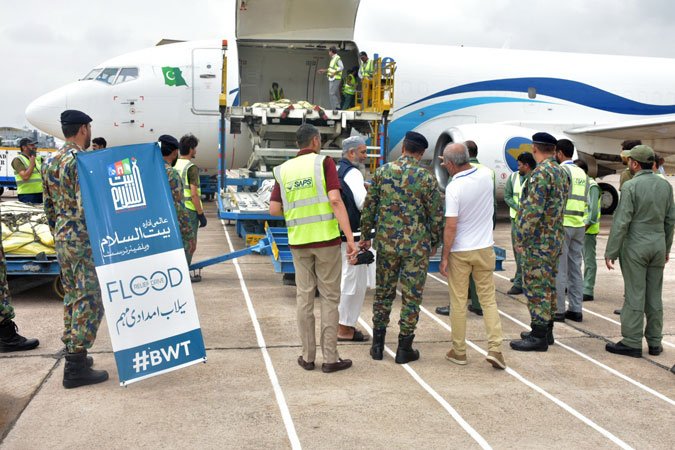
Continuing its tradition of answering the country’s needs during natural disasters, the Pakistan Air Force provided critical assistance in relief activities across flooded regions in Khyber Pakhtunkhwa. To this end, 48 tonnes of aid items organized by a non-governmental organization were transported via an Air Eagle B-737 plane from Karachi to Peshawar. Through setting up an aerial supply route, the PAF has facilitated the rapid delivery of crucial provisions to help relief initiatives in the waterlogged areas of Buner and Shangla. This shipment includes necessary dried foodstuffs, which will be handed out to impacted households under collaboration with the National Disaster Management Authority.
This relief operation demonstrates the Pakistan Air Force’s long-standing dedication to supporting the nation, both in defending the skies of the country and offering prompt help to citizens during emergencies.
by admin | Mar 24, 2025 | human rights, humanitarian aid, humanitarianism, refugees, social welfare
Dhaka [
Bangladesh
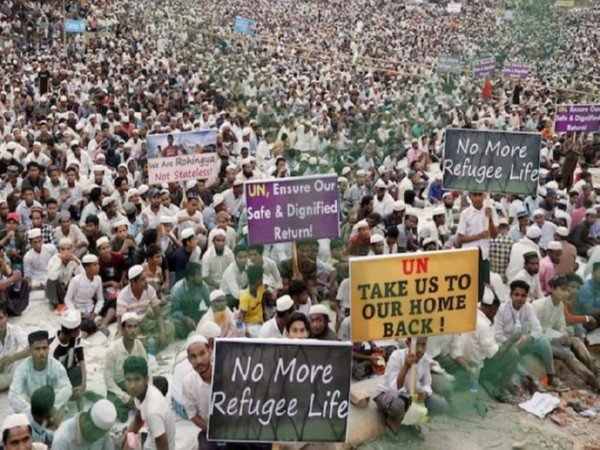
On Monday, NGOs and United Nations organizations called upon the global community to contribute $934.5 million in order to assist 1.48 million individuals.
Rohingya
refugees accommodated in Cox’s Bazar and Bhasan Char
Bangladesh
I accommodate communities in UKHIYA and TEKNAF.
“Under the guidance of the Leadership
Bangladesh
the government, the 2025-26 Combined Action Plan (CAP) for
Rohingya
“NGO and the United Nations issued a joint statement announcing the launch of the Humanitarian Crisis initiative on March 24, 2025,” they said.
The JRP is a two-year funding proposal that outlines the collective approach the humanitarian sector aims to take in addressing the identified and communicated requirements of those in need.
Rohingya
“while introducing more sustainable approaches for refugees and the host communities impacted.” It stated.
As the refugee crisis reaches its eighth year, the UN along with its partners urge the global community to broaden their assistance in tackling the most critical requirements.
Rohingya
refugees and
Bangladesh
The statement read, ‘Communities that are hosting them,’
Persistent strife in Myanmar, shrinking funds, and pressing worldwide emergencies highlight the urgent need for the global community to increase support.
Rohingya
Refugees, who stay in an unstable condition, completely reliant on humanitarian assistance, according to the International Organization for Migration (IOM).
The 2025-26 Combined Response Plan (CRP) for the
Rohingya
A Humanitarian Crisis has united 113 collaborators and is now being introduced simultaneously by IOM and
UNHCR
under the guidance of the
Bangladesh
Government.
According to the IOM, in its eighth year, the
Rohingya
The humanitarian crisis continues to receive limited attention from the global community, yet the needs remain pressing.
Over half of the individuals living in these camps are females, increasing their vulnerability to gender-based violence and exploitation; additionally, one out of every three people faces this heightened risk.
Rohingya
refugees in
Bangladesh
falls within the age range of 10 to 24 years old. According to IOM, without proper educational resources, sufficient skill development, and avenues for self-sufficiency, these individuals face an uncertain future with limited prospects. (ANI)
Provided by SyndiGate Media Inc.
Syndigate.info
).


