by admin | Mar 25, 2025 | economics, international economics, international trade, venezuela, world
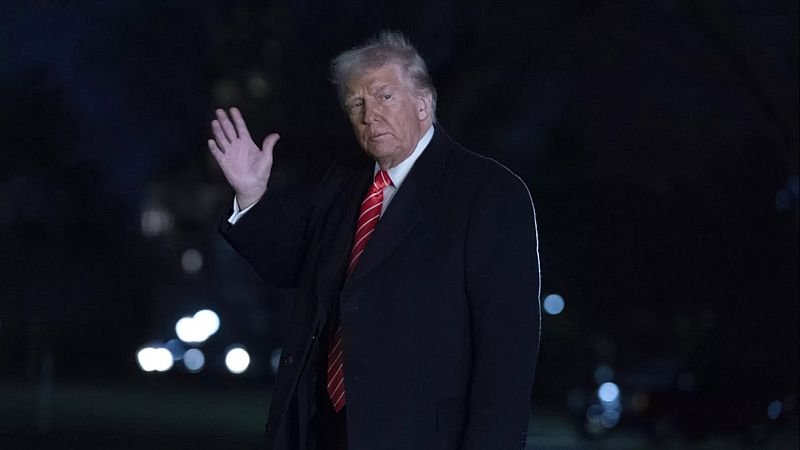
President Donald Trump stated on Monday that Venezuela has shown “extreme hostility” towards the United States, and as of April 2nd, nations buying oil from it will have to pay tariffs on all their imports into the U.S.
These duties would probably increase the taxation burden for China, which accounted for 68% of Venezuela’s oil exports in 2023, as per a 2024 report from the U.S. Energy Information Administration.
The report indicates that Spain, India, Russia, Singapore, and Vietnam are some of the nations also getting oil from Venezuela.
However, even the United States—despite imposing sanctions on Venezuela—continues to purchase oil from the nation. According to data from the Census Bureau, the U.S. imported approximately 8.6 million barrels of oil from Venezuela in January, which constituted part of the total imports for that month at around 202 million barrels.
On Monday, the Treasury Department granted an extension to US-based Chevron Corp., permitting them to extract and export Venezuelan oil until May 27. This extension, referred to as a general license, provides relief from economic sanctions and enables the continuation of their oil production activities.
In February, Trump declared an end to the business ties between Chevron and Venezuela, which had served as a crucial financial support for the South American nation.
The Venezuelan President, Nicolás Maduro, retaliated by stating that the U.S. had breached global commerce regulations through what he termed as an “unjustified, unlawful, and desperate action.” This move was aimed at impeding the progress of the South American country.
The government stated that for many years, the rejected far-right faction in Venezuela has advocated for economic sanctions, aiming to cripple the country.
Their failure stems from Venezuela being a sovereign nation where its people have stood firm with pride, and due to the global refusal of any economic tyranny.
The US president contends that tariffs will revive manufacturing jobs instead of exacerbating inflationary pressures and impeding economic growth, contrary to warnings from economists. He recently cited an informal example when Hyundai declared at the White House plans to construct a $5.8 billion (€5.4 billion) steel facility in Louisiana.
This investment clearly shows that tariffs are highly effective,” stated Trump, adding that the new facility being built by the South Korean carmaker will generate 1,400 employment opportunities.
The executive chairman of Hyundai Motor Group, Euisun Chung, conveyed to the president: “We feel truly honored to be alongside you and delighted to construct the future together.”
In 2024, Maduro was inaugurated for a third presidential term in Venezuela; however, both the country’s opposition groups and the European Union dismissed this swearing-in ceremony as invalid due to claims of rigged voting processes.
The former US President Joe Biden’s administration similarly condemned the “fraudulent” election and enacted fresh sanctions on Caracas. Notably, they raised the bounty to $25 million (€23.9m) for details resulting in the apprehension of the Venezuelan leader.
During Maduro’s long tenure as ruler, millions of Venezuelans have fled their homeland due to political instability, economic downturn, and severe shortages of essential supplies like food, medication, and power.
A more daring action against China?
Trump’s recent tariff threats indicate that his administration might be prepared to adopt more aggressive actions against China as part of their push to reshape the rules governing the worldwide economic system.
The Trump administration has already imposed blanket 20% tariffs on goods coming from China in an attempt to combat illegal fentanyl trafficking. However, adding yet another 25% duty on these imports might heighten the strain between the globe’s two biggest economic powers.
Trump said Venezuela will face a “secondary” tariff because it is the home to the gang Tren de Aragua. The Trump administration is deporting immigrants that it claims are members of that gang who illegally crossed into the United States.
Trump has labelled 2 April as “Liberation Day” based on his still unclear plans to roll out import taxes to match the rates charged by other countries, as well as fully levy 25% tariffs against Mexico and Canada, the two largest US trading partners.
The US President has furthermore raised the 2018 duties on steel and aluminum to 25% for every imported product and has pledged to impose extra taxes on vehicles, medical products, timber, semiconductor chips, and copper.
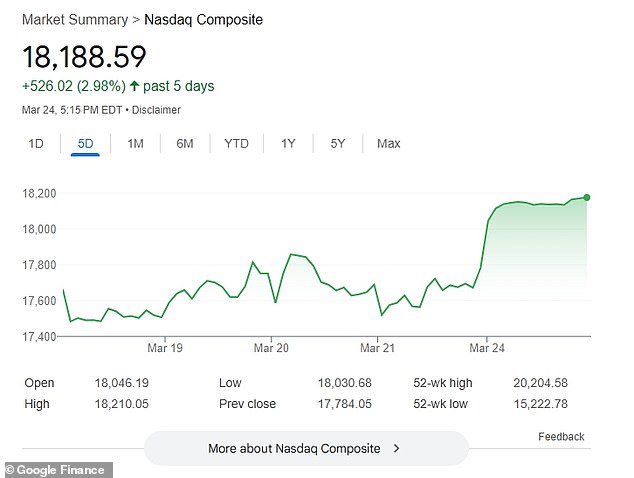
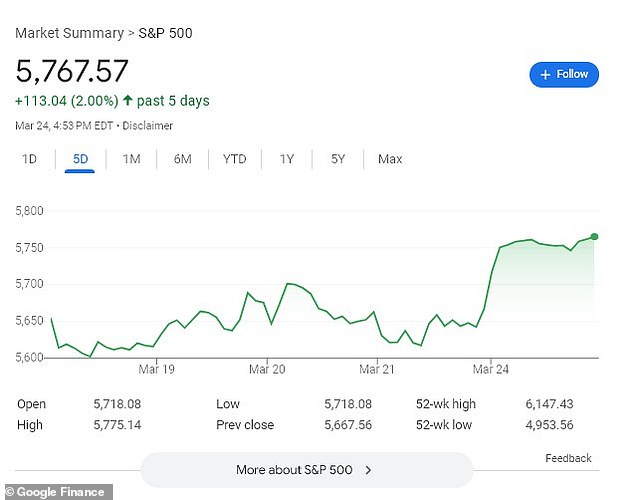
On Monday, the US stock market was rising as investors anticipated that the tariffs would be more precisely aimed rather than being widespread. Nevertheless, the S&P 500 index has declined year-to-date due to worries that a trade conflict might impede economic expansion and boost inflationary pressures.
However, Trump has been rather carefully guarding his intentions regarding tariffs, stating on Monday that although he aims to impose “reciprocal” charges, they “might end up being even more lenient than expected.”
by admin | Mar 25, 2025 | business, commerce, donald trump, government regulations, international economics
Canada
and
Mexico
might find some solace afterwards
Donald Trump
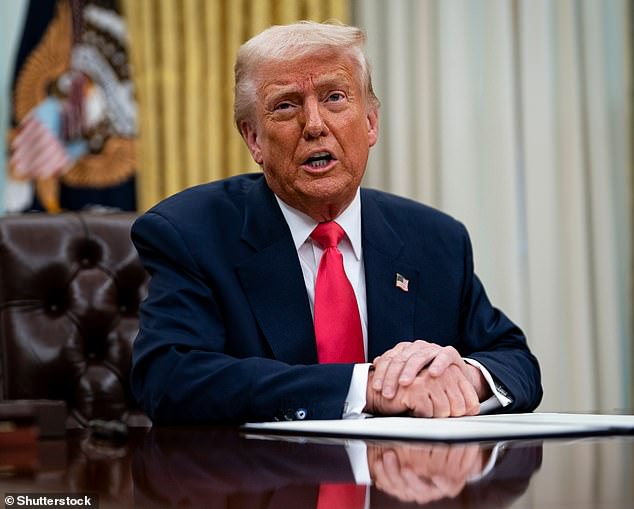
mentioned that the reciprocal tariffs set for April 2 might turn out less severe than what he initially pledged.
On Monday, earlier, Trump stated that a 25% tariff would be imposed on oil and gas imports from Venezuela.
put into effect on April 2, a date he had been mentioning
will be ‘DAY OF LIBERATION IN AMERICA.’
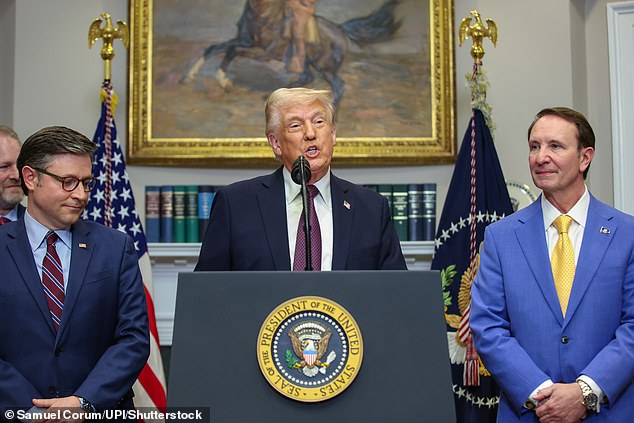
Nevertheless, during his address to the press in the Oval Office later that same day, he expressed willingness to show flexibility regarding certain other tariffs partly as a means to set an example for their neighbouring countries and allies.
“We might accept less than their asking price since they have overcharged us significantly; I doubt they can demand more,” Trump stated.
“In simpler terms, they have billed us an amount that makes me feel awkward about charging back what we were charged,” he mentioned, although he didn’t mention specific countries he might be looking into for reversals.
Trump
mentioned that some of his additional tariffs on automobiles, wood products, medicines, and chips might be delayed until further into the year.
He remains committed to declaring April 2 as ‘Freedom Day.’ He believes that by then, they will have generated sufficient income to reduce taxes and generate employment opportunities.
The U.S.
stock market
had been recovering on Monday as investors believe the tariffs will likely be more focused than initially anticipated.
The S&P 500 climbed by 1.8%, the Nasdaq Composite gained 2.3%, and Tesla
surged up 12%, continuing a bounce back that began last week, per the Wall Street Journal.
Nevertheless, the S&P 500 index has declined this year due to worries that a trade conflict might impede economic expansion and elevate inflationary stresses.
Canada and Mexico have responded with anger to the tariffs, whereas British Prime Minister Keir Starmer
has been attempting to reduce the tariffs
headed his way.
On April 2, Trump was
anticipated to impose full tariffs of 25% on goods from both Mexico and Canada, which are the biggest trading partners of the United States.
The presidential figure from the Republican party has further heightened the tariffs imposed in 2018 on steel and aluminium to 25% for every imported product. He has also pledged to introduce extra duties on vehicles, medicinal products, timber, semiconductor chips, and copper.
Recently, the United States and Canada have been at odds due to an escalating trade war and tariff disputes.
introduced by Trump, who has persistently criticized the country and its administration,
triggering demonstrations during sports competitions.
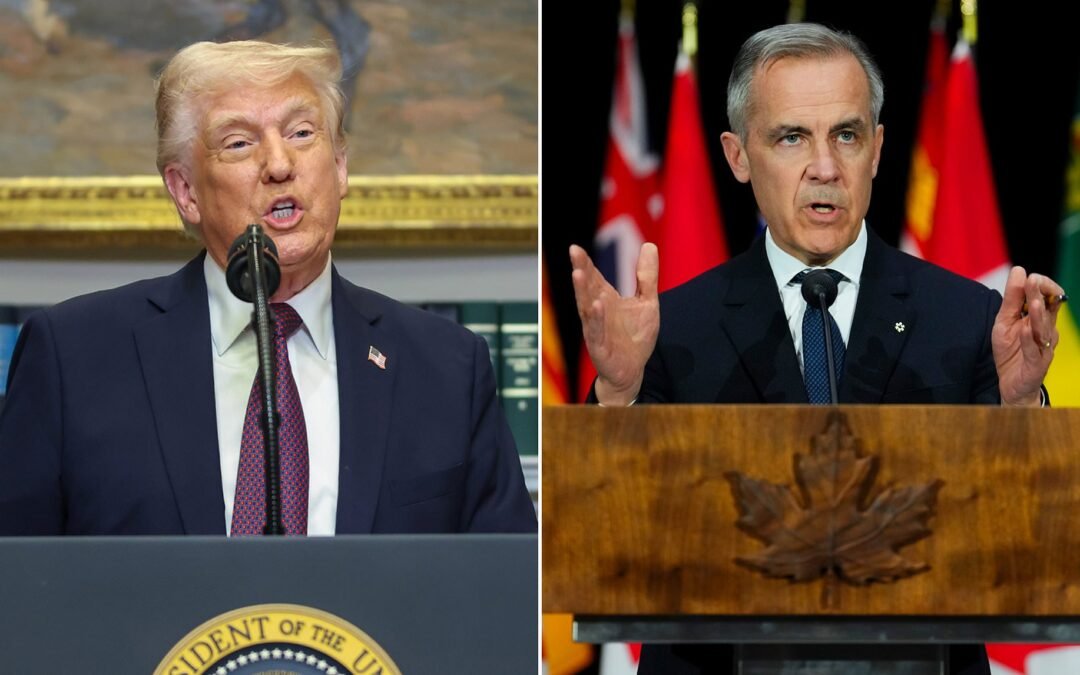
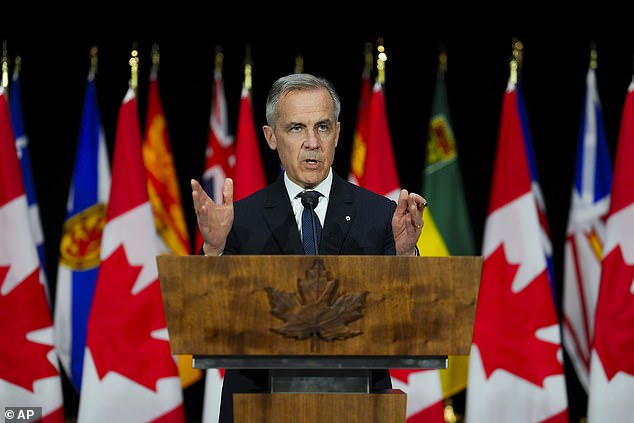
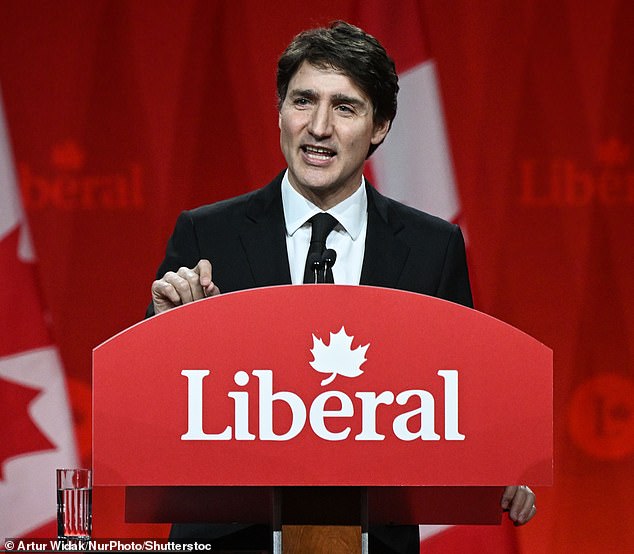
The newly appointed Canadian Prime Minister, Mark Carney, delivered a scathing critique of Trump regarding the continuing trade disagreement.
He charged Trump with ‘attempting to undermine our economy’ during his address to a boisterous gathering of Liberal party supporters.
‘As we are aware, Donald Trump imposed unwarranted tariffs
“What we construct, what we market, and how we earn our livelihood,” he stated.
He’s targeting Canadian workers, families, and businesses. We can’t allow him to win. And we won’t.
The harsh statements indicate that he plans to keep following the approach of former Prime Minister Justin Trudeau, engaging in public disagreements with the president.
Trump first began
suggesting Canada’s entry during Trudeau’s tenure, where he mocked him by calling him the ‘Governor of California’
‘.
He has implemented a 25 percent tax on all imports from Canada as part of an effort to ensure the country is held accountable for stopping illegal immigration and adhering to their commitments.
halting the influx of lethal fentanyl and other narcotics into our nation
“, stated a White House announcement.
Present polls indicate that there is minimal backing from Canadians regarding unification with the United States, as approximately 90 percent are against it.
Trump’s provocation similarly ignited numerous demonstrations against the United States among Canadian sports enthusiasts, who have
selected to show their discontent by jeering ‘The Star-Spangled Banner’ prior to matches
.
Before MLS matches in Canada, as well as during WWE events in Toronto and particularly intense Four Nations Face-Off competitions between the two countries in February, Canadians have focused their efforts on the US national anthem.
Nevertheless, a loud minority from Canada’s petroleum-rich regions
inspired by Trump’s ‘Drill Baby Drill’ policy
have emerged and identified themselves as 51st-staters.
On Monday, though, Trump seemed to shift his focus onto Venezuela.
In a Truth Social posting, Trump stated that Venezuela has shown significant hostility towards the United States, and nations buying oil from it will face consequences.
pay the duty on all their commerce with the U.S.
starting April 2.
These duties would probably increase the taxation burden for China, which in 2023 purchased 68% of the oil exported from Venezuela, as per a 2024 report by the U.S. Energy Information Administration.
The report indicates that Spain, India, Russia, Singapore, and Vietnam are some of the nations importing oil from Venezuela.
However, even the United States — notwithstanding its sanctions against Venezuela — purchases oil from that nation.
In January, the U.S. brought in 8.6 million barrels of oil from Venezuela, as reported by the Census Bureau, which makes up approximately 202 million barrels imported during that month.
On Monday, the Treasury Department extended the permission for U.S.-based Chevron Corp. to extract and ship Venezuelan oil until May 27th.
The extension, referred to as a general license, frees the nation from economic sanctions and permits it to keep producing oil.
In February, Trump declared the termination of the business ties between Chevron and Venezuela, which had served as a crucial financial support for the South American nation.
The Venezuelan President Nicolás Maduro countered by blaming the United States for
breaching global commerce regulations through an ‘arbitrarily chosen, unlawful, and hasty action’ aimed at ‘hindering the progress’ of the South American country
.
The president contends that tariffs will revive manufacturing employment, instead of exacerbating inflationary concerns and impeding economic expansion as experts in economics have cautioned.
His most recent personal account emerged on Monday when Hyundai declared at the White House about their plan to construct a $5.8 billion steel mill in Louisiana.
Trump said Venezuela will face a “Secondary” tariff because it is the home to the gang Tren de Aragua . The Trump administration is deporting immigrants that it claims are members of that gang who illegally crossed into the United States.
Read more

by admin | Mar 24, 2025 | currencies, economics, financial markets, international economics, money
-
A CBK report indicated that Kenya’s foreign exchange reserves increased to $10,001 million (KSh 1.3 trillion) in March 2025.
-
CBK said this represents 5.1 months of import cover, supporting importers’ demand for US dollars
-
The Kenyan shilling retained its stability, exchanging at a rate of KSh 129.38 per US dollar.
The LIFEHACK.co.ke correspondent Wycliffe Musalia boasts more than six years of expertise in areas such as finance, commerce, tech, and environmental issues. This background provides him with significant understanding of both Kenya’s and international economic patterns.
Kenya’s foreign exchange reserves have reached their highest level in three months starting from January 2025.
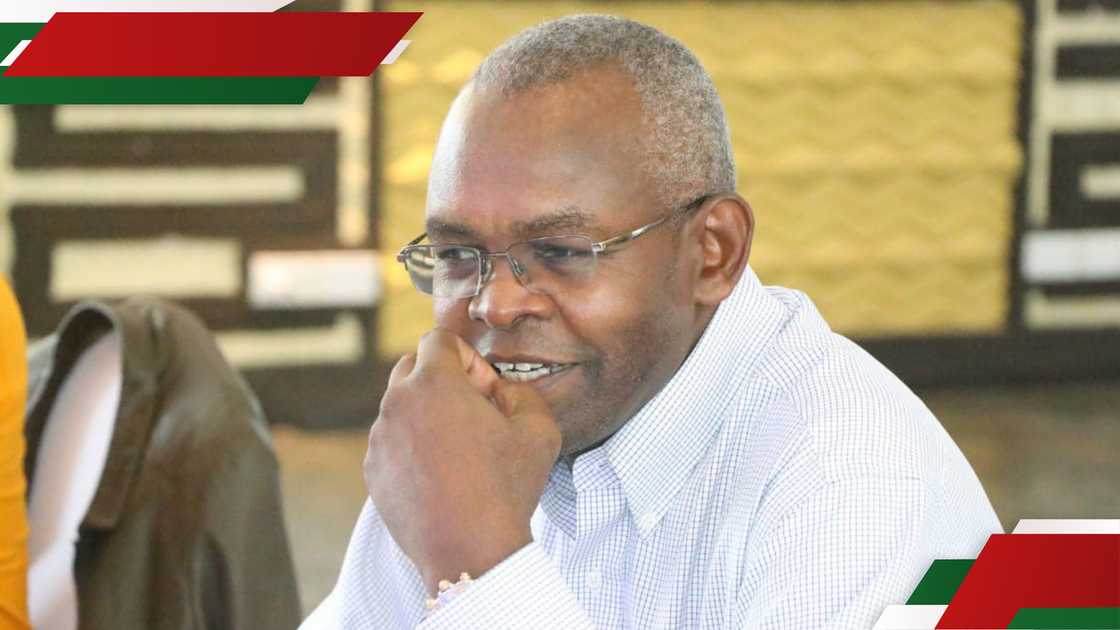
According to data from the Central Bank of Kenya (CBK), foreign reserves reached $10,001 million (KSh 1.3 trillion, using the present exchange rate).
How rising foreign reserves impact Kenya
This figure rose to $8,877 million (KSh 1.1 trillion), up from what was reported in January 2025.
The CBK observed that the increase in foreign currency reserves will be sufficient for approximately 5.1 months of import needs.
As of March 20, the available foreign exchange reserves were sufficient at USD 10,001 million (covering imports for 5.1 months). The Central Bank Report stated this fulfills the CBK’s legal obligation to strive for maintaining at least four months’ worth of import coverage.
In February, the foreign exchange reserves amounted to $9,142 million (KSh 1.2 trillion), which was sufficient to cover approximately four months of imports.
What is the worth of the shilling?
The report indicated that the value of the shilling remained steady over the three-month period ending in March 2025.
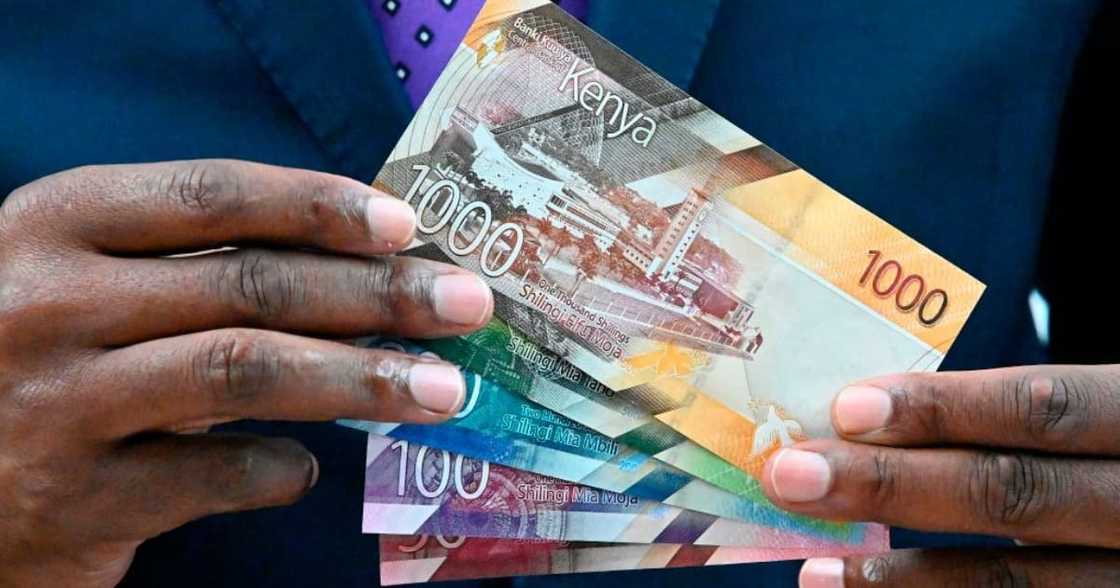
As of March 20, 2025, Kenya’s currency, the shilling, was trading at KSh 129.38 for one US dollar, down from KSh 129.43 recorded at the beginning of the month.
In January 2025, the shilling traded at KSh 129.31 for each US dollar, notwithstanding fluctuations in the foreign exchange market.
The U.S. dollar maintained stability throughout the month, preceding the inauguration of US President Donald Trump, whereas the shilling stayed bullish.
How CBK is maintaining shilling stability
In March 2025, the Kenyan shilling reached its highest point in six months relative to the US dollar when the Central Bank of Kenya implemented strategies aimed at stabilising it.
Following reports of heightened demand in February 2025, the regulator offloaded dollars to traders.
The reserves held by the CBK saw a decline from KSh 1.19 trillion ($9.256 billion) to KSh 1.16 trillion ($9.057 billion) over the previous week, partly due to dollars flowing out of the CBK’s treasury.
The sale was prompted by a rise in dollar inflows, notably from the recently issued infrastructure bond.
What other measures does CBK use to strengthen shilling
-
In February 2025, the regulatory body called for tenders for Treasury bonds as part of an effort to secure KSh 25 billion through local borrowing.
-
In March, CBK urged investors to lend the government KSh 70 billion through a newly launched bond offering aimed at providing budgetary assistance. The bank stated that the subscription window would be open from March 18, 2025, until March 26, 2025, with an auction planned for March 27, 2025.
by admin | Mar 24, 2025 | business, economics, exports, international economics, manufacturing
New Delhi [India], March 24 (ANI): With worries surrounding U.S. President Donald Trump,
Trump
According to a report by Motilal Oswal, India’s tariff policies present an opportunity to bolster its local manufacturing sectors.
The report stated that although the tariffs present difficulties like increasing expenses, variations in currency values, and possible declines in export revenues, they simultaneously create opportunities for India to emphasize self-sufficiency and enhance domestic manufacturing.
“Despite ongoing worries about rising expenses, fluctuating currency values, and possible effects on exports, India has the opportunity to leverage trade disputes and strengthen its local businesses,” the report stated.
In recent years, the United States has implemented significant tariffs on goods coming from India. Specifically, in 2018, a tariff rate of 25 percent was applied to $761 million worth of steel imports from India, along with a 10 percent duty on $382 million worth of aluminum products.
The increased expenses rendered Indian goods less competitive in the US market, resulting in a 46 percent decrease in steel exports over the course of a year. As American purchasers chose more affordable options, Indian companies experienced financial losses.
A major worry for India is how trade tensions affect its currency. Additionally, the report noted that India imports 87 percent of its crude oil, which requires payment in U.S. dollars.
A depreciating rupee because of capital outflows caused by worldwide trade conflicts would increase the expense of oil imports, exerting pressure on India’s economy. The report cautions that an extended tariff dispute might reduce India’s GDP by 0.3 percent.
Even with these difficulties, India has the potential to transform this scenario into an advantage. Traditionally, India has kept tariffs higher compared to other significant economic powers. Through careful implementation of import taxes and by bolstering local businesses, India could lessen its reliance on products from abroad.
The report indicated that the trade dispute ought to drive India toward achieving manufacturing independence and increasing exports in areas less impacted by tariff measures.
Trump
The country’s strategies strive to strike a balance between protective measures and sustaining American competitiveness in international markets. Despite the resulting uncertainties, according to a report, India could leverage the circumstances by boosting domestic manufacturing, attracting local investment, and enhancing trade deals with other countries. (ANI)
Provided by SyndiGate Media Inc.
Syndigate.info
).


