by admin | Mar 31, 2025 | border security, government, roads, safety, transportation
The Balochistan administration has prohibited late-night travel—primarily for public transportation—on key highways across multiple districts due to worsening security conditions. This decision was communicated through advisories released by district deputy commissioners within the province.
This decision follows an increase in terrorist activities throughout Balochistan, with several events occurring this year involving gunmen targeting travelers. Notifications prohibiting nighttime travel have been issued by the deputy commissioners of Gwadar, Kachhi, Zhob, Noshki, and Musakhel districts. Additionally, the authorities in Quetta mandated that all public transportation leaving the city must cease operations during the night hours.
The Quetta Commissioner, Hamza Shafqaat, informed the press that during a meeting he led, it was determined that public transportation would be banned from using the Karachi-Quetta highway (N-25), often referred to as the RCD Highway, after dark. This decision effectively severs connections between Balochistan and Sindh provinces.
It was emphasized as well that buses and coaches should leave punctually to prevent any hold-ups during the trip.
“Trackers and CCTV cameras on all buses and coaches must remain operational, and transport companies have been instructed to comply with the government’s instructions,” Shafqaat stated.
On March 28, Gwadar District Commissioner Hamoodur Rehman announced in an official notice that all public transportation along the Makran Coastal Highway (N-10) would be prohibited during nighttime hours until further notice.
The statement added that considering the safety of the passengers, both the administration and the private transportation association agreed to impose restrictions on departure times from Karachi, Gwadar, and Quetta. This was done to guarantee that travelers reach their destinations prior to nighttime.
Every transportation moving from Karachi or Quetta towards Gwadar would leave between 5 am and 10 am, whereas those departing from the port city of Gwadar to either of these two cities would set off between 6 am and 1 pm.
As stated in a notice issued by Kachhi DC Jahanzaib Langove, both public and private transportation were instructed not to use the Quetta-Sukkur highway (N-65) during nighttime hours—from 5 pm until 5 am—starting March 28th onwards unless otherwise notified. This effectively isolates Balochistan from Sindh after dark.
Cars traveling from Sibi to Quetta during the specified hours will be detained at the Nari Riverbank in Sibi, whereas vehicles arriving from the provincial capital will be held at Kolpur, the notice further stated.
A distinct directive issued by Zhob Deputy Commissioner Mehboob Ahmad prohibited public buses and coaches from traveling via Zhob along the N-50 National Highway – which connects Quetta to Khyber Pakhtunkhwa’s Dera Ismail Khan – during nighttime hours.
The drivers were instructed not to operate between 6 pm and 6 am starting March 27 until additional instructions are provided.
DC Noshki of Amjad Soomro and DC Musakhel of Juma Dad Mandokhail similarly released directives prohibiting public transportation from using the Quetta-Taftan (N-40) and Multan-Loralai (N-70) highways during the hours of 6 pm to 6 am.
As stated by Shahid Rind, the spokesperson for the Balochistan government, national highways have been shut down 76 times for different reasons starting from January 1st.
Recently, militants in Balochistan have stepped up their assaults, with the proscribed group Balochistan Liberation Army (BLA) becoming a prominent actor behind terrorist activities in Pakistan during 2024.
Recently, armed individuals obstructed the Coastal Highway in Gwadar and murdered six people, all of whom were from Punjab, after removing them from a bus heading towards Karachi.
Earlier this month, a Jaffar Express train was seized by attackers, resulting in 26 fatalities among the captives, of whom 18 were security officers. Additionally, five further security personnel died during the rescue mission.
A few weeks ago, insurgents obstructed several key locations along the Quetta-Sukkar N-65 highway in Bolan and took hold of weaponry belonging to the protection detail of Balochistan’s Parliamentary Secretary Mir Liaquat Ali Lehri.
Last month, seven individuals traveling to Punjab were removed from a bus and killed in Balochistan’s Barkhan district.
Last August, when BLA carried out multiple assaults throughout the region, 23 passengers were removed from vehicles and killed in the Musakhail district.
In April 2024, nine individuals were removed from a bus and subsequently killed by gunfire after assailants blocked the Quetta-Taftan Highway N-40 close to Noshki.
Provided by Syndigate Media Inc. (
Syndigate.info
).
by admin | Mar 30, 2025 | business, commerce, manufacturing, technology, transportation
Easytech Integrated Services Limited, a company from Nigeria, has joined forces with Guangzhou Dayun Motorcycle Company Limited, a prominent producer of motorcycles and tricycles based in China, to manufacture affordable yet superior quality tricycles designed specifically for improving the transport of farm products in countryside regions.
A press release provided to reporters in Lokoja by Oyigu Elijah outlined that the collaboration intends to manufacture tricycles tailored for effective cargo and baggage transport.
During a joint meeting with its partners, the Managing Director and CEO of Easytech Integrated Services Limited, Alhaji Abdulsalam Iyaji—a retired Assistant Inspector General of Police from Kogi State—highlighted the significant impact that transportation has on Nigeria’s socioeconomic growth.
“Our mission is to tackle issues, and our objective here is to resolve the transportation difficulties affecting the everyday routines and economic endeavors of our community members, with special emphasis on those residing in rural regions,” Iyaji noted.
“We decided to collaborate with Dayun due to their established success and stellar standing in the market for crafting robust and effective items,” he noted.
Edo government collaborates with LAPO to address issues affecting women and girls; Okun Development Association organizes security conference; Abia government plans to work with NASS on renewable energy projects
Alhaji Iyaji emphasized the advantages of the newly introduced pickup tricycles. These vehicles are well-suited for carrying merchandise and farm products. He pointed out their efficient fuel usage, robust construction, and ability to handle demanding tasks effectively.
“These tricycles are specifically designed for transporting goods and baggage. They are robust, dependable, and boast great fuel efficiency, which makes them an ideal choice for small enterprises and personal use,” he clarified.
The partnership is set to launch cutting-edge tricycle designs powered by alternative energy sources. Iyaji shared intentions to produce electric and compressed natural gas (CNG) tricycles aimed at decreasing dependence on fuel-driven versions and adhering to international environmental objectives.
“We are currently investigating methods to manufacture electric tricycles and Compressed Natural Gas (CNG) compliant versions. Our objective is to reduce the difficulties related to transport, thereby simplifying and lowering costs for people in Nigeria,” he stated additionally.
Ms. Heidi, the Sales Manager at Guangzhou Dayun Motorcycle Co. Ltd., conveyed her company’s excitement about the collaboration during the event.
“We are delighted to join forces with Easytech Integrated Services Limited, a reliable and forward-thinking firm. This partnership represents a crucial move toward enhancing our reach and influence in Nigeria, which stands as the continent’s most populated nation,” she stated.
The event saw the presence of important delegates from both organizations, featuring Mr. Niu, who holds the position of Technical Officer at Dayun, alongside Mr. Suleiman Iyaji, serving as the Sales Director for Easytech Integrated Services Limited.
FURTHER READING FROM NIGERIAN TRIBUNE
Get real-time news updates from Tribune Online! Follow us on WhatsApp for breaking news, exclusive stories and interviews, and much more. Join our WhatsApp Channel now
Provided by Syndigate Media Inc. (
Syndigate.info
).

by admin | Mar 30, 2025 | battery charging, battery electric vehicles, electric cars, electric vehicle charging stations, transportation
BYD amazed everyone with its rapid charging capabilities. A chief executive from an electric vehicle charging network commented, “Speed isn’t everything when it comes to charging.”
This month, the Chinese car manufacturer BYD stunned the global market when it
boasted extremely fast charging speeds for its upcoming electric vehicles
BYD claims these vehicles can handle up to 1,000 kilowatts of charging power—which is roughly four times the capacity of an average Tesla—resulting in charge times as brief as five minutes for approximately 250 miles of range.
For years, it has been evident that electric vehicle chargers must become quicker to attract more customers. However, according to Andrew Cornelia, CEO of Mercedes-Benz High-Power Charging, a charge time of merely five minutes might be excessive.
during an interview
on the
InsideEVs Plugged-In Podcast
this week.
He remarked, ‘This represents an incredible advancement. The sector will undoubtedly follow.’ However, he added, ‘It’s important to remember that quicker isn’t necessarily preferable.’
Today,
Most popular electric vehicles require between 15 to 40 minutes for charging.
To accumulate a substantial level of charge at a sufficiently potent DC fast-charging station. This would provide enough power for several hundred miles of highway travel during a journey. Cornelia emphasizes that advancing quicker-charging vehicles is crucial; however, she believes the sector is nearer to achieving this ideal state than it might appear.
Should we aim to finish charging within five minutes? Likely not, as the typical duration spent refilling a gas tank usually ranges from 10 to 12 minutes,” he stated. “That’s essentially what we’re trying to determine.
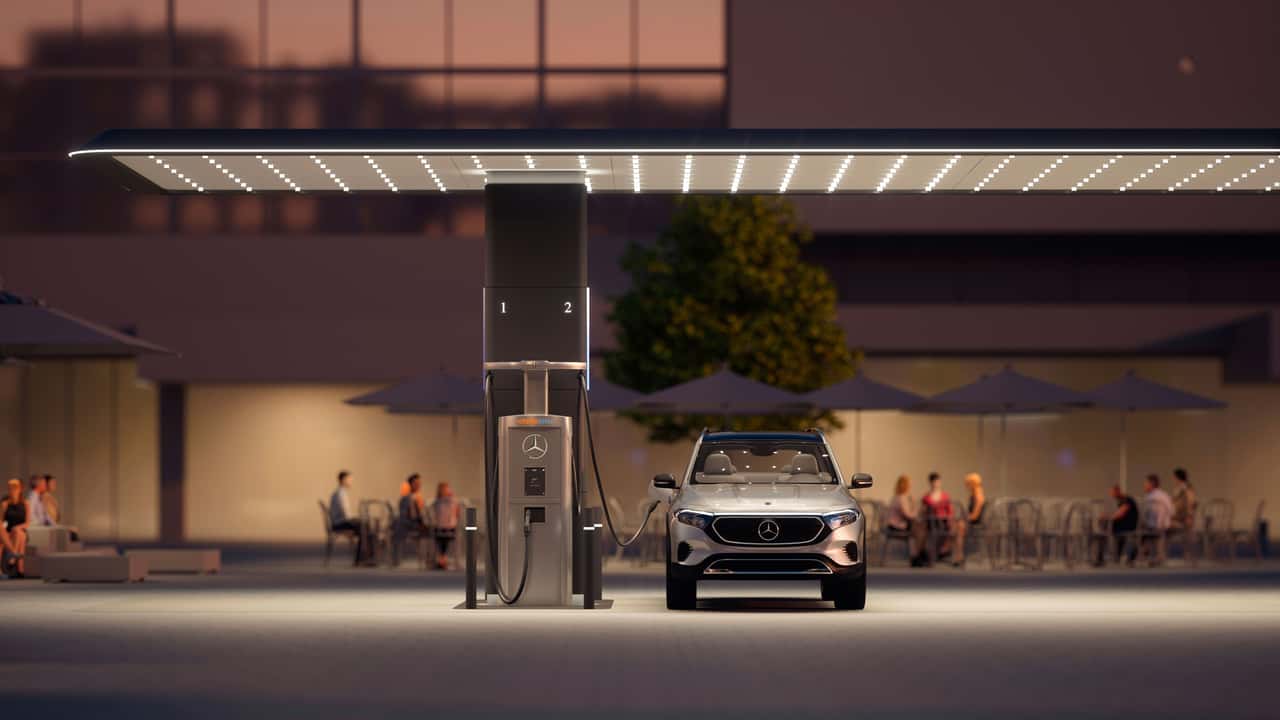
Mercedes Fast-Charging Stations
It sounds reasonable. Filling a gas tank might only require three to five minutes, yet customers frequently end up purchasing coffee or lottery tickets as well. This often results in what I consider an unacceptable practice: leaving your vehicle at the fuel pump. However, that topic deserves its own discussion.
Moreover, he argues, people are thinking about charging times all wrong. It’s not about making charging as fast as possible all the time—but rather making the charging time fit the stop or activity you’re doing. After all, a big pro of EVs is that they can be plugged in and sucking up juice whenever they’re parked, whether that’s for five minutes or five hours.
He argues that 1,000 kilowatts of charging power wouldn’t be practical for a residential garage since you will invariably be stationary for multiple hours regardless.
He mentioned that when visiting a movie theater, you don’t require a 1,000-kilowatt charge; instead, you need a system suitable for a two-hour stay. If you’re at a café, perhaps you’d prefer quicker service, yet it typically involves just a brief 15-minute pause.
According to Cornelia, “five-minute charging is really practical for only a specific set of situations.”
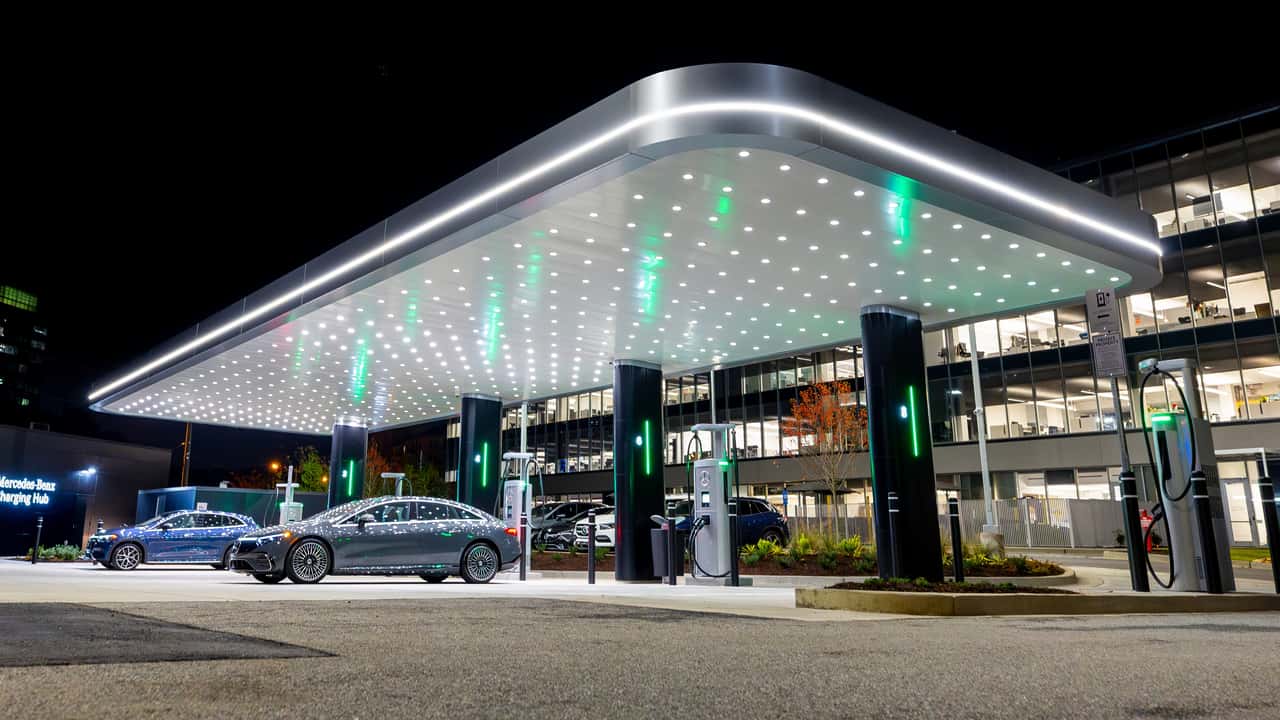
The Mercedes-Benz Charging Hub at the Mercedes-Benz USA headquarters in Sandy Springs, Georgia.
Certainly, Mercedes-Benz High-Power Charging remains dedicated to ensuring that charging stops are as swift and effortless as possible. They utilize 400-kW stations, providing ample energy for nearly every electric vehicle available in the United States.
Furthermore, as inferred from Cornelia’s point of view, the firm prioritizes installing charging points in spots where motorists can engage in activities during the refueling process. They’ve formed partnerships with establishments such as Starbucks and Buc-ee’s, known for their extensive service areas.
Nevertheless, Cornelia pointed out that BYD’s declaration serves as a powerful statement showcasing the promising future of electric vehicle charging infrastructure.
“It’s crucial to convey that charging can theoretically provide power at this output and speed under specific conditions,” he stated. “However, such scenarios aren’t the most common.”
Have information regarding the electric vehicle industry? Reach out to the author:
Tim.Levin@InsideEVs.com
More EV Charging News
-
2025 Porsche Taycan Cross Turismo Range Tested: ‘Speechless’
-
The 2025 Ford F-150 Lightning Has Marginally Improved DC Fast-Charging Capabilities
-
Tesla Model Y Battery Performance After 100,000 Miles: An Unexpected Outcome
-
Dodge Charger Daytona EV: What Information Are You Seeking?
-
General Motors’ Rapid-Charging Stations for Electric Vehicles Have Expanded Across More Than 25 U.S. States
-
Chevrolet EVs Gain Tesla Supercharger Access in the United States.
by admin | Mar 30, 2025 | business, commerce, energy sector, petroleum, transportation
By Stanley Senya
Accra, March 30, GNA – In an effort to boost its fuel security, Burkina Faso’s National Hydrocarbons Company (SONABHY) plans to leverage the robust petroleum distribution network of Ghana’s Bulk Energy Storage and Transportation Company Limited (BOST).
The collaboration intends to simplify the transportation of petroleum goods from Ghana to Burkina Faso through BOST’s efficiently connected logistical infrastructure, which encompasses pipelines, waterways, large-scale trucks, and purposefully placed storage facilities.
During a recent top-tier gathering in Accra, both State-Owned Enterprises reiterated their dedication to strengthening collaboration, emphasizing the use of BOST’s facilities to achieve more efficient and economical fuel distribution.
A combined technical group will evaluate BOST’s operational capabilities to enhance the ease of petroleum trading and minimize disruptions in the supply chain.
BOST’s fuel distribution network relies on a multifaceted logistical approach designed to enhance both efficiency and dependability.
The key elements of BOST’s fuel distribution infrastructure encompass the Tema-Akosombo Petroleum Pipeline (TAPP), the Buipe-Bolgatanga Petroleum Product Pipeline (B2P3), as well as transportation via river using VLTC-operated barges along the Volta Lake.
Although the TAPP system streamlines the transportation of petroleum products between Tema and Akosombo, acting as an essential component in the logistics network, the B2P3 structure guarantees efficient fuel distribution from Ghana’s central region to the five northern zones and further into countries like Burkina Faso.
Moreover, the VLTC and BOST river barges offer an alternate means for fuel transportation from Akosombo to Buipe, thereby alleviating strain on road transport systems.
Once more, key fuel storage facilities like those at Accra Plains, Akosombo, Buipe, and Bolgatanga, managed by BOST, act as vital centers for both local and international commerce.
Mr. Afetsi Awoonor, the Managing Director of BOST, emphasized the company’s willingness to assist SONABHY in ensuring a consistent supply of petroleum products.
“The effective utilization of our pipelines, storage facilities, river barges, road transportation alliances, and the Blue Ocean terminal creates a more streamlined fuel distribution network, which benefits all involved,” he stated.
Mr. Wendpanga Aimé, the Managing Director of SONABHY, showed optimism about the collaboration, emphasizing its ability to stabilize fuel supplies and manage expenses effectively.
“Boasting a solid capital foundation of 20 billion CFA francs, SONABHY is poised to enter into extended trade pacts with BOST. This partnership is essential for maintaining a steady and economical provision of fuels for Burkina Faso,” he stated.
Apart from petroleum trades, Burkina Faso has sought higher levels of electricity imports from Ghana with the aim of boosting its industry and economy.
During the visit, Burkina Faso’s Energy Minister, Yacouba Zabré Gouba, headed a group that visited BOST’s Bolgatanga Depot and GRIDCo’s Navrongo substation to investigate potential enhancements in energy distribution networks.
The refreshed collaboration between BOST and SONABHY, initiated by President John Dramani Mahama along with his Burkinabe counterpart, boosts inter-country oil commerce. This alliance ensures that Ghana’s sophisticated petro-transport system aids in maintaining energy stability and improving trading effectiveness throughout West Africa.
GNA
GRB
Provided by SyndiGate Media Inc.
Syndigate.info
).
by admin | Mar 28, 2025 | business, cargo, commerce, driving, transportation
MANILA, Philippines – Despite entering a field dominated primarily by men, Joy Ann Torres chose driving various sized vehicles as her career. She holds the belief that women make for better and safer drivers than their male counterparts.
Her dad instructed her on driving when she turned 12. By the time she reached 18, she had acquired an official permit enabling her to operate big rigs like buses and semi-trailers. During this period, she also mastered changing tires and diagnosing typical motor issues.
“Frankly, mas madaling ko pong mag-park ng trailer truck,” shares the 40-year-old with a smile.
READ:
Lista, Mober, and Zed make it onto Forbes Asia’s ‘100 to Watch’ list
In 2017, Torres transitioned from being a captain’s steward on a cruise ship to becoming a bus driver. Daily, she would travel the path between Parañaque Integrated Terminal Exchange and Monumento. She expresses that this role held great significance for her, as she felt proud to be among the few women driving public transportation vehicles.
Her 12-year-old daughter frequently boasted to her classmates about how her mom drives a bus for work. “I suppose it made her feel proud knowing that her mommy has a role typically played by dads,” she shares in Filipino.
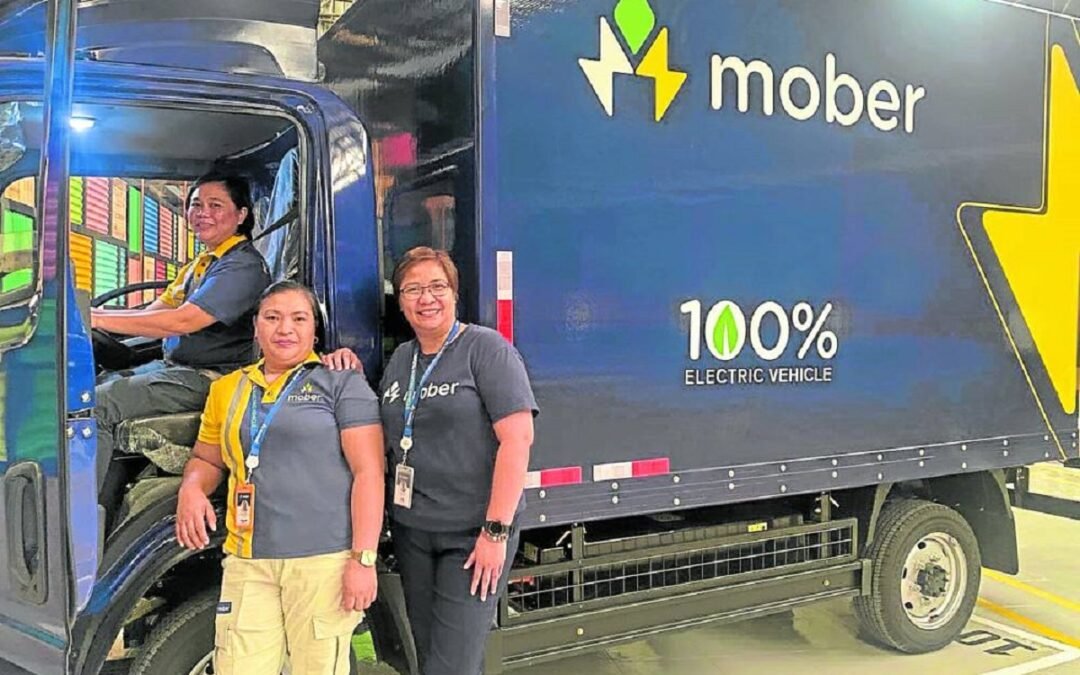
In 2023, Torres saw a job posting for a female driver of electric vehicles (EV). Wanting a change of scenery, she tried her luck. After hurdling the initial screening and safety process, she was hired as the first female truck driver of Mober, a pioneer in green logistics in the Philippines.
Torres, who is now known as a green delivery specialist, operates Mober’s electric vehicle for transporting furnishings within Metro Manila and Cavite. Accompanying her on these routes are an assembler and a helper.
Inclusive and sustainable
She mentions during an interview with SANGGRALOKA that driving an electric vehicle offers great ease and convenience. One of the reasons for this is that she doesn’t have to concern herself with environmental damage.
Mober is at the forefront of shifting towards eco-friendly deliveries in the Philippines. By concentrating on helping companies reduce carbon emissions from their delivery operations, Mober provides smooth solutions that do not require initial investments.
This B2B platform aids deliveries for IKEA Philippines, SM Appliance Center, Nestlé Philippines, Nespresso, Ajinomoto Philippines, and Maersk.
Dennis Ng, the founder and CEO of Mober, aims to dismantle obstacles by promoting careers in logistics for women. He states, “At Mober, we are committed to fostering an inclusive atmosphere where everybody gets a chance.”
Prior to their deployment, the drivers of Mober’s eco-friendly fleet receive training on the proper handling of the electric vehicles. “We advise them to apply gentle braking,” Ng further explains, “since each time you press the brake pedal, it helps recharge the battery.”
Every truck boasts a battery lifespan of up to eight to ten years with adequate upkeep, enabling them to cover distances of around 210 kilometers per full charge.
‘Handywomen’
In addition to drivers, Mober is currently recruiting female furniture assemblers. Known as “handymen,” these women receive training to assemble and install IKEA furnishings.
Nelda Palisoc previously worked as a domestic helper in Kuwait, Norway, and Hong Kong before she joined Mober last year. She was one of the initial employees hired at Mober as a female assembler.
Following her completion of the upskilling and safety training at the “Assembly Academy” held within the company, she acquired knowledge on the correct usage of a drilling machine and identifying useful tools.
Many times, some customers doubt whether she can handle the task, particularly when it involves assembling big, heavy furniture. She simply smiles at them. “In the end, they will be astonished by my abilities,” states this 45-year-old woman in Filipino.
Torres and Palisoc mention that they have never faced discrimination from their male counterparts. In fact, their fellow workers are quite willing to offer assistance and share their technical expertise with them.
Central Charge
Wing Alforque, who leads transportation at Mober, observes a rise in applications from women seeking roles as truck drivers, assemblers, and helpers.
READ:
Mober introduces completely electric truck tractors.
“They would share with me during interviews their enthusiasm about taking on a role typically dominated by men,” she clarifies.
On March 10, Mober revealed the nation’s biggest commercial electric vehicle charging station. Situated in Pasay City, Central Charge spans 3,000 square meters and features 56 stations designed for e-van and e-truck fleets.
Using a well-organized three-shift schedule, this ₱14 million facility has the capacity to recharge as many as 200 electric vehicles (EVs) per day. The station comes equipped with 50 charging points each rated at 7 kilowatts (kW), along with an additional two stations capable of delivering power at 60 kW for rapid charges. This setup allows Mober to optimize their processes and reduce idle time for their fleet significantly.
The inauguration of the new site comes after the debut of the firm’s initial charging station in 2023, covering an area of 800 square meters with 30 charging stations located in Pasay City.
Solar energy
In order to considerably decrease its environmental impact, Mober is considering installing solar photovoltaic panels along with a 500 kWh battery energy storage system at Central Charge.
“Central Charge isn’t merely about investing in infrastructure; it’s a strategic move to address the rising need for environmentally friendly delivery options while upholding our pledge of zero emissions,” Ng states.
Ng points out that Mober’s innovation surpasses just infrastructure with its exclusive battery management system (BMS) and transport management system (TMS). The BMS aids in prolonging the lifespan of electric vehicles’ batteries, whereas the TMS aims at optimizing delivery paths, cutting down energy usage, and boosting overall operational effectiveness.
The logistics firm intends to construct two extra charging stations, which could be located in either Bulacan or Pampanga along with Laguna. Both the Northern Bolt and Southern Spark facilities will cover an area ranging from 6,000 to 10,000 square meters, aiming to improve their logistics network and facilitate growth.
Mober’s objective is to grow its fleet to 500 units by 2026. However, in the short term, they plan to increase their number to 240 electric vehicles by the end of this year, starting from the current count of 110 units.
“Ng mentions that we’re expecting 100 additional units, which means we require 100 drivers.”
And indeed, the firm is giving priority to recruiting additional female employees.
by admin | Mar 27, 2025 | commerce, flying, transportation, Travel, vietnam
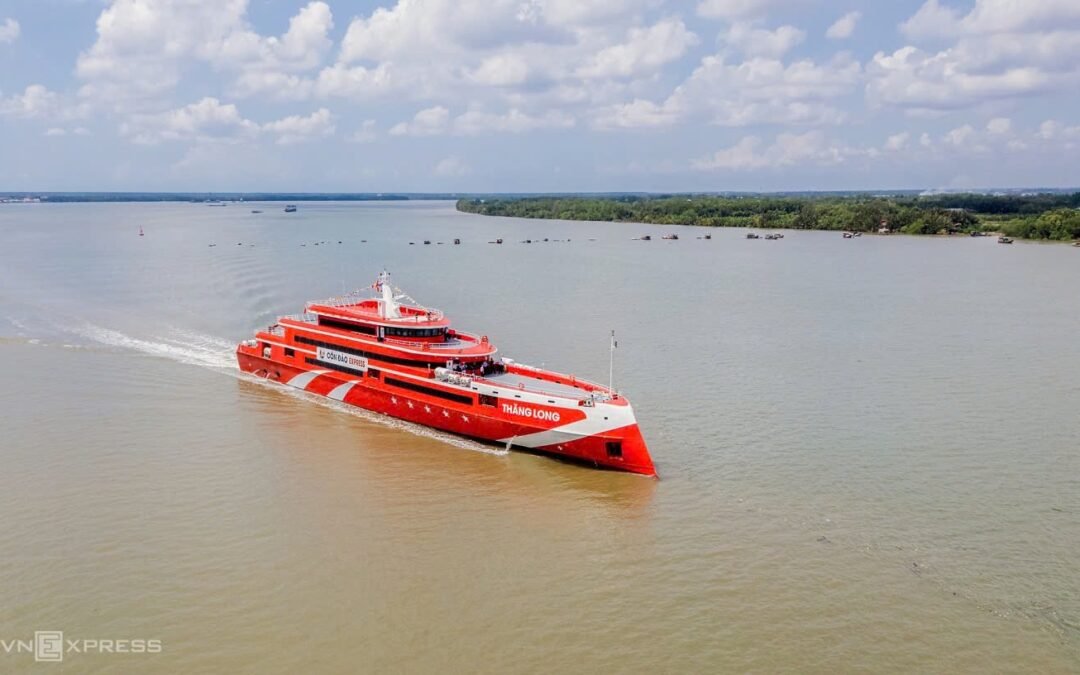
The high-speed ferry connecting Ho Chi Minh City and Con Dao Island, which can accommodate up to 1,017 travelers, is scheduled to restart services in mid-April following an absence of eight months.
The Phu Quoc Express Boat Company, which operates the service, stated that the ticket prices have stayed constant at VND615,000 to 1.1 million ($24-$43), varying based on seat category and time of departure.
The ship started operations in May of last year.
With a maximum speed of 35 nautical miles (over 60 kilometers) per hour, it takes approximately four hours to journey from Ho Chi Minh City to Con Dao, which is an island located off the coast of the southern province of Ba Ria-Vung Tau.
This vessel is the biggest high-speed passenger ship in Vietnam, measuring over 77 meters in length.
However, just weeks into operation, it was running below half of its intended capacity, leading the provider to halt the service in late July.
A number of travelers mentioned that the facilities and features aboard the ship were top-notch but
the
route from central Ho Chi Minh City to Hiep Phuoc Port
The point of departure for the vessel was distant, which made things rather inconvenient.
At present, individuals can reach Con Dao Island either by flying or by taking a ferry from Vung Tau town, which is approximately two hours away from Ho Chi Minh City.
The Con Dao archipelago consists of 16 islands, where Con Son Island is the biggest and the sole inhabited island, situated 185 kilometers away from Vung Tau.
The town boasts approximately 10,000 inhabitants and attracts many visitors each year.


