
by admin | Mar 27, 2025 | archaeology, british monarchy, culture, heritage, history
-
READ MORE: Were the individuals buried at Sutton Hoo actually royalty?
For nearly a hundred years, the Sutton Hoo burial site has provided an intriguing look into Britain’s early past.
Among the astounding treasures discovered at the site, the most remarkable item is undoubtedly the Sutton Hoo helmet.
regarded as one of the most valuable jewels of the Anglo-Saxon era
.
Up until this point, archaeologists thought that the helmet had arrived in Britain from
Sweden
As a diplomatic present or family treasure.
However, a recent finding by an amateur metal detectorist has raised questions about the helmet’s provenance — potentially altering our understanding of early European history.
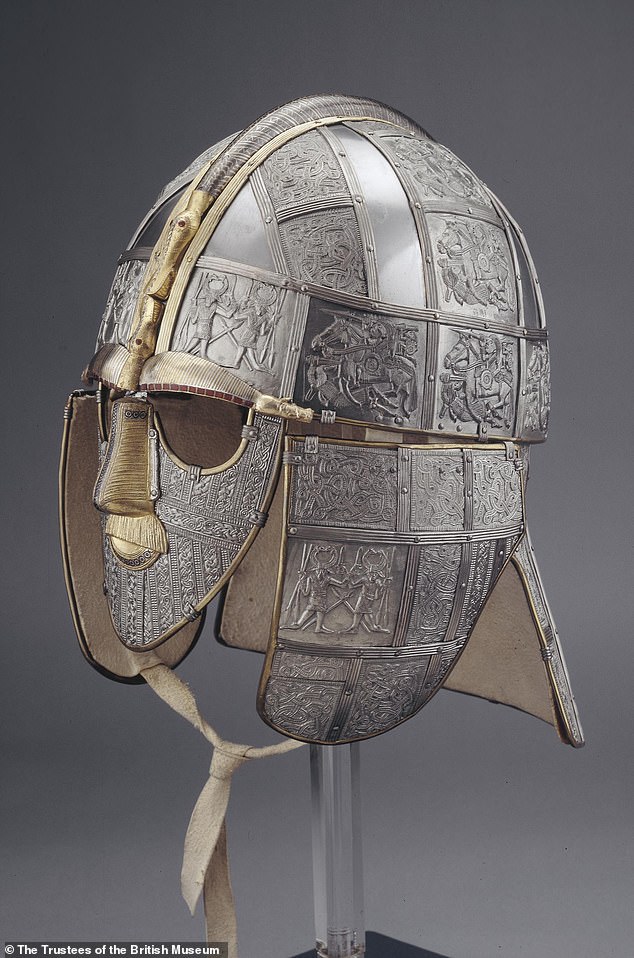
Among the numerous adornments on the damaged helmet, dating back to the 7th century, are two petite panels depicting soldiers mounted on horses.
Based on an examination conducted by the National Museum of Denmark, these panels closely resemble a tiny metallic stamp discovered on the Danish island of Taasinge.
This opens up the intriguing prospect that it originated in Denmark rather than Sweden.
Peter Pentz, a curator at the National Museum of Denmark, stated to the Ritzau news agency: “Given the striking similarity, this might indicate that not only were these items produced in the same location, but they may have been crafted by the very same artisans.”
The renowned helmet found at Sutton Hoo had disintegrated into numerous fragments; however, archaeologists managed to reconstruct it, uncovering elaborate designs and embellishments.
This includes an image of a mounted warrior charging over a fallen man.
So far, archaeologists thought this design was inspired by previous Roman styles and might have originated from Uppland in eastern Sweden, a region known for comparable warrior designs on helmets.
Nevertheless, experts from the National Museum claim they have found an artifact that casts doubt on that narrative.
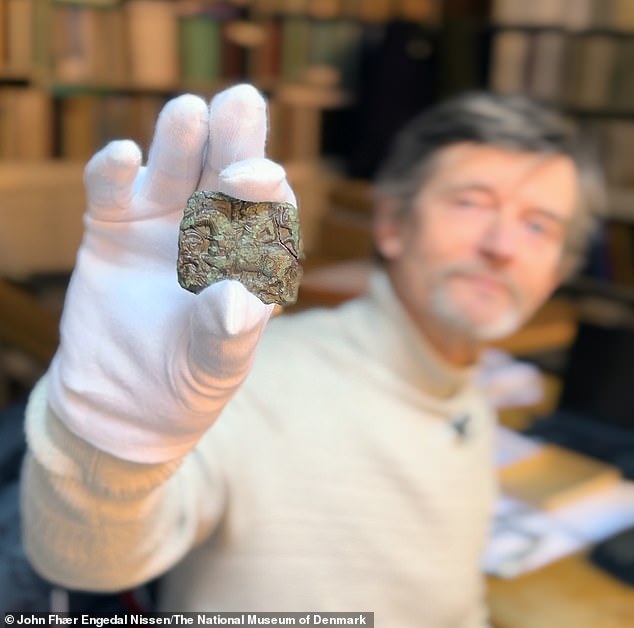
Local archaeologist Jan Hjort was scouring the fields of Taasinge in 2023 when he discovered a small, flat metal object just four centimetres by five centimetres.
Following the submission of the artifact to the nearby museum, it was identified as a form of stamp or mold referred to as a ‘patress’.
Metal sheets could be positioned above the form and hammered to transfer the pattern onto them.
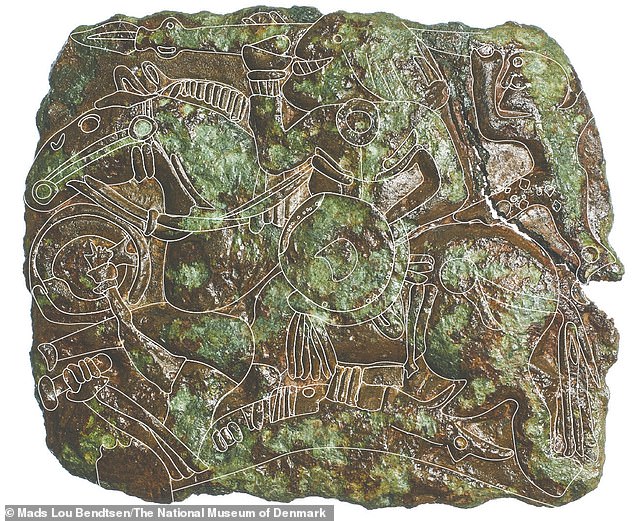
In this particular instance, the design features a man atop a horse trampling a fallen figure. Experts suggest that this depiction bears an even stronger resemblance to the Sutton Hoo design compared to the various Swedish interpretations.
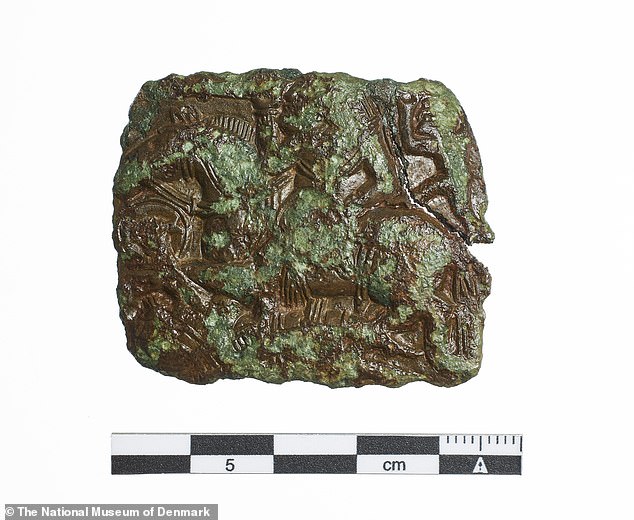

The researchers highlight features such as the lines under the horseman’s foot and those along the edge of the prone man’s foot, noting these elements appear identical in both the Patti and Sutton Hoo helmet remnants.
Although Mr. Pentz recognizes that the themes might have been influenced by each other, he contends that such a high degree of resemblance cannot simply be written off as mere copying.
A number of historians think that the island of Taasinge might have housed a metalworking site in the seventh century. Thin metallic plates unearthed in this region suggest they may have been utilized for producing stamped foils.
“That might offer compelling proof that the Sutton Hoo helmet was indeed crafted in Taasinge, making this discovery truly remarkable,” states Mr. Penz.
Nevertheless, there are multiple problems hindering this theory—primarily due to the fragmentation of the Sutton Hoo helmet and its considerably worn condition.
Moreover, the Taasinge seal tag is made from such a tiny piece of metal that it might have been readily transported from another location.
However, if the Sutton Hoo helmet actually originated from Denmark instead of Sweden, it would challenge historians’ understanding of the power dynamics in seventh-century Europe.
The study indicates that Sweden and England might have served as outlying areas under the influence of a Danish center of power, with the helmet highlighting a significant link to Denmark as the dominant force in the area.
Mr. Pentz states: “It remains premature to reach any definitive conclusions, yet it suggests that Denmark held a more significant position during this era than initially believed.”
We frequently credit the unification of the kingdom to Harald Bluetooth during the 10th century; however, Denmark might have achieved relative unity and strength as far back as 600 CE. This discovery challenges earlier beliefs and such revelations are inherently intriguing.
However, skepticism remains among some who do not believe this discovery is as groundbreaking as claimed by the National Museum of Denmark.
Professor Helen Gittos, a specialist in medieval history at the University of Oxford, informed MailOnline that the seal impression was “an intriguing discovery,” though she noted that the design was not particularly rare.
Dr. Gittos states: “The images align with comparable instances discovered in Valsgarde, Sweden, along with locations in southern Germany and other areas.”
It’s especially useful to uncover evidence of metalwork activities, as it reinforces the idea of how closely linked the military elite groups were during this time in northwestern Europe.
The burial at Sutton Hoo took place roughly between AD 610 and AD 635, during which time the location was part of the Anglo-Saxon kingdom known as East Anglia.
Back in 1939, amateur archaeologist Basil Brown uncovered the site after being asked by local resident Edith Pretty to clear away the Suffolk earth.
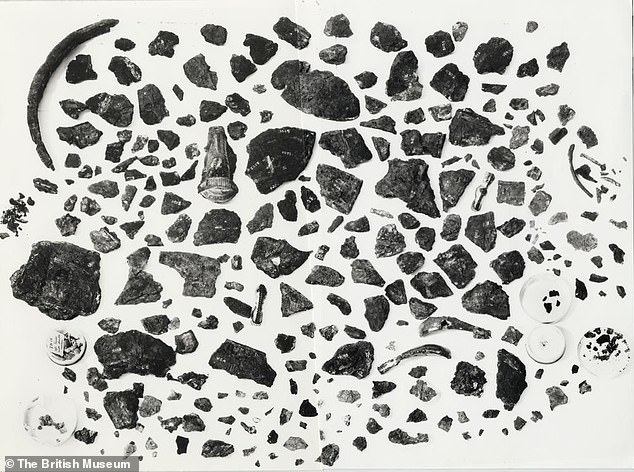
He discovered proof of a massive funeral structure — an 88.6-foot-long vessel containing a chamber filled with lavish items.
Over 1,300 years, the acidic ground caused the ship’s wood to decay completely, leaving behind just a spectral outline.
Subsequent examination revealed the presence of phosphates in the soil — a sign that a human body had previously been buried there.
The alkaline environment has eroded the human bones, indicating that identifying the person buried there will probably be impossible.
Those interred here did not leave behind any written accounts, making it impossible to determine their precise identities. However, historians have maintained that Sutton Hoo served as the burial ground for the ruling family of East Anglia—the Wuffingas dynasty.
Some believe that a prominent ruler or hero from East Anglia was buried with his riches, potentially King Rædwald, as stated by the National Trust.
The individual’s regal standing is evident from the extensive assembly of over 260 artifacts discovered interred with them.
These consist of items such as a shield and drinking horns that have ties to Scandinavia, along with the renowned Sutton Hoo helmet.
Read more

by admin | Mar 27, 2025 | culture, laws and regulations, regulation, rules and regulations, tourists
Bali has implemented a set of new rules for visitors in an effort to curb improper conduct.
The authorities state that these stringent measures are designed to protect the cultural integrity and holy locations of the Indonesian island.
The rules cover clothing and behaviour when visiting temples and religious complexes, including prohibiting menstruating women from entering.
The mayor has warned that some transgressions could be met with legal consequences under Indonesian law.
Updated regulations for managing foreign visitors in Bali
The new regulations were introduced by Bali Governor I Wayan Koster on March 24th.
“We issued a similar regulation before, but as things change, we need to adapt. This ensures that Bali’s tourism remains respectful, sustainable, and in harmony with our local values,” Koster said.
The guidelines emphasize maintaining respectful conduct when visiting holy sites and require the payment of
Bali
’s tourist levy.
Tourists are required to hire only licensed guides and stay in approved accommodations, adhere to traffic regulations, and trade money exclusively at designated locations.
“I am putting this directive into effect immediately to manage foreign tourists during their stay in Bali,” Koster said additionally.
Updated regulations prohibit improper images and disposable plastic items.
The updated regulations mandate that visitors should dress modestly and show respect by behaving appropriately in various locations such as places of worship, eateries, commercial zones, or streets.
Visitors are
banned
The mayor stated that swearing, causing disruptions, or displaying rudeness towards locals, officials, or other visitors is not allowed. Additionally, he mentioned that “posting hateful messages or false information on social media platforms will also be forbidden.”
Activities that are prohibited encompass accessing holy temple zones without authorization, discarding waste indiscriminately, and operating without valid permits.
Single-use plastics such as plastic bags, Styrofoam containers, plastic straws, and beverages in plastic packaging have been prohibited.
Under the new guidelines,
foreign tourists
must respect and adhere to Balinese customs, traditions, and cultural practices, particularly during rituals” and “ensure appropriate attire when going to temples, tourist sites, or public areas.
Furthermore, foreign visitors are not allowed to enter sacred temple zones unless they are worshipping and dressed in traditional Balinese clothing. The guideline further states that menstruating women are also barred from accessing these regions.
Visitors must refrain from climbing sacred trees or monuments and are prohibited from taking inappropriate or nude photographs at religious locations.
Visitors who do not pay the required levy may encounter legal repercussions.
In February, Bali implemented a single-entry charge of 150,000 Indonesian rupiah (€9) for tourists from abroad aimed at supporting preservation initiatives.
Under the new rules, tourists failing to pay the tourism tax will not be allowed entry into attractions, and individuals found breaking these regulations will encounter legal repercussions as per Indonesian laws.
Recently, Balinese authorities proposed a
daily tourist tax
Similar to the $100 (€95) Sustainable Development Charge levied on most foreign tourists visiting Bhutan.
‘We expect our guests to show the same respect that we extend to them’
The directive comes just a few days before Nyepi – a sacred holiday known as the day of silence – on 29 March. The festival sees the island come to a standstill for 24 hours, requiring everyone, including tourists, to stay indoors.
We’ve put together a specialized team for this mission.
tourists
“Those who misbehave will face immediate firm action,” Koster said according to The Bali Sun, a local newspaper.
He mentioned that the island’s civil service police force will keep an eye on tourists’ behavior and ensure they comply with the new rules.
“Bali is a stunning and holy island, and we ask our visitors to demonstrate the same level of respect that they receive,” Koster stated.

by admin | Mar 25, 2025 | culture, greenland, heritage, indigenous, traditions
Aviaja Rakel Sanimuinaq is an Inuk from Greenland who serves as both a shaman and a spiritual healer. Adorned with traditional Inuit facial tattoos, she assists individuals in connecting with their forebears to mend historical traumas.
During my upbringing, it was quite normal for me to discuss the relationship with spirits,” Sanimuinaq remembers. “However, my mother advised me not to mention it as it could be perilous. I couldn’t grasp her reasoning since I hadn’t encountered the repression endured by my forebears.
Today, she is part of an expanding group of Greenlanders who are embracing their Inuit roots and spiritual traditions.
Describing the importance of her tattoos, she explains, “Each pair of lines represents our realm and the spiritual dimension. The gap between these lines symbolizes the unknown.”
Even though around 90% of Greenland’s population identifies as Inuit, the majority are members of the Lutheran Church, a religion brought by Danish missionaries over three centuries ago.
“The sanctity of Christianity remains holy in my view, just like Buddhism and Hinduism do. My profession holds equal importance for me too. This is how I see things—our culture’s emergence along with ours as a community should involve recognizing the legitimacy and equality within our cultural framework,” explains Sanimuinaq.
![]()
In recent times, there has been an increasing refusal to accept the colonial heritage imposed by European missionaries, who dismissed Inuit customs by deeming them heathen.
“The generations present here today are those who truly think that we have the ability to heal,” she states.
Yet another ‘charm offensive’ from the USA
Greenland remained under Danish colonial rule until 1953, at which point it transformed into a province. It achieved home rule in 1979, and three decades later, it evolved into a self-governing territory. Nonetheless, Denmark continues to oversee the island’s external and defense matters.
The recent comments made by U.S. President Donald Trump regarding Greenland have drawn considerable interest. In his remarks, he stated that using military power to take over the island wouldn’t be off the table, emphasizing that asserting U.S. dominance over it is crucial for America’s national security. He similarly stressed this point about Puerto Rico.
In the meantime, Usha Vance, who is married to US Vice President JD Vance, along with US National Security Adviser Mike Waltz, plan to tour Greenland next week prior to the upcoming local elections.
As reported by local media, their schedule features a trip to the capital city of Nuuk, participation in a dog sledding event in Sisimiautown which is Greenland’s second most populous municipality, and possibly visiting the country’s sole United States military installation located in the northern region.
However, as the focus remains on the island and its mineral wealth, this increased scrutiny is simultaneously intensifying calls for self-determination. More people in Greenland feel emboldened to voice their concerns regarding the inequities brought about by past colonial governance.
Included among them is Inuk singer-songwriter Naja Parnuuna, who has fully adopted her pre-Christian Indigenous roots.
I once felt that being a Dane was considered trendier,” she explains, “or that speaking Danish seemed more impressive than actually practicing our own customs, which I found somewhat awkward.
Via her melodies, she has rediscovered her origins and inspires others to follow suit.
“I started to understand the significance of embracing one’s origins or even my own background. That’s why I believe it’s crucial to revive this awareness so that our community, and us as individuals, can rediscover self-love,” she states.
For Sanimuinaq, this cultural resurgence is about rediscovering their Inuit heritage.
“The Inuit voice has not been heard. We have remained incredibly secluded for centuries,” she states. “It’s essential for us to free ourselves and seize the platform. To take charge and lead our own path. This is what fills me with hope.”
by admin | Mar 25, 2025 | culture, faith and religion, news, religion, society
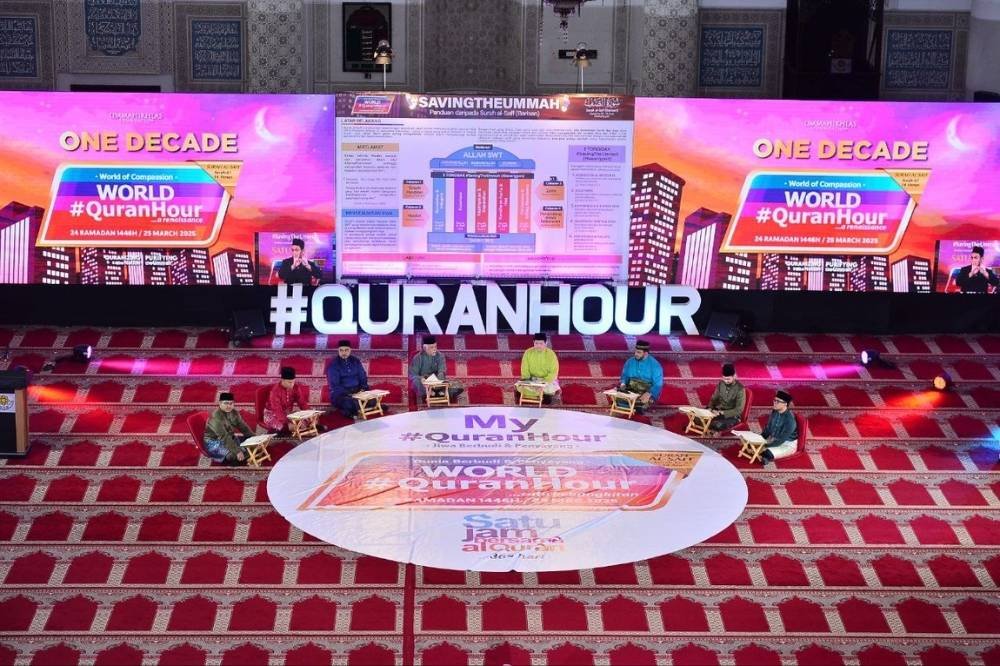
KUALA LUMPUR – The World #QuranHour 2025 successfully brought together Muslims from around the globe for contemplation and recitation of Surah Al-Saff, a passage rich with profound messages relevant to our current times.
The event, initiated by the founder of Warisan Ummah Ikhlas Foundation (WUIF), Datuk Hussamuddin Yaacub, celebrated its tenth anniversary with an emphatic plea for solidarity and resilience among Muslims.
At the event held today, Minister in the Prime Minister’s Department for Religious Affairs, Datuk Dr Mohd Na’im Mokhtar, emphasized the importance of this year’s theme. The focus was on ‘bunyan marsus,’ which refers to building a strong and well-organized structure.
Al-Saff refers to lines or formations, and in verse four of this surah, the idea of ‘bunyan marsus’ is emphasized, representing a strong and well-structured arrangement.
“This theme holds significant importance, particularly in our current situation, as it emphasizes the need for solidarity and fortitude within the Muslim community,” he stated to journalists during the World #QuranHour 2025 event conducted at the Sultan Haji Ahmad Shah Mosque of International Islamic University Malaysia (IIUM) in Gombak today.

Na’im stressed that Surah Al-Saff ought to act as a guiding principle for leaders, ‘umara’ (rulers), ‘ulama’ (scholars), and the whole Muslim community.
He mentioned that the purpose of the event was to encourage people to return to reading the Quran, fostering unity and camaraderie particularly during the holy month of Ramadan.
He additionally highlighted the link between the theme and the challenges encountered by individuals in Palestine, notably those in Gaza.
The message conveyed through “Bunyan Marsus”—a term signifying robust organization—is a potent appeal urging Muslims across the globe to come together in safeguarding Palestinian rights and battling against their subjugation by Zionist forces.
“This is precisely why unity and solidarity, drawing inspiration from Surah Al-Saff, have been selected as the main theme for World Quran Hour 2025,” he stated.
This year, World Quran Hour 2025 was themed around ‘Preserving the Ummah,’ highlighting the significance of solidarity in maintaining Islamic faith under Allah SWT.
The 10th edition of the World Quran Hour 2025 program gathered numerous participants via in-person presence at the primary location, live TV transmissions, and online streaming.
Moreover, this year’s event saw registrations from 1,370 sites within the nation, alongside 25 venues located in 19 different foreign nations.
by admin | Mar 25, 2025 | beauty, culture, passports and international travel, Travel, world
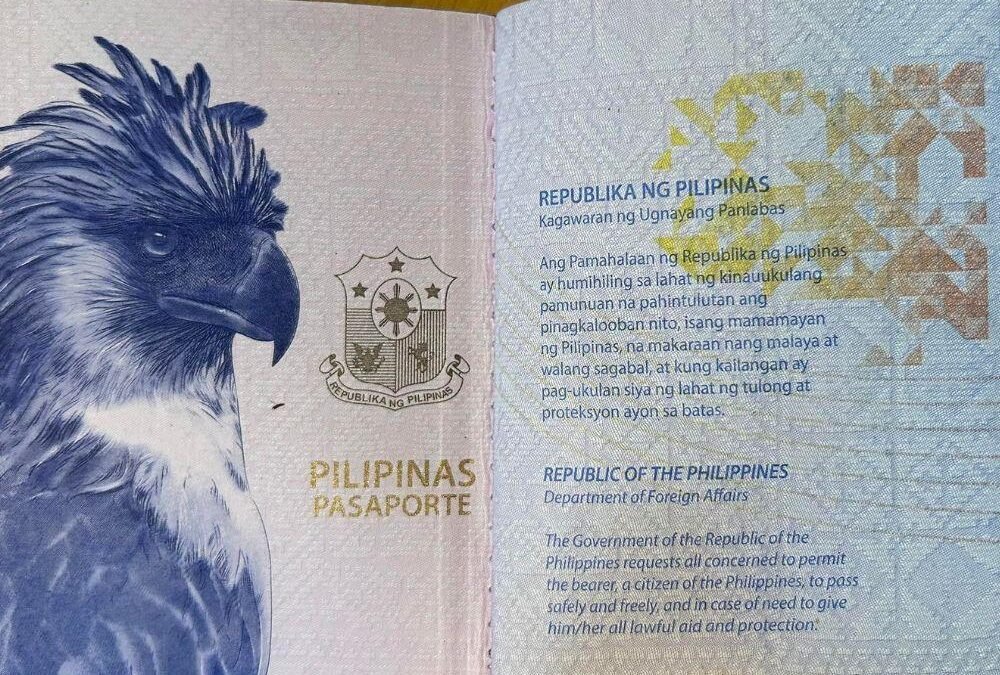
When it comes to design, the Philippine passport undoubtedly shines brightly!
In a post on Instagram, the modern culture and lifestyle brand Hypebeast shared a compilation of the most visually appealing passports globally, which featured the Philippines among them.
Hypebeast featured the “iconic Philippine eagle” print on its flip cover.
“Following the unveiling of Switzerland’s freshly redesigned passport, we gathered some of the most impressively crafted passports globally,” it started.
“From Norway’s UV-reactive landscapes to Japan’s ukiyo-e art, the Philippines’ recognizable Philippine eagle, New Zealand’s stylish black cover, and more — these passports raise the standard for design,” Hypebeast noted.
Other nations featured on this roster include Norway, Canada, Hong Kong, Japan, Finland, New Zealand, Hungary, and Belgium, apart from the Philippines.
At least our passport scores well in terms of design, yes? Based on the most recent Henley Passport Index, the Filipino passport stands at 75th place worldwide, dropping two positions compared to before.
2024 rank
.
The present standing of the Philippine passport enables travelers to go to
67 destinations visa-free
, as of July 2024
At the same time, according to the Henley Passport Index report, Singapore still holds the position of having the strongest passport globally.
— Jade Veronique Yap/_LA, GMA Integrated News
This article
The Philippine passport ranks as one of the ‘most aesthetically pleasing’ globally, says Hypebeast.
was originally published in
GMA News Online
.
by admin | Mar 24, 2025 | culture, entertainment, events and festivals, festivals, music
________________
;
The stage is ready for the Yenze Hip-Hop Culture Fest, an innovative event celebrating Uganda’s hip-hop culture.
Set for June 28, 2025, at the Lugogo Cricket Oval, the event seeks to bring together different generations.
artistes
and fans.
Addressing a media briefing on Monday,
Sheraton
Geoffrey Jeff Ekongot, from Hotel, shared his enthusiasm for the event.
“Hip-hop has matured,” Ekongot stated.
It has influenced countless individuals, encompassing those of us who are part of the older generations as well as the present youth.
The festival aims at rejuvenating the essence of hip-hop, following its evolution, and imagining its next chapter.”
The festival aims to showcase all five aspects of hip-hop: rap, breaking, DJing, fashion, and graffiti. Ekongot stressed that hip-hop extends beyond mere music; “It embodies culture, identity, and a robust economic ecosystem.”
Accompanying him at the press conference were Lagum the Rapper and King Honey, who represent the fresh wave of Ugandan hip-hop talent.
Lagum the Rapper, a rising star, looked back on his path into hip-hop and the impact of Uganda.
artistes
Similar to Navio, Ruyonga, Tucker HD, and Keko.
“Hip-hop in Uganda boasts a robust sense of community. This festival isn’t solely focused on performances; it’s also aimed at uncovering and motivating fresh talent,” he stated.
The event will include freestyle competitions, fashion exhibitions, and chances for artists, DJs, and designers to network. King Honey, recognized for her daring style, invited designers to join in.
“Hip-hop encompasses style as well. It’s an opportunity for us to back one another and develop collectively,” she stated.
Ekongot also pointed out the global acknowledgment that Ugandan hip-hop has achieved.
“Artists such as Xenson Senkaaba have showcased their graffiti work in France. Ugandan breakdancers have also gained prominence on international stages. We brought hip-hop to the State House, and remarkably, we witnessed the world’s first president who rapped,” he pointed out.
Provided by Syndigate Media Inc. (
Syndigate.info
).
Page 6 of 19« First«...45678...»Last »


