by admin | Mar 24, 2025 | africa, government, international relations, politics, politics and government
Leaders from the East African Community (EAC) and the Southern African Development Community (SADC) will hold their second combined summit on Monday evening to discuss the security issues in eastern Democratic Republic of the Congo (DRC).
The virtual summit will be led jointly by President William Ruto, who holds the position of EAC Chairperson, and Zimbabwean President Emmerson Mnangagwa, who is the SADC Chairperson.
The leaders will discuss a report from the joint EAC-SADC ministerial meeting held on March 17 in Harare, Zimbabwe, as they look for answers to address the continuing unrest in the area.
The leaders from the East African Community (EAC) and the Southern African Development Community (SADC) will hold their second combined summit on March 24, 2025, to discuss the significant security issues in the Democratic Republic of the Congo (DRC), according to a portion of the announcement.
The Southern African Development Community (SADC) will be represented by its Double Troika consisting of Zimbabwe (the current chair), Angola (the previous chair), and Madagascar (the upcoming chair). Additionally, countries guiding the SADC Organ on Politics, Defence, and Security Affairs include Tanzania (current chair), Malawi (upcoming chair), and Zambia (previous chair).
South Africa, which contributes troops to the SADC mission in the DR Congo, will join the virtual meeting alongside the Democratic Republic of the Congo.
The gathering will be the second collaborative summit since President Ruto jointly chaired the first meeting in January, following an agreement made during the EAC Summit on January 26.
Although DRC President Félix Tshisekedi and Rwandan President Paul Kagame had both confirmed their presence at the gathering, Tshisekedi did not attend the meeting.
His spokesperson, Tina Salama, subsequently attributed the conflict to scheduling issues in her statement to the press.
Provided by Syndigate Media Inc. (
Syndigate.info
).
by admin | Mar 24, 2025 | foreign policy, foreign relations of iran, international relations, iran and the middle east, politics
________________
On Monday, Iran stated it was willing to engage in indirect discussions with the United States following President Donald Trump’s call for negotiations toward a new nuclear agreement.
Indirect negotiations are now possible,” stated Foreign Minister Abbas Araghchi, ruling out direct discussions “unless there is a shift in the other party’s stance toward the Islamic Republic.
The top Iranian diplomat said Tehran would not engage in direct talks with Washington under threats and so long as Trump maintain his “maximum pressure” policy.
During his initial presidential term, Trump enacted a policy that led to the U.S. withdrawing from an important accord regarding Iran’s nuclear program in 2018 and reinstated stringent economic penalties against Tehran.
The agreement reached in 2015 involving Tehran and the Western nations mandated that Iran curb its nuclear aspirations in return for easing of economic sanctions.
Several Western nations, such as the United States, have frequently alleged that Iran has been seeking to develop nuclear weapons, a claim that Tehran refutes. Iran maintains that all its uranium-enrichment efforts are strictly intended for civilian use only.
On March 7, Trump stated that he had sent a letter to Iran’s Supreme Leader, Ayatollah Ali Khamenei, urging for discussions on nuclear matters and threatening potential military action should Tehran decline.
The letter reached Tehran on March 12, according to Fars News Agency, and was brought there by UAE Presidential Adviser Anwar Gargash.
On Friday, Khamenei stated that U.S. threats would “achieve nothing,” and he cautioned about retaliatory actions “should they take any harmful steps” against Iran.
On Thursday, Araghchi stated that Trump’s letter was more like a threat, yet he also mentioned it might present certain opportunities. He further indicated that Tehran would provide a response shortly.
The US Middle East special representative Steven Witkoff stated in an interview released on Friday that Trump’s objective was to prevent military confrontation by fostering trust with Iran.
He maintained that the letter was never intended as a threat.
Following Iran’s 1979 Islamic Revolution, which overthrew the Western-supported shah, Tehran and Washington severed their diplomatic relations.
Ever since, the Swiss embassy in Tehran has been instrumental in facilitating communication between the two countries.
Oman, a Gulf nation, has facilitated indirect discussions regarding Iran’s nuclear matter through what is known as the “Muscat Process”. In October, Araghchi mentioned that this process had been temporarily suspended, according to him.
Provided by Syndigate Media Inc. (
Syndigate.info
).
by admin | Mar 24, 2025 | international relations, military, news, russia ukraine conflict, ukraine
On Monday, Chinese Foreign Ministry spokesperson Guo Jiakun dismissed the idea of China taking part in a possible peacekeeping force in Ukraine once the hostilities have ceased.
“I want to emphasize that these media reports are inaccurate. China’s stance on the Ukrainian crisis remains consistent and clear,” Guo stated at a press briefing.
In late February, Kremlin spokesperson Dmitry Peskov stated that Russia had not considered the potential participation of Chinese peacekeeping forces in relation to resolving the conflict in Ukraine.
On Saturday, a German daily newspaper stated that China was in talks with several European nations regarding the potential involvement of Chinese troops in a peacekeeping operation in Ukraine.
On March 6, Russian Foreign Minister Sergey Lavrov stated that Russia does not see any potential for reaching an agreement regarding the possible placement of European peacekeeping forces in Ukraine.
Earlier this month in March, media reports indicated that French President Emmanuel Macron and UK Prime Minister Keir Starmer are attempting to persuade 37 nations to become part of a coalition willing to send peacekeeping forces to Ukraine and offer security assurances to Kyiv.
Last year, the Russian Foreign Intelligence Service claimed that Western countries might send approximately 100,000 soldiers to Ukraine under the pretense of a peacekeeping mission aimed at reviving Kyiv’s military strength.
Peskov has maintained that during any conflict, the involvement of international peacekeeping forces can occur solely with the agreement of all conflicting parties.
Provided by Syndigate Media Inc. (
Syndigate.info
).
by admin | Mar 24, 2025 | international relations, military, news, politics, politics and law
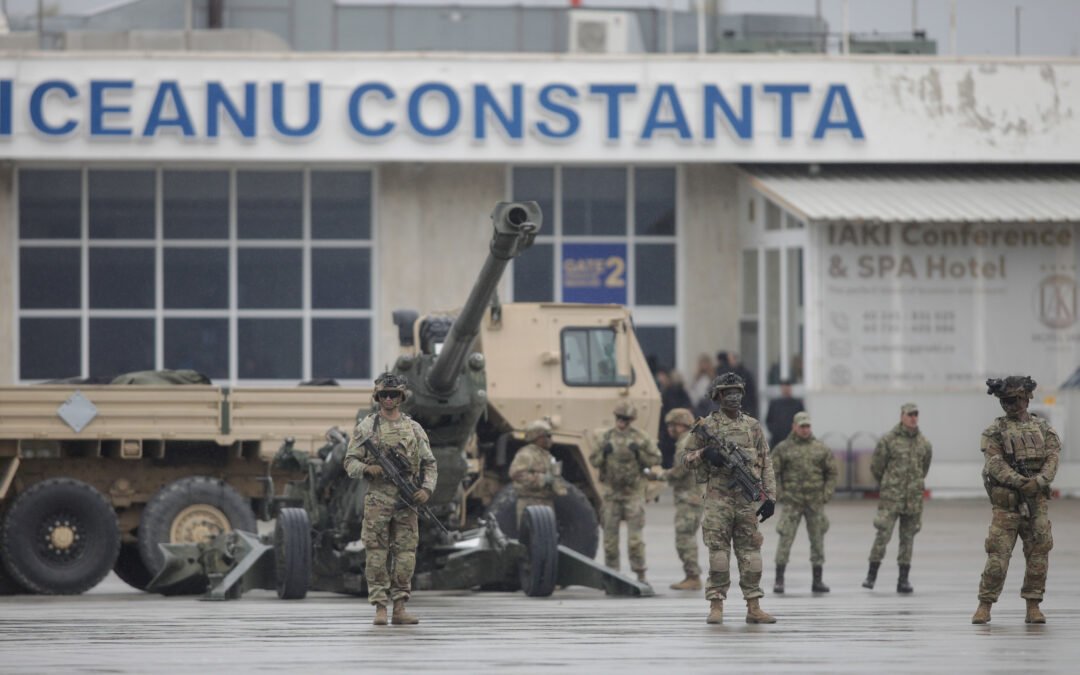
Two U.S. conservative periodicals have urged the Trump administration to remove its forces from the Kogălniceanu Base in Romania, arguing that the choice was “undemocratic.”
block Călin Georgescu’s candidacy
And the significant expense associated with the base.
The
first article
Published in The American Conservative, the article entitled “It’s Time to Sever Ties with Romania” is penned by Anthony J. Constantini. In this piece, the author criticizes Romania’s Constitutional Court.
canceling the 2024 presidential elections
and prohibiting Calin Georgescu from participating again. He states this
condemnations issued by U.S. Vice President JD Vance
serve as a positive initial move, yet “the Trump administration should take additional steps by utilizing this chance to clearly state its intention to withdraw troops and support from Mihail Kogalniceanu Air Base.”
Days later,
another article
In an opinion piece published on the conservative platform The National Interest, it was suggested that “reassessing” America’s ties with Romania could serve as a foundational move towards overhauling NATO. Like in the previous article, the writer mentions how far-right pro-Russian contender Calin Georgescu was disqualified from contesting the presidency. Additionally, the author contends that the decisions of the Romanian Constitutional Court were made under the endorsement of the Biden administration.
“Pulling out troops from Romania might unsettle NATO, indeed, yet it would showcase America’s determination and spur Europeans into taking concrete steps toward strategic independence rather than merely discussing it. Such a move could also serve as leverage to motivate Russia to stop combat operations in Ukraine, considering their longstanding concern over NATO forces advancing further east,” writes author Michael Hall.
The two articles could potentially signal a significant change in the relationship between the United States and Romania. During an interview,
HotNews
According to security expert Iulia Joja, the possibility of troop withdrawal from the base by the US remains plausible.
“In just a couple of days, two articles emerged suggesting this might be part of a coordinated effort. Upon closer examination, they share common threads, focusing specifically on the Kogălniceanu base. We could have potentially discussed another location like the one in Deveselu instead,” said Iulia Joja, who teaches at both Georgetown and George Washington Universities.
Furthermore, in each instance, an immediate connection exists between the creator or distributor of the publication and Russia. Dmitri Simes, who previously served as the CEO of the Center for the National Interest, hails from Moscow and reportedly sustains connections to Russia, as reported by U.S. media outlets. The writer behind the piece in The American Conservative, Anthony J. Constantini, pursued his education in Vienna and earned a Master’s degree in arms control and strategic studies from Saint Petersburg State University.
Russia has frequently objected to the presence of the Kogălniceanu base. The decision to withdraw might align with the Trump administration’s approach of extreme accommodation towards Putin.
Joja states that for Russia, having a military base – which happens to be one of NATO’s biggest installations – where troops from Western countries such as America, France, Britain, or Germany could be deployed poses a significant issue.
“The expert emphasized that we should not view these as mere coincidences, particularly considering the connections between certain authors, publishers, and Russian affiliations. Additionally, it is noteworthy how closely aligned the statements made by the Trump administration about the eastern flank, European security, and Ukraine align with Russia’s strategic objectives,” she added. “Given this alignment, Russian intelligence services would logically advocate for policies aimed at hindering NATO expansions, such as the development of the Kogălniceanu military base, using whatever means necessary—even fabricated information,” the analyst concluded.
Shutting down the base would directly contradict this.
earlier statement
According to reports from US Special Envoy Keith Kellogg, in February he informed Romanian Foreign Minister Emil Hurezeanu that the military bases in Romania would not only remain but also undergo expansion.
By February 2025, approximately 5,000 foreign troops were stationed in Romania, with just 1,500 being Americans distributed across three main locations: Kogălniceanu, Deveselu, and Câmpia Turzii. Among these sites, Kogălniceanu accommodates the most personnel at roughly 1,000 soldiers. In contrast, Poland hosts around 10,000 U.S. military members within its borders.
radu@romania-insider.com
(Photo credit: Inquam Photos/George Calin)

by admin | Mar 24, 2025 | europe, foreign policy, international relations, politics, politics and law
The Israeli Foreign Minister welcomed the European Union’s High Representative for Foreign Affairs, Kaja Kallas, to “Jerusalem DC, David’s Capital” on Monday.
“As we engage in this conflict representing the free world, nations like Iran, the Houthis, Hamas, and Hezbollah target us — simply due to our proximity. However, let’s be clear: their battle is directed at Western civilization as a whole, challenging both our core values and lifestyle. Given these circumstances, it seems reasonable to anticipate greater backing from European countries,” remarked Sa’ar during a joint press conference following their discussion.
Sa’ar similarly mentioned the “barbaric assault near Yokne’am” on Monday morning as being a consequence of the continuous agitation propagated by the Palestinian Authority. He further stated, “It was only following ISIS’s defeat on the battleground that it ceased recruiting young Europeans into its fold.”
In closing, Sa’ar spoke directly to Kallas, saying, “Israel and the European Union face numerous common challenges.” He further emphasized, “Together with our American allies, we should join forces against the ‘axis of evil’ comprising Iran, the Houthis, Hamas, and Hezbollah. The efforts initiated in Brussels have the potential to transform these challenges into opportunities. This could lead to increased stability and prosperity for Israel, Europe, and the broader democratic world.”

by admin | Mar 24, 2025 | foreign policy, government, international relations, politics, politics and government
Washington D.C., March 24 (ANI): The
East Turkistan
Government-in-Exile (
ETGE
) vehemently opposed the
Turkiye
–
China
The Joint Security Cooperation Mechanism and its recently held meeting in Ankara on March 20.
ETGE
suggested that this partnership is a misleading coalition designed to destabilize, penetrate, and subdue
East Turkistan
People’s legitimate struggle for independence and liberty.
According to
ETGE
,
Turkiye
is serving as the flexible outer layer for
China
‘s heavy-handed strategies, freely acting as an agent in Beijing’s effort to eliminate the
East Turkistan
A country under the pretense of “counterterrorism” and “security.”
The meeting, headed by Turkish Deputy Foreign Minister Nuh Yilmaz and Chinese Deputy Foreign Minister Qin Xiaodong, drew attention from observers.
ETGE
part of a broader effort aimed at expansion
China
global campaign of suppression.
ETGE
asserts that it seeks to control, influence, and lead diaspora organizations, leaders, and political activities, with the ultimate aim of disassembling them.
East Turkistan
quest for national sovereignty.
Salih Hudayar, who serves as the Minister for Foreign Affairs and Security,
ETGE
Issued a severe warning stating, ”
Turkiye
has abandoned its Turkic-Islamic principles and become a tool of
China
Beijing’s expansionist goals. As Beijing carries out genocide
East Turkistan
,
Turkiye
is helping extend
China
‘s tyranny beyond
East Turkistan
It is closely collaborating alongside
China
To penetrate and dominate our worldwide diaspora communities and organizations, suppress genuine voices, and hinder our efforts to regain our national sovereignty. This represents a significant betrayal of history.
East Turkistan
“The one who will always be remembered,” as stated by the individual.
ETGE
.
The
ETGE
The report highlights how the Turkish government, despite claiming connections with the Turkic world, is being leveraged to suppress Uyghur activists and weaken their efforts.
East Turkistan
‘s resistance to
China
‘colonization, genocide, and occupation.’
The
ETGE
gave a call to
Turkiye
to promptly and unambiguously halt all security and intelligence partnerships
China
It called upon the global community to recognize and condemn
Turkiye
his part as an intermediary
China
in global repression against
East Turkistan
It was stated that governments globally should refrain from allowing
Turkiye
to serve as Beijing’s gentle front in the destruction of the
East Turkistan
I support people in their legitimate national struggle. (ANI)
Provided by Syndigate Media Inc. (
Syndigate.info
).
Page 9 of 10« First«...678910»


